A BROWN bear rescued by Brigitte Bardot and brought to Scotland has become the latest symbol of conflict between animal-rights campaigners and the debt-ridden Glasgow Zoopark.
Bongo the Bear was to be put down tomorrow, but the plans have been shelved after Advocates for Animals claimed it would be the first in a mass cull of animals unable to be rehoused when the zoo closes in September.
Management at the zoo last night dismissed as "disgracefully sensationalist" the claims by the animal-rights campaigners. They claim Bongo’s death will be a mercy killing, as the beast is suffering from old age and disease.
The war of words came as it emerged that other Scottish zoos have no space to commit to the Glasgow animals.
The 100-acre site at Calderpark in the east end of the city has run up debts approaching £3.65 million and saw a rescue plan involving the sale of land to housebuilders hit by planning delays.
The Scottish Society for the Prevention of Cruelty to Animals (SSPCA) has been brought in to assist the zoo in finding new homes for the 68 species.
However, yesterday, management at Edinburgh Zoo and Blair Drummond Safari Park, in Stirlingshire, admitted they cannot offer accommodation for the beasts.
A spokeswoman for Edinburgh Zoo said: "We don’t have any empty enclosures, so we couldn’t take any big animals.
"But there is a chance we could help with some of the smaller animals, such as the reptiles."
She added: "We just don’t have the resources or the staff."
Gary Gilmour, the manager of Blair Drummond Safari Park, said they could not help in the relocation, adding: "We don’t have the space to take any more animals."
Mr Gilmour said that taking tigers or lions could not happen as they exist in complex social groups which would not accept new additions.
Mr Gilmour said that Glasgow Zoopark was a victim of a slump in visitor numbers.
He added: "It’s a catch 22 situation. If you don’t have the number of visitors coming in then you won’t have the money to improve the enclosures and the conditions."
Advocates for Animals yesterday slammed the zoo, insisting that the death by lethal injection of Bongo would set a precedent for the four remaining bears which, aged between 20 and 30, would be considered too old to move to other sanctuaries.
Yvonne Taylor, the charity’s campaign co-ordinator, said: "They have exploited these animals over the years and they deserve to be cared for in the best possible standards for the rest of their natural lives. Now the zoo is closing, they are saying that any animals not rehoused should be destroyed.
"If there is any money left over from the sale of land, it should be used to provide for these animals and make sure they live out the rest of their lives in comfortable surroundings."
Ms Taylor added that the zoo had declined offers from the charity to help in the bid to rehouse the beasts through global contacts in the animal welfare community.
"We have been completely ignored by the zoo," she insisted. "We have found potential homes for these bears but been told to post the details.
"The zoo says they are outraged by these scare stories, but these will continue unless the zoo works with people in the open."
A spokeswoman for Glasgow Zoopark said there was no "schedule for the slaughter of our animals", adding: "While it is true that Bongo the bear was due to be put down on Wednesday, this decision was taken purely on health grounds as Bongo is a very old, unwell bear and it is entirely unrelated to the zoo’s closure.
"Bongo will no longer be put down on Wednesday. It will happen in the near future, but the date for this cannot be made public following this media frenzy."
Bongo was rescued from a zoo in Italy in 2000. The cost of his transfer was met by the foundation set up by Bardot, the former French actress turned committed animal lover. However, the bear, which has had previous operations for testicular cancer, stomach ulcers and arthritis is now considered too unwell to move to another home. The zoo’s vet, Emma Timperley, has advised that Bongo’s deteriorating quality of life warrants euthanasia.
Thursday, August 02, 2007
Monday, July 30, 2007
Singapore Zoo's Orang Utans get Home Upgrades
ORANG UTANS at the Singapore Zoo now have a newly renovated home. The renovation cost about $1 million and took five months to complete.
The centrepiece - the world's first tree top boardwalk that allows visitors to walk among the free range orang utans.
Ms Fanny Lai, Executive Director of Singapore Zoo and Night Safari, said the newly constructed boardwalk is designed to bring visitors closer to the animals.
For example, the new Sumatran habitat allows visitors to stand eye to eye with the 90kg male adult orang utan, Charlie.
In addition, the zoo has upgraded the Borneo exhibit area by adding more live plants, trees and fallen logs which provide shade for the animals.
By attracting more visitors to see the playful orang utans, the zoo hopes to raise public awareness about the endangered species.
There are currently 25 orang utans housed at the zoo.
Is this the same as vote for PAP and get your HDB upgrades. ?
The centrepiece - the world's first tree top boardwalk that allows visitors to walk among the free range orang utans.
Ms Fanny Lai, Executive Director of Singapore Zoo and Night Safari, said the newly constructed boardwalk is designed to bring visitors closer to the animals.
For example, the new Sumatran habitat allows visitors to stand eye to eye with the 90kg male adult orang utan, Charlie.
In addition, the zoo has upgraded the Borneo exhibit area by adding more live plants, trees and fallen logs which provide shade for the animals.
By attracting more visitors to see the playful orang utans, the zoo hopes to raise public awareness about the endangered species.
There are currently 25 orang utans housed at the zoo.
Is this the same as vote for PAP and get your HDB upgrades. ?
Wednesday, July 25, 2007
Zoo attack 5
An eight-year-old Indonesian boy died after being attacked by a Komodo dragon in a national park in the east of the country, an official said.
"The dragon bit his waist, tossed him and dragged him. His right leg was badly scratched," Heru Rudiharto of the Komodo National Park said by telephone.
He said the boy had been attacked on Saturday after entering a bush for a toilet stop in a fishing village in the national park on Komodo, an island 1,500 km (930 miles) east of the capital Jakarta.
His uncle, who had been mending fishing nets nearby, tried to free him by throwing stones at the dragon, he added.
"However, the boy bled to death half an hour after the attack," added Rudiharto.
The official said it was rare for such attacks on humans, although in the dry season that started in April the dragon's normal prey became more scarce.
"It is very common here to see dragons roaming in the residential area in the national park. But it is very rare that a Komodo dragon kills a human," said Rudiharto.
"Usually, people here only suffer minor injuries."
There are about 2,000 of the protected and endangered dragons living in the wild, mainly on Indonesia's Komodo and Rinca islands, he said.
The dragons, which are agile and have a keen sense of smell, can grow to a length of 3 metres (more than 9 ft) and weigh on average 200 lbs (90 kg), according to data from Honolulu Zoo.
Komodo dragons regularly kill prey such as pigs and small deer and have been known to take down an adult water buffalo.
But they are opportunistic feeders and are prepared to eat anything they can overpower -- including small dragons and occasionally humans.
The mouth of the dragon also has virulent bacteria that means even if its prey survives an attack it will probably die of infection later.
"The dragon bit his waist, tossed him and dragged him. His right leg was badly scratched," Heru Rudiharto of the Komodo National Park said by telephone.
He said the boy had been attacked on Saturday after entering a bush for a toilet stop in a fishing village in the national park on Komodo, an island 1,500 km (930 miles) east of the capital Jakarta.
His uncle, who had been mending fishing nets nearby, tried to free him by throwing stones at the dragon, he added.
"However, the boy bled to death half an hour after the attack," added Rudiharto.
The official said it was rare for such attacks on humans, although in the dry season that started in April the dragon's normal prey became more scarce.
"It is very common here to see dragons roaming in the residential area in the national park. But it is very rare that a Komodo dragon kills a human," said Rudiharto.
"Usually, people here only suffer minor injuries."
There are about 2,000 of the protected and endangered dragons living in the wild, mainly on Indonesia's Komodo and Rinca islands, he said.
The dragons, which are agile and have a keen sense of smell, can grow to a length of 3 metres (more than 9 ft) and weigh on average 200 lbs (90 kg), according to data from Honolulu Zoo.
Komodo dragons regularly kill prey such as pigs and small deer and have been known to take down an adult water buffalo.
But they are opportunistic feeders and are prepared to eat anything they can overpower -- including small dragons and occasionally humans.
The mouth of the dragon also has virulent bacteria that means even if its prey survives an attack it will probably die of infection later.
Friday, July 20, 2007
Zoo animals as Food
A German mayor has filed charges against zoo workers in his town for shooting animals and selling them as meat.
The mayor's spokesperson said deer were amongst animals which had been killed and sold without permission by workers at Erfurt Zoo.
She said: "The case is now with the state prosecutors".
The German Animal Protection League has demanded a review of controls at Erfurt Zoo and all institutions housing animals in the state of Thuringia.
Wolfgang Apel, president of the League, said: "We are worried this is only the tip of the iceberg."
Erfurt Zoo is home to lions, elephants and giraffes among other animals. It has been the subject of complaints from animal rights campaigners and federal authorities over its imports of South American wild elephants.
The mayor's spokesperson said deer were amongst animals which had been killed and sold without permission by workers at Erfurt Zoo.
She said: "The case is now with the state prosecutors".
The German Animal Protection League has demanded a review of controls at Erfurt Zoo and all institutions housing animals in the state of Thuringia.
Wolfgang Apel, president of the League, said: "We are worried this is only the tip of the iceberg."
Erfurt Zoo is home to lions, elephants and giraffes among other animals. It has been the subject of complaints from animal rights campaigners and federal authorities over its imports of South American wild elephants.
Wednesday, July 18, 2007
Polar Stays
WRS Animal Welfare & Ethics Committee (AWEC) Recommendation for Polar Bear Inuka to stay in SingaporeThe Wildlife Reserves Singapore Animal Welfare & Ethics Committee recommends that Singapore-born polar bear Inuka should remain here and not be sent to an institution in a temperate country, upon the demise of his mother Sheba. This recommendation was made during the Committee’s meeting on 27 January 2007.
Following are the supporting arguments for this recommendation, which considers above all else, what is best for Inuka:
Inuka was born in Singapore and already acclimated to the conditions here.
The life span of both Inuka (16 years old) and his mother Sheba (30 years old) indicate that both polar bears are faring well in this environment.
Male polar bears are solitary by nature and associate with females only during the breeding season. Maintaining Inuka alone at the Singapore Zoo after his mother’s demise is not counter to what occurs naturally in the wild.
The transport of a full grown polar bear to an institution in a temperate country will be a stressful situation and carries its own share of risks; most extreme being that Inuka may die during transportation or during the introduction process in the new facility.
Depending on when Sheba passes on, Inuka may have only limited breeding potential because of his age, and if sent to a temperate institution, will probably not contribute to the captive breeding effort.
Moving Inuka to a temperate facility after losing his mother will add further stress, since he will be removed from an environment that he is already familiar with.
Inuka will continue to be the Singapore Zoo’s ambassador for the conservation and educational thrusts regarding climate change, throughout his whole life here.
The public is invited to give their feedback on the Committee’s recommendation.
The WRS Animal Welfare & Ethics Committee comprises:
Chairman
Following are the supporting arguments for this recommendation, which considers above all else, what is best for Inuka:
Inuka was born in Singapore and already acclimated to the conditions here.
The life span of both Inuka (16 years old) and his mother Sheba (30 years old) indicate that both polar bears are faring well in this environment.
Male polar bears are solitary by nature and associate with females only during the breeding season. Maintaining Inuka alone at the Singapore Zoo after his mother’s demise is not counter to what occurs naturally in the wild.
The transport of a full grown polar bear to an institution in a temperate country will be a stressful situation and carries its own share of risks; most extreme being that Inuka may die during transportation or during the introduction process in the new facility.
Depending on when Sheba passes on, Inuka may have only limited breeding potential because of his age, and if sent to a temperate institution, will probably not contribute to the captive breeding effort.
Moving Inuka to a temperate facility after losing his mother will add further stress, since he will be removed from an environment that he is already familiar with.
Inuka will continue to be the Singapore Zoo’s ambassador for the conservation and educational thrusts regarding climate change, throughout his whole life here.
The public is invited to give their feedback on the Committee’s recommendation.
The WRS Animal Welfare & Ethics Committee comprises:
Chairman
Thursday, July 12, 2007
Mr Wong Family at Zoo
http://wongfamily.wordpress.com/2007/07/01/family-trip-singapore-2007-part-iii
Thankfully the weather was clear but cool, so it was a good substitute for the Night Safari that we missed on Friday.
First off, it was lunch at the food court.
Then the Family went for a proper exploration of the Singapore Zoo.
The entrance itself immediately impressed upon us that this was going to be quite different from Zoo Negara – it was a plank walkway high off the ground with trees on the sides, conjuring an atmosphere of going on a jungle adventure!
By walking and taking the tram, we fully explored the Zoo, visiting Orang Utans, birds, big cats, dogs, reptiles, horses (Ama and May’s animal birth year), bears and all manner of animals that had the Kids in ecstasy.
Aba’s lime flavoured Popsicle with vanilla flavoured ice-cream filling (purchased from zoo vendor) helped cool down the Kids in between rest stops. (The Twins had been walking without the stroller the whole day!)
Finally, it was evening.
We took dinner at the KFC, before going to the Causeway, and back to Good Ol’ Malaysia!
Thankfully the weather was clear but cool, so it was a good substitute for the Night Safari that we missed on Friday.
First off, it was lunch at the food court.
Then the Family went for a proper exploration of the Singapore Zoo.
The entrance itself immediately impressed upon us that this was going to be quite different from Zoo Negara – it was a plank walkway high off the ground with trees on the sides, conjuring an atmosphere of going on a jungle adventure!
By walking and taking the tram, we fully explored the Zoo, visiting Orang Utans, birds, big cats, dogs, reptiles, horses (Ama and May’s animal birth year), bears and all manner of animals that had the Kids in ecstasy.
Aba’s lime flavoured Popsicle with vanilla flavoured ice-cream filling (purchased from zoo vendor) helped cool down the Kids in between rest stops. (The Twins had been walking without the stroller the whole day!)
Finally, it was evening.
We took dinner at the KFC, before going to the Causeway, and back to Good Ol’ Malaysia!
Tuesday, July 10, 2007
Wildlife officials rescue 950 monkeys from smugglers in southern Malaysia, detain 4
Malaysian authorities busted a wildlife smuggling ring, rescuing 950 monkeys believed bound for China and Holland and detaining four men including an Indonesian, an official said Tuesday.
Officials discovered the 950 long-tailed macaques starving and cramped in filthy cages in a raid on a farm in Johor state on Saturday following a two-week investigation, said Wildlife Department assistant director Celescoriano Razond.
"From our initial investigation, they were targeting to send the monkeys to restaurants in China and laboratories in Holland. We are still investigating," Celescoriano said.
The primates were in a pitiful condition, some were eating the carcasses of their young, and another 100 dead monkeys were piled up nearby, he said.
Celescoriano said he believed the macaques had been caught in Malaysian jungles and that they had been caged for at least a month.
"This is the biggest seizure of smuggled monkeys ever," he told The Associated Press, adding that the department has treated the monkeys and released them back into protested forest areas.
Celescoriano said three Malaysians, including one who is believed to be the ring leader, would be charged with unlawful possession and cruelty to wildlife, and that they could be jailed for up to three years or fined up to 6,000 ringgit (US$1,714; €1,428) each if convicted.
The Indonesian, who was a worker at the farm, has been handed over to the immigration department, he said. Immigration officials could not be reached for further details.
Malaysian authorities busted a wildlife smuggling ring, rescuing 950 monkeys believed bound for China and Holland and detaining four men including an Indonesian, an official said Tuesday.
Officials discovered the 950 long-tailed macaques starving and cramped in filthy cages in a raid on a farm in Johor state on Saturday following a two-week investigation, said Wildlife Department assistant director Celescoriano Razond.
"From our initial investigation, they were targeting to send the monkeys to restaurants in China and laboratories in Holland. We are still investigating," Celescoriano said.
The primates were in a pitiful condition, some were eating the carcasses of their young, and another 100 dead monkeys were piled up nearby, he said.
Celescoriano said he believed the macaques had been caught in Malaysian jungles and that they had been caged for at least a month.
"This is the biggest seizure of smuggled monkeys ever," he told The Associated Press, adding that the department has treated the monkeys and released them back into protested forest areas.
Celescoriano said three Malaysians, including one who is believed to be the ring leader, would be charged with unlawful possession and cruelty to wildlife, and that they could be jailed for up to three years or fined up to 6,000 ringgit (US$1,714; €1,428) each if convicted.
The Indonesian, who was a worker at the farm, has been handed over to the immigration department, he said. Immigration officials could not be reached for further details.
Sunday, July 01, 2007
NO GST Increase In FEEs
Open 365 days a year, the Singapore Zoo is a must-see destination on every visitor's attractions list. With the following useful information at hand, you can plan your day of fun and exploration with ease.
Opening hours
8.30am to 6.00pm daily
Entrance fees (admission only):
Adult S$15.00Child S$7.50
All prices include 7% GST
Parking charges:
Car/saloon S$3.90Lorry/Van S$4.90
Parking charges are per entry basis. No grace period.
(Electronic Parking System. Please insert your cashcard with sufficient funds into the vehicle's I/U unit when exiting the carpark.)
Tram & Train (unlimited rides for both weekdays & weekends):
The tram ride covers 2.2km with three stopovers.
Adult S$5.00Child (3-12 years old) S$2.50
Park Hoppers special (admissions only):
Zoo & Night Safari Adult S$30.00Child S$15.00
Zoo, Night Safari & BirdPark Adult S$40.00Child S$20.00
Opening hours
8.30am to 6.00pm daily
Entrance fees (admission only):
Adult S$15.00Child S$7.50
All prices include 7% GST
Parking charges:
Car/saloon S$3.90Lorry/Van S$4.90
Parking charges are per entry basis. No grace period.
(Electronic Parking System. Please insert your cashcard with sufficient funds into the vehicle's I/U unit when exiting the carpark.)
Tram & Train (unlimited rides for both weekdays & weekends):
The tram ride covers 2.2km with three stopovers.
Adult S$5.00Child (3-12 years old) S$2.50
Park Hoppers special (admissions only):
Zoo & Night Safari Adult S$30.00Child S$15.00
Zoo, Night Safari & BirdPark Adult S$40.00Child S$20.00
Friday, June 22, 2007
When an animal dies at a zoo, what do they do with the body?
Responsible zoos have the policy of doing a necropsy (autopsy) on every single animal that dies on site.
This includes a general health assessment as well as identificiation of the cause of death. Not only is there a physical examination, but samples of blood and tissues are sent off for routine testing, as well as testing that may be associated with the cause of death.
Where possible, the necropsy is also used as a teaching tool - vets and vet students will use this opportunity to learn more about that type of animal. For many exotic animals in zoos there may be limited information about their physiology.
For many species, especially those who are endangered, there may also be a collection of sperm or eggs from the animal, for storage or study. This can be done even after the animal has died, in the process of "gamete rescue". Quite a few North American zoos now have this capability, and if they don't they are able to courier the testes/ovaries to a facility that can perform the rescue.
DNA samples (usually hair or a small section of skin) are often taken from the animal as well, to be used in research or frozen away for possible future needs.
Finally, the animal will be disposed of as appropriate for the species. Generally cremation would happen, but some animals would have their skeletons or hides preserved, or in some rare cases they might even be stuffed - for teaching tool purposes. This would be done by the zoo or an associated museum or similar organisation. Extremely large species (like elephants) are usually buried somewhere on the zoo site, space permitting.
Responsible zoos have the policy of doing a necropsy (autopsy) on every single animal that dies on site.
This includes a general health assessment as well as identificiation of the cause of death. Not only is there a physical examination, but samples of blood and tissues are sent off for routine testing, as well as testing that may be associated with the cause of death.
Where possible, the necropsy is also used as a teaching tool - vets and vet students will use this opportunity to learn more about that type of animal. For many exotic animals in zoos there may be limited information about their physiology.
For many species, especially those who are endangered, there may also be a collection of sperm or eggs from the animal, for storage or study. This can be done even after the animal has died, in the process of "gamete rescue". Quite a few North American zoos now have this capability, and if they don't they are able to courier the testes/ovaries to a facility that can perform the rescue.
DNA samples (usually hair or a small section of skin) are often taken from the animal as well, to be used in research or frozen away for possible future needs.
Finally, the animal will be disposed of as appropriate for the species. Generally cremation would happen, but some animals would have their skeletons or hides preserved, or in some rare cases they might even be stuffed - for teaching tool purposes. This would be done by the zoo or an associated museum or similar organisation. Extremely large species (like elephants) are usually buried somewhere on the zoo site, space permitting.
Sunday, June 10, 2007
Animals Die with the Forest
INDONESIA'S tropical rainforests are disappearing 30 per cent faster than previously estimated as illegal loggers raid large national parks, threatening the long-term survival of orang utans, according to a United Nations report released on Monday.
The Indonesian authorities recently intercepted shipments totalling 70,000 cu m - about 3,000 truckloads - of illegal timber and arrested several people, but loggers were clearing an estimated 2.1 million ha of forest a year for timber worth US$4 billion (S$6 billion), said the report by the UN Environment Programme (UNEP).
Only about 7,000 Sumatran orang utans and about 50,000 Borneo orang utans now exist in the wild.
'The populations are crashing dramatically,' said Ms Melanie Virtue of UNEP's Great Apes Survival Project, which carried out the study.
The number of Sumatran orang utans has fallen 91 per cent in the last century, based on studies of the number of apes in today's dense forests, said Mr Ian Redmond, also of the Great Apes Survival Project.
It is not known how much the population of the Borneo orang utans has declined.
Orang utans fleeing overlogged areas have ended up in 'refugee camps' run by the UNEP project.
Indonesian rescue centres now have about 1,000 orang utans, and the illegal trade in young orang utans for private zoos and safari parks has increased to 'significant numbers', the report said, without specifying further.
Earlier forecasts have said Indonesia's natural rainforest would be seriously degraded by 2032.
But projections based on new satellite surveillance suggest that 98 per cent of lowland forest will be destroyed by 2022, and many protected areas will be gone within the next five years, said the report, called 'The Last Stand of the Orang Utan'.
Orang utans breed only once in seven years, meaning their numbers struggle to recover even without the loss of their habitat.
But the report said orang utans have shown they can survive selective logging. Evidence from Ketgambe and Gunung Leuser in Sumatra showed their numbers declined after large trees were extracted from the forest, but rebounded as the forest regenerated.
The report was released at the triennial meeting of the 171-nation Convention on International Trade in Endangered Species (Cites).
The 1975 Cites treaty prohibits all trade in orang utans except by special permit.
The report said illegal loggers were operating in 37 out of 41 Indonesian national parks. Further pressure came from plantation owners clearing forests for palm oil trees to meet the demand for biofuels.
The report estimates that up to 88 per cent of all Indonesian timber is logged illegally and usually shipped abroad after being processed into lumber in saw mills or used as pulp.
The Indonesian authorities recently intercepted shipments totalling 70,000 cu m - about 3,000 truckloads - of illegal timber and arrested several people, but loggers were clearing an estimated 2.1 million ha of forest a year for timber worth US$4 billion (S$6 billion), said the report by the UN Environment Programme (UNEP).
Only about 7,000 Sumatran orang utans and about 50,000 Borneo orang utans now exist in the wild.
'The populations are crashing dramatically,' said Ms Melanie Virtue of UNEP's Great Apes Survival Project, which carried out the study.
The number of Sumatran orang utans has fallen 91 per cent in the last century, based on studies of the number of apes in today's dense forests, said Mr Ian Redmond, also of the Great Apes Survival Project.
It is not known how much the population of the Borneo orang utans has declined.
Orang utans fleeing overlogged areas have ended up in 'refugee camps' run by the UNEP project.
Indonesian rescue centres now have about 1,000 orang utans, and the illegal trade in young orang utans for private zoos and safari parks has increased to 'significant numbers', the report said, without specifying further.
Earlier forecasts have said Indonesia's natural rainforest would be seriously degraded by 2032.
But projections based on new satellite surveillance suggest that 98 per cent of lowland forest will be destroyed by 2022, and many protected areas will be gone within the next five years, said the report, called 'The Last Stand of the Orang Utan'.
Orang utans breed only once in seven years, meaning their numbers struggle to recover even without the loss of their habitat.
But the report said orang utans have shown they can survive selective logging. Evidence from Ketgambe and Gunung Leuser in Sumatra showed their numbers declined after large trees were extracted from the forest, but rebounded as the forest regenerated.
The report was released at the triennial meeting of the 171-nation Convention on International Trade in Endangered Species (Cites).
The 1975 Cites treaty prohibits all trade in orang utans except by special permit.
The report said illegal loggers were operating in 37 out of 41 Indonesian national parks. Further pressure came from plantation owners clearing forests for palm oil trees to meet the demand for biofuels.
The report estimates that up to 88 per cent of all Indonesian timber is logged illegally and usually shipped abroad after being processed into lumber in saw mills or used as pulp.
Monday, June 04, 2007
First Released Panda Died in Wild
A five-year-old panda - who last year became the first to be released into the wild after being bred in captivity - has died, state media and Chinese nature reserve officials said yesterday.
The body of Xiang Xiang was found Feb. 19 on snow-covered ground in the forests of Sichuan province in China's southwest, the Xinhua News Agency said. He survived less than a year in the wild after nearly three years of training in survival techniques and defence tactics.
"Xiang Xiang died of serious internal injuries in the left side of his chest and stomach by falling from a high place," said Heng Yi, an official from the Wolong Giant Panda Research Centre in Sichuan. "The scratches and other minor injuries caused by other wild pandas were found on his body.
So Xiang Xiang may have fallen from trees when being chased by those pandas."Heng said the long delay in announcing Xiang Xiang's death was attributed to the need for a full investigation."We are all sad about Xiang Xiang, but it doesn't mean the project has failed," Zhang Hemin, the centre's head, was quoted as saying by Xinhua. "The lessons we have learned from what happened to Xiang Xiang will help us adapt and improve the project."
The nearly 80-kilogram male panda was released from Wolong in April 2006 and had been trained almost three years to survive in the wild. Xiang Xiang, whose name means auspicious, learned how to build a den, forage for food and mark his territory, experts at Wolong have said. He also developed defensive skills like howling and biting.
Li Desheng, deputy director of the Wolong centre, said Xiang Xiang's case proves that wild-panda communities are reluctant to accept male outsiders."We chose Xiang Xiang because we thought that a strong male panda would have a better chance of surviving in the harsh natural environment," Li was quoted as saying. "But the other male pandas clearly saw Xiang Xiang as a threat.
Next time we will choose a female panda."State media last year said that Xiang Xiang hesitated for a second when the door of his cage was opened, then scampered off into a nearby bamboo forest where he was tracked by a global positioning device attached to his collar.
He has been buried at the foot of a mountain, about 13 kilometres from the Wolong centre, Li said.
The body of Xiang Xiang was found Feb. 19 on snow-covered ground in the forests of Sichuan province in China's southwest, the Xinhua News Agency said. He survived less than a year in the wild after nearly three years of training in survival techniques and defence tactics.
"Xiang Xiang died of serious internal injuries in the left side of his chest and stomach by falling from a high place," said Heng Yi, an official from the Wolong Giant Panda Research Centre in Sichuan. "The scratches and other minor injuries caused by other wild pandas were found on his body.
So Xiang Xiang may have fallen from trees when being chased by those pandas."Heng said the long delay in announcing Xiang Xiang's death was attributed to the need for a full investigation."We are all sad about Xiang Xiang, but it doesn't mean the project has failed," Zhang Hemin, the centre's head, was quoted as saying by Xinhua. "The lessons we have learned from what happened to Xiang Xiang will help us adapt and improve the project."
The nearly 80-kilogram male panda was released from Wolong in April 2006 and had been trained almost three years to survive in the wild. Xiang Xiang, whose name means auspicious, learned how to build a den, forage for food and mark his territory, experts at Wolong have said. He also developed defensive skills like howling and biting.
Li Desheng, deputy director of the Wolong centre, said Xiang Xiang's case proves that wild-panda communities are reluctant to accept male outsiders."We chose Xiang Xiang because we thought that a strong male panda would have a better chance of surviving in the harsh natural environment," Li was quoted as saying. "But the other male pandas clearly saw Xiang Xiang as a threat.
Next time we will choose a female panda."State media last year said that Xiang Xiang hesitated for a second when the door of his cage was opened, then scampered off into a nearby bamboo forest where he was tracked by a global positioning device attached to his collar.
He has been buried at the foot of a mountain, about 13 kilometres from the Wolong centre, Li said.
Friday, June 01, 2007

Wednesday, May 23, 2007
Zoo: When animal attack 4
An orangutan escaped from a Taiwanese zoo and terrified patrons at a nearby restaurant Wednesday, overturning picnic tables and motorbikes and forcing terrified diners to cower inside the eatery.
The orangutan, who pushed his way out of his cage before wandering into the restaurant, was subdued when an official shot him with a tranquilizer dart. He was carted off for treatment in the scoop of a small bulldozer.
Wednesday's incident occurred six weeks after a 440-pound crocodile chewed the forearm off a veterinarian at the same zoo. The vet's limb was reattached in a seven-hour surgery.
Orangutans are native to the forests of Malaysia and Indonesia. They have a shaggy, reddish-brown coat, long arms and no tail.
The orangutan, who pushed his way out of his cage before wandering into the restaurant, was subdued when an official shot him with a tranquilizer dart. He was carted off for treatment in the scoop of a small bulldozer.
Wednesday's incident occurred six weeks after a 440-pound crocodile chewed the forearm off a veterinarian at the same zoo. The vet's limb was reattached in a seven-hour surgery.
Orangutans are native to the forests of Malaysia and Indonesia. They have a shaggy, reddish-brown coat, long arms and no tail.
Monday, May 21, 2007
Zoo: when animals attack 3
A 57-year-old Dutch woman who was attacked by a gorilla at a Rotterdam zoo said the ape was still her favorite even though she felt she was going to die when he bit her.
"I go to the zoo almost every day with my husband, and we're always going to see Bokito. I even have pictures and videos from Berlin when he was only four months old," the woman told Dutch mass-circulation daily Telegraaf.
"He is and remains my darling," the paper quoted the woman as saying from her hospital bed, where she is being treated for bite wounds and a broken arm and wrist. The 11-year old male gorilla burst out of its enclosure on Friday and went on a rampage in the zoo's cafeteria before being recaptured.
"I stood by the small apes in the Africa section when I heard a thud behind me. I turned around and there was Bokito. I had nowhere to go. He gripped me, sat on me with his full weight and began biting me," the woman told the Telegraaf.
"I could only think 'O God, I'm going to die, I'm going to die'."
The Telegraaf said people had since come from across the country to Rotterdam Zoo to see the gorilla.
"I go to the zoo almost every day with my husband, and we're always going to see Bokito. I even have pictures and videos from Berlin when he was only four months old," the woman told Dutch mass-circulation daily Telegraaf.
"He is and remains my darling," the paper quoted the woman as saying from her hospital bed, where she is being treated for bite wounds and a broken arm and wrist. The 11-year old male gorilla burst out of its enclosure on Friday and went on a rampage in the zoo's cafeteria before being recaptured.
"I stood by the small apes in the Africa section when I heard a thud behind me. I turned around and there was Bokito. I had nowhere to go. He gripped me, sat on me with his full weight and began biting me," the woman told the Telegraaf.
"I could only think 'O God, I'm going to die, I'm going to die'."
The Telegraaf said people had since come from across the country to Rotterdam Zoo to see the gorilla.
Friday, May 18, 2007
TCM Singapore Zoo
Acupuncture for a limping elephant? Herbal tea for a constipated orangutan? The Singapore Zoo has tried it all, and it works.
Around 200 animals, including giraffes, elephants, horses, pythons and sea lions, have successfully been treated with acupuncture and traditional herb-based Chinese medicine in the past decade, although Western medicine remains the first line of treatment in the zoo.
"The Western medicine did not always work, so we had to find other solutions," Oh Soon Hock, a senior veterinarian at the zoo told Reuters on Friday.
Earlier this week the zoo received a S$30,000 ($19,700) grant for further research into traditional Chinese medicine (TCM) for animals from a Singapore-based firm that produces TCM.
Oh -- who was trained in Western veterinarian medicine but also studied Chinese medicine -- said this sort of healing is typically used after Western medicine fails to produce results.
He said an orangutan who had received modern medication for constipation for more than a year recovered after drinking an ancient Chinese brew of herbs, ground and dissolved in its honey drink, for just one week.
The zoo has also used acupuncture to reduce the swelling around the fractured leg of a sedated cheetah.
Treating an elephant with acupuncture requires some industrial-size needles to pierce its 2.5 centimeter (one inch) thick hide and sometimes through 15 centimeters of muscles.
The custom-made stainless steel needles are 15 to 20 cm long and 0.6 mm (0.024 inch) thick, Oh said.
"We use stainless steel needles because they bend but won't break," Oh said, adding that the needles need to pierce through the hide and muscles to get close to the bones for the treatment to be most effective.
Acupuncture, an ancient Chinese treatment, stimulates blood circulation by sticking needles at specific points of the body through which the body's energy flows.
According to Chinese medicine, the blood carries "qi", or body energy, that flows along pathways through the body. Acupuncture stimulates the blood by stimulating the "qi".
Around 200 animals, including giraffes, elephants, horses, pythons and sea lions, have successfully been treated with acupuncture and traditional herb-based Chinese medicine in the past decade, although Western medicine remains the first line of treatment in the zoo.
"The Western medicine did not always work, so we had to find other solutions," Oh Soon Hock, a senior veterinarian at the zoo told Reuters on Friday.
Earlier this week the zoo received a S$30,000 ($19,700) grant for further research into traditional Chinese medicine (TCM) for animals from a Singapore-based firm that produces TCM.
Oh -- who was trained in Western veterinarian medicine but also studied Chinese medicine -- said this sort of healing is typically used after Western medicine fails to produce results.
He said an orangutan who had received modern medication for constipation for more than a year recovered after drinking an ancient Chinese brew of herbs, ground and dissolved in its honey drink, for just one week.
The zoo has also used acupuncture to reduce the swelling around the fractured leg of a sedated cheetah.
Treating an elephant with acupuncture requires some industrial-size needles to pierce its 2.5 centimeter (one inch) thick hide and sometimes through 15 centimeters of muscles.
The custom-made stainless steel needles are 15 to 20 cm long and 0.6 mm (0.024 inch) thick, Oh said.
"We use stainless steel needles because they bend but won't break," Oh said, adding that the needles need to pierce through the hide and muscles to get close to the bones for the treatment to be most effective.
Acupuncture, an ancient Chinese treatment, stimulates blood circulation by sticking needles at specific points of the body through which the body's energy flows.
According to Chinese medicine, the blood carries "qi", or body energy, that flows along pathways through the body. Acupuncture stimulates the blood by stimulating the "qi".
Thursday, April 12, 2007
Zoo: When Animals Attack 2
A zoo worker had his forearm reattached Thursday after his colleagues recovered the severed limb from the mouth of a 440-pound Nile crocodile, an official said.
The crocodile severed Chang Po-yu's forearm on Wednesday at the Shaoshan Zoo in the southern city of Kaohsiung when the veterinarian tried to retrieve a tranquilizer dart from the reptile's hide, zoo officials said.
The Liberty Times newspaper said Chang failed to notice the crocodile was not fully anesthetized when he stuck his arm through an iron rail to medicate it.
As Chang was rushed to the hospital on Wednesday, a zoo worker shot two bullets at the crocodile's neck to retrieve the forearm, said Chen Po-tsun, a zoo official.
"The crocodile was unharmed as we didn't find any bullet holes on its hide," Chen said. "It probably was shocked and opened its mouth to let go of the limb."
The 17-year-old reptile is one of a pair of Nile crocodiles kept by the Kaohsiung zoo. The crocodile is listed as an endangered species, and is rapidly disappearing from its native African habitat.
Chen said the zoo purchased the crocodile from a local resident who had kept it as a pet.
The crocodile severed Chang Po-yu's forearm on Wednesday at the Shaoshan Zoo in the southern city of Kaohsiung when the veterinarian tried to retrieve a tranquilizer dart from the reptile's hide, zoo officials said.
The Liberty Times newspaper said Chang failed to notice the crocodile was not fully anesthetized when he stuck his arm through an iron rail to medicate it.
As Chang was rushed to the hospital on Wednesday, a zoo worker shot two bullets at the crocodile's neck to retrieve the forearm, said Chen Po-tsun, a zoo official.
"The crocodile was unharmed as we didn't find any bullet holes on its hide," Chen said. "It probably was shocked and opened its mouth to let go of the limb."
The 17-year-old reptile is one of a pair of Nile crocodiles kept by the Kaohsiung zoo. The crocodile is listed as an endangered species, and is rapidly disappearing from its native African habitat.
Chen said the zoo purchased the crocodile from a local resident who had kept it as a pet.
Friday, March 02, 2007
Singapore Zoo and Night Safari
One of the most often recommended things to do in Singapore is the Zoo and specifically the “Nght Safari”. To be sure not to miss anything, we did both ($22US) and we decided that both is too much. Our recommendation is to do one of the two - you’ll see more animals at the Zoo during the day and it has very impressive collection – from White Bengal Tigers to Manatees to Pygmy Hippos to Black Spitting Cobras.
After a long day of animal watching, the night safari was interesting but more about event production than the animals from our perspective. It includes a “night show” complete with campy humor, a tram ride (done in a dramatic whisper so as not to bother the nocturnal animals) and expensive food and drinks. But, you aren’t melting in the Singapore sun and it is quite entertaining.
Friday, February 23, 2007
Zoo: When Animals Attack
A crocodile attacked a zookeeper at Singapore's zoo, puncturing the 37-year-old's leg in seven places and leaving a tooth stuck in his calf -- the third incident of animals gone amok at the zoo in the year 2005.
The zookeeper was cleaning the crocodile's den when a 1.7 metre (5 ft 7 in) crocodile suddenly charged and bit him, the zoo said on Thursday in a brief statement on the April 10 incident. "When the crocodile bit me, all I could think of was to get my left leg out of the crocodile's mouth," zookeeper Jamaludin Abdul Wahid told The New Paper, an English daily.
On Sunday, a female jaguar escaped from its enclosure before being sedated and captured about an hour later. On Monday, a one metre (3 ft) wild African cat leapt off a stage during a performance and clawed a tourist's foot, causing an infection.
Zoo officials said measures are being taken to ensure the safety of its keepers and visitors.
The zookeeper was cleaning the crocodile's den when a 1.7 metre (5 ft 7 in) crocodile suddenly charged and bit him, the zoo said on Thursday in a brief statement on the April 10 incident. "When the crocodile bit me, all I could think of was to get my left leg out of the crocodile's mouth," zookeeper Jamaludin Abdul Wahid told The New Paper, an English daily.
On Sunday, a female jaguar escaped from its enclosure before being sedated and captured about an hour later. On Monday, a one metre (3 ft) wild African cat leapt off a stage during a performance and clawed a tourist's foot, causing an infection.
Zoo officials said measures are being taken to ensure the safety of its keepers and visitors.
Tuesday, February 20, 2007
Pools for Our Polar...
http://www.zoo.com.sg/whatsnew/PublicPoll_Inuka/index.html
Do your part, pls.
I am in favour of Inuka leaving for a temperate zoo.
1303 (32.74%)
I am NOT in favour of Inuka leaving for a temperate zoo.
2642 (63.90%)
I have no opinion on whether Inuka remains in the Singapore Zoo or gets transferred to a temperate zoo.
144 (3.36%)
Total Poll
4089
Do your part, pls.
I am in favour of Inuka leaving for a temperate zoo.
1303 (32.74%)
I am NOT in favour of Inuka leaving for a temperate zoo.
2642 (63.90%)
I have no opinion on whether Inuka remains in the Singapore Zoo or gets transferred to a temperate zoo.
144 (3.36%)
Total Poll
4089
Thursday, February 01, 2007
GOOD Reviews
1. If you are single, married, or a fmaily group, you should take the time out to go see this zoo! I loved the whole experience and the animals all look happy and well cared for :)
2. I love this place! staff are friendly! It is very clean! the animals are very fun! Everyone will enjoy it, its a very relaxing place.
3. A good place to bring the kids. I would like to suggest that you join as a member if you have young kids and go there at least 3 times a year and you could save a lot. You need not stay too long to actually see all the attraction there at one visit but go there again some other time if you are already a member. Many interesting animals for the kids to see.
4. This is the place to go. It is the BEST ZOO IN THE WORLD. The animals are not in cages, but instead they are in huge, spacious areas with a river or ditch seperating them from us. The enclosures are made to be exactly like the animals natural habitats, and they have done an excellent job at it. The animals are happy and the are places in the zoo where you can touch the animals. Like the goats. At the elephant show, pay only $5.00 and you can feed the elephants a basket of fruit.I HIGHLY recommend this zoo to anyone, whether they are an animal lover or not because this zoo has something for everyone.
5. My previous visit to the Singapore Zoo was about 20 years ago. And I must say that they have done a marvelous job of updating this zoo. Lots of trees and shades, so even if you don't take the tram ride, you can still manage to walk around the whole zoo. We did get the all-day tram ride, which I don't think is quite worth it (since there's only 4 stops, and the zoo is small enough to walk all the way around). Good scenery, surrounded by the Seletar Reservoir. Pretty good variety of animals for a somewhat small zoo, especially primates. Good clean stalls for animals. Good walking paths, easy for baby strollers. Location is abit out of the way from downtown city-centre, though easily accessible by transit. We took the MRT from City Hall station to Khatib station (closest MRT station to the zoo, S$1.50 per person), then a taxi to the zoo (S$8 for ride), which took us about 45min from city-centre (which apparently would cost over S$20 for taxi ride). Cost for entrance is S$15 for adults, with S$5 extra for tram ride. Overall good experience, certainly worth the time and money.
6. The Singapore Zoo beats all zoo's hands down. This place is amazing to see and is huge. It took my wife and I about 6.5 hours to walk every inch of this place, I recommend doing the night safari to those who cant take the heat though.I cant think of any animal that they do not have on display, including most birds, reptiles and rodents.If you want to have one of the greatest experiences you can have and have a day to spend, then I suggest you check out the Singapore Zoo.Its easily accessable from Bus and Taxi.
7. Amazing! This place beats out any zoo you've ever seen before because it's set in the natural rainforest. This means all the tropical animals- monkeys, etc- are in their natural habitat. There are no cages separating you. None of the animals are locked up in steel cages. When I was there a monkey came right up to me and I could touch him and play with him. They would cross the path in front of us, or climb the branches above us and surprise us. You feel like you are in the middle of a wild jungle because, well, you are. The more dangerous animals, like lions, are set off by ditches and things so they can't hurt you.
8. The Singapore Zoo is enormous, and it is practically impossible to see absolutely everything in a single visit. The zoo is set alongside a reservoir in some of Singapore's only remaining natural rainforest.You have the choice of walking the park by yourself, or taking one of the trams aruond the park. For the more athletic, I highly recommend walking the park, as there is a lot to see.Since Singapore's climate is so hot and humid, the zoo has small "air conditioning shelters" scattered throughout the park, for visitors to cool down and get a cool drink from a vending machine. It's touches like this that make the Singapore Zoo so worthwhile to visit.If you are planning a visit to the Singapore Zoo with several people, I do not recommend booking with a tour company. It is much cheaper (with several people) to take a taxi to and from the Zoo, and buy your entry ticket at the gate. Also, if you are planning on visiting the (in my opinion, superior) Night Safari next door during your visit to Singapore, you can buy joint Zoo and Night Safari tickets from either place, and save some money. The tickets do not have to be used on the same day.
2. I love this place! staff are friendly! It is very clean! the animals are very fun! Everyone will enjoy it, its a very relaxing place.
3. A good place to bring the kids. I would like to suggest that you join as a member if you have young kids and go there at least 3 times a year and you could save a lot. You need not stay too long to actually see all the attraction there at one visit but go there again some other time if you are already a member. Many interesting animals for the kids to see.
4. This is the place to go. It is the BEST ZOO IN THE WORLD. The animals are not in cages, but instead they are in huge, spacious areas with a river or ditch seperating them from us. The enclosures are made to be exactly like the animals natural habitats, and they have done an excellent job at it. The animals are happy and the are places in the zoo where you can touch the animals. Like the goats. At the elephant show, pay only $5.00 and you can feed the elephants a basket of fruit.I HIGHLY recommend this zoo to anyone, whether they are an animal lover or not because this zoo has something for everyone.
5. My previous visit to the Singapore Zoo was about 20 years ago. And I must say that they have done a marvelous job of updating this zoo. Lots of trees and shades, so even if you don't take the tram ride, you can still manage to walk around the whole zoo. We did get the all-day tram ride, which I don't think is quite worth it (since there's only 4 stops, and the zoo is small enough to walk all the way around). Good scenery, surrounded by the Seletar Reservoir. Pretty good variety of animals for a somewhat small zoo, especially primates. Good clean stalls for animals. Good walking paths, easy for baby strollers. Location is abit out of the way from downtown city-centre, though easily accessible by transit. We took the MRT from City Hall station to Khatib station (closest MRT station to the zoo, S$1.50 per person), then a taxi to the zoo (S$8 for ride), which took us about 45min from city-centre (which apparently would cost over S$20 for taxi ride). Cost for entrance is S$15 for adults, with S$5 extra for tram ride. Overall good experience, certainly worth the time and money.
6. The Singapore Zoo beats all zoo's hands down. This place is amazing to see and is huge. It took my wife and I about 6.5 hours to walk every inch of this place, I recommend doing the night safari to those who cant take the heat though.I cant think of any animal that they do not have on display, including most birds, reptiles and rodents.If you want to have one of the greatest experiences you can have and have a day to spend, then I suggest you check out the Singapore Zoo.Its easily accessable from Bus and Taxi.
7. Amazing! This place beats out any zoo you've ever seen before because it's set in the natural rainforest. This means all the tropical animals- monkeys, etc- are in their natural habitat. There are no cages separating you. None of the animals are locked up in steel cages. When I was there a monkey came right up to me and I could touch him and play with him. They would cross the path in front of us, or climb the branches above us and surprise us. You feel like you are in the middle of a wild jungle because, well, you are. The more dangerous animals, like lions, are set off by ditches and things so they can't hurt you.
8. The Singapore Zoo is enormous, and it is practically impossible to see absolutely everything in a single visit. The zoo is set alongside a reservoir in some of Singapore's only remaining natural rainforest.You have the choice of walking the park by yourself, or taking one of the trams aruond the park. For the more athletic, I highly recommend walking the park, as there is a lot to see.Since Singapore's climate is so hot and humid, the zoo has small "air conditioning shelters" scattered throughout the park, for visitors to cool down and get a cool drink from a vending machine. It's touches like this that make the Singapore Zoo so worthwhile to visit.If you are planning a visit to the Singapore Zoo with several people, I do not recommend booking with a tour company. It is much cheaper (with several people) to take a taxi to and from the Zoo, and buy your entry ticket at the gate. Also, if you are planning on visiting the (in my opinion, superior) Night Safari next door during your visit to Singapore, you can buy joint Zoo and Night Safari tickets from either place, and save some money. The tickets do not have to be used on the same day.
Saturday, January 13, 2007
I am Proud Of My ZOO
The Singapore zoo is a model of the 'open zoo' concept. The animals are kept in spacious, landscaped enclosures, separated from the visitors by either dry or wet moats. The moats are concealed with vegetation or dropped below the line of vision. In the case of dangerous animals which can climb very well, moat barriers are not used. Instead, these animals are housed in landscaped glass-fronted enclosures.
The zoo has not expanded beyond the original 28 hectares. However, 40 hectares of secondary forest were later developed into the Night Safari. The remaining undeveloped land has been kept as wooded land. This and the waters of Upper Seletar Reservoir contribute to the Zoo, giving it a sense of natural, unrestricted space.
The zoo also has a "friends of the zoo" programme, where people can sign up for a yearly pass which grants them special privileges such as:
The zoo has not expanded beyond the original 28 hectares. However, 40 hectares of secondary forest were later developed into the Night Safari. The remaining undeveloped land has been kept as wooded land. This and the waters of Upper Seletar Reservoir contribute to the Zoo, giving it a sense of natural, unrestricted space.
The zoo also has a "friends of the zoo" programme, where people can sign up for a yearly pass which grants them special privileges such as:
Free and unlimited entry to Singapore Zoo for whole year
Free Zoo tram rides and parking
A free once every 3 months "Wildlife wonders" magazine
10% discount at some participating retail outlets
Among various attractions that the zoo offers, a highlight is the "Breakfast with an Orangutan" programme which allow visitors to meet and interact closely with the orangutans in the zoo, including the famous primate Ah Meng who is an icon of the Singapore tourism industry. Animal shows, as well as token feedings coupled with live commentaries by keepers, are also the daily staple in the Singapore zoo.
The zoo also offers various modes of transportation within the premises: trams, buggies, and horse carriage rides. Additional modes of transportation which can only be rented include: strollers, motorised wheelchairs and wheelchairs.
Singapore zoo also can facilitate weddings, banquets and private events at the Forest Lodge.
Friday, January 12, 2007
History Of My ZOO
The Singapore Zoo (Chinese: 新加坡动物园), formerly known as the Singapore Zoological Gardens and commonly known locally as the Mandai Zoo, occupies 28 hectares (0.28 km²) of land on the margins of Upper Seletar Reservoir within Singapore's heavily forested central catchment area. The zoo was built at a cost of $9m granted by the government of Singapore and opened on 23 June 1973. It is operated by Wildlife Reserves Singapore, who also manage the neighbouring Night Safari and the Jurong Bird Park.
From the beginning, Singapore Zoo followed the modern trend of displaying animals in naturalistic, 'open' exhibits, i.e. with hidden barriers, behind moats and shrubbery etc. It also houses the largest captive colony of orangutans in the world.
The conception of the Singapore Zoo dates from 1969. At the time, the Public Utilities Board (PUB) decided to use some of its land holdings around reservoirs for parks and open recreational facilities. The then Executive Chairman of PUB, Dr Ong Swee Law, set aside 88 hectares of land for the construction of a zoological garden.
In 1970, consultants and staff were hired, and in 1971, the construction of the basic 50 enclosures started. Animals were collected from dealers and donated by sponsors. The Director of the Colombo Zoo in Sri Lanka, Lyn de Alwis, was hired as a special consultant to work out problems inherent in tropical zoos.
On 23 June 1973, the Singapore Zoo opened its gates for the first time with a collection of 270 animals from over 72 species, and a staff of 130. By 1990, 1,600 animals from more than 160 species lived in social groups, housed in 65 landscaped exhibits with boundaries conceived to look as natural as possible.
From the beginning, Singapore Zoo followed the modern trend of displaying animals in naturalistic, 'open' exhibits, i.e. with hidden barriers, behind moats and shrubbery etc. It also houses the largest captive colony of orangutans in the world.
The conception of the Singapore Zoo dates from 1969. At the time, the Public Utilities Board (PUB) decided to use some of its land holdings around reservoirs for parks and open recreational facilities. The then Executive Chairman of PUB, Dr Ong Swee Law, set aside 88 hectares of land for the construction of a zoological garden.
In 1970, consultants and staff were hired, and in 1971, the construction of the basic 50 enclosures started. Animals were collected from dealers and donated by sponsors. The Director of the Colombo Zoo in Sri Lanka, Lyn de Alwis, was hired as a special consultant to work out problems inherent in tropical zoos.
On 23 June 1973, the Singapore Zoo opened its gates for the first time with a collection of 270 animals from over 72 species, and a staff of 130. By 1990, 1,600 animals from more than 160 species lived in social groups, housed in 65 landscaped exhibits with boundaries conceived to look as natural as possible.
Wednesday, December 27, 2006

Tuesday, December 26, 2006
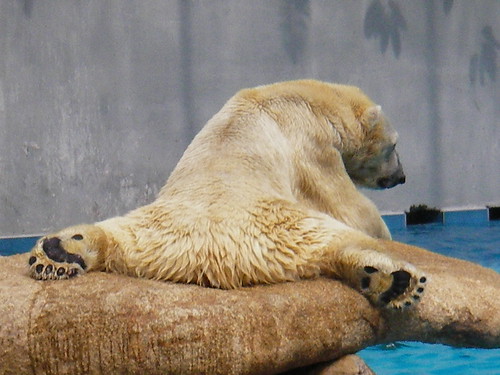
Polar Bear Inuka
Singapore Zoo's polar bear Inuka celebrates 16th birthday Singapore Zoo's Inuka the Polar bear turned 16 on Tuesday and he celebrated it in style with family and friends.A polar bear ice carving and a birthday cake, made of ice, carrots and frozen fish, were presented to the birthday boy.
His mother, Sheba, at 29, is four years over the average 25-year lifespan for polar bears in captivity.
The Zoo has made plans to relocate Inuka to another zoo when his mother dies.
It has to do this, it says, as it will now be focusing more on species from the tropical rainforest in line with its Rainforest Zoo positioning.
This means, it will no longer bring in Arctic animals.
Tuesday's birthday event was also part of a series of conservation and educational activities the zoo has organised from December to end of February next year.
Apart from seeing Inuka and his mother, visitors would learn more about polar bears and the effects of global warming on the Arctic.
His mother, Sheba, at 29, is four years over the average 25-year lifespan for polar bears in captivity.
The Zoo has made plans to relocate Inuka to another zoo when his mother dies.
It has to do this, it says, as it will now be focusing more on species from the tropical rainforest in line with its Rainforest Zoo positioning.
This means, it will no longer bring in Arctic animals.
Tuesday's birthday event was also part of a series of conservation and educational activities the zoo has organised from December to end of February next year.
Apart from seeing Inuka and his mother, visitors would learn more about polar bears and the effects of global warming on the Arctic.
Tuesday, November 21, 2006
Enjoy @ Zoo
Protect those peepers!
Sensitive to sunlight? We recommend that you bring sunshades, sunglasses or visors to keep the glare away. Better yet, soothe on some sunblock for added skin protection.
Rain, rain, go away!
The rain sometimes makes an unexpected appearance. Having an umbrella or raincoat handy will ensure you remain dry should this happen. Many parts of the zoo are sheltered though, and you'll still be able to enjoy excellent views of the animals from there.
Mozzie alert?
Although the zoo does take preventive measures to keep the mosquitoes and other creepy crawlies at bay, you might want to consider bringing some insect repellant to make sure they stay away! The zoo is after all situated in a secondary rainforest and many animals treat this as a haven.
Take your time!
There's always something happening at the zoo. Allow at least half a day to enjoy what's available, but a full day would be even better. Make sure you pick up a map as you enter so you won't miss out on the many presentations, token feeding sessions, keeper talks, rides and photography opportunities that happen during the day.
Feet first!
Taking a leisurely stroll is the ideal way to enjoy everything the zoo has to offer. Comfortable footwear will ensure you get to explore the park endlessly minus sore and tired feet.
Tired of walking?
Then hop onto a tram to rest your soles. Or take a break at one of the air-conditioned shelters while you get your wind back. Many of our exhibits also have viewing galleries that allow you to observe the animals comfortably.Wheels galore! We realise long walks might be taxing for little feet. Parents can rent strollers and wagons for their children. Wheelchairs, both motorised and otherwise, are also available.
Stay hydrated!
As the weather in Singapore tends to be hot and humid year-round, do remember to bring enough drinking water, and keep drinking throughout the day. An ample supply is on sale at our numerous F&B outlets if you happen to run out.
Munch time!
Our food outlets serve a variety of cuisines to tickle every tastebud:
KFC and Pizzafari – Great for kids
Jungle Tandoor – Perfect for spice-lovers
Jungle Flavours and Forest Fare – For the undecided, Asian and Western delights are available
Jungle Breakfast – A delightfully unique dining experience with the animals
Remember though, to savour the food for yourselves and not to share with any of the animals. Their diets are well taken care of.Service with a smile If in doubt at any time, do approach any of our guest relations officers, or any of our staff in fact. They will be more than happy to answer any questions you might have. Repeat, please. Remember to visit the zoo often. New and exciting things are always waiting to be discovered.
See you again soon!
Sensitive to sunlight? We recommend that you bring sunshades, sunglasses or visors to keep the glare away. Better yet, soothe on some sunblock for added skin protection.
Rain, rain, go away!
The rain sometimes makes an unexpected appearance. Having an umbrella or raincoat handy will ensure you remain dry should this happen. Many parts of the zoo are sheltered though, and you'll still be able to enjoy excellent views of the animals from there.
Mozzie alert?
Although the zoo does take preventive measures to keep the mosquitoes and other creepy crawlies at bay, you might want to consider bringing some insect repellant to make sure they stay away! The zoo is after all situated in a secondary rainforest and many animals treat this as a haven.
Take your time!
There's always something happening at the zoo. Allow at least half a day to enjoy what's available, but a full day would be even better. Make sure you pick up a map as you enter so you won't miss out on the many presentations, token feeding sessions, keeper talks, rides and photography opportunities that happen during the day.
Feet first!
Taking a leisurely stroll is the ideal way to enjoy everything the zoo has to offer. Comfortable footwear will ensure you get to explore the park endlessly minus sore and tired feet.
Tired of walking?
Then hop onto a tram to rest your soles. Or take a break at one of the air-conditioned shelters while you get your wind back. Many of our exhibits also have viewing galleries that allow you to observe the animals comfortably.Wheels galore! We realise long walks might be taxing for little feet. Parents can rent strollers and wagons for their children. Wheelchairs, both motorised and otherwise, are also available.
Stay hydrated!
As the weather in Singapore tends to be hot and humid year-round, do remember to bring enough drinking water, and keep drinking throughout the day. An ample supply is on sale at our numerous F&B outlets if you happen to run out.
Munch time!
Our food outlets serve a variety of cuisines to tickle every tastebud:
KFC and Pizzafari – Great for kids
Jungle Tandoor – Perfect for spice-lovers
Jungle Flavours and Forest Fare – For the undecided, Asian and Western delights are available
Jungle Breakfast – A delightfully unique dining experience with the animals
Remember though, to savour the food for yourselves and not to share with any of the animals. Their diets are well taken care of.Service with a smile If in doubt at any time, do approach any of our guest relations officers, or any of our staff in fact. They will be more than happy to answer any questions you might have. Repeat, please. Remember to visit the zoo often. New and exciting things are always waiting to be discovered.
See you again soon!
Friday, November 10, 2006
Happy birthday Party!

Come face-to-face with the world’s biggest bear
This year-end school holidays, Singapore Zoo has planned a series of fun conservation and educational activities centred on the polar bear, the largest of all bear species and the largest land carnivore. This is also in conjunction with the 16th birthday celebration for Inuka, the Zoo’s captive-bred polar bear, on 26 December.
Enrichment activities, incorporating an enlightening commentary, will be conducted for Sheba and Inuka, our polar bears. Learn more about the plight of the species and discover how the Zoo keeps them busy with innovative toys.Venue: Polar Bear Underwater Viewing ExhibitDate: 18 November – 31 DecemberTime: 10.05am, 1.05pm and 4.45pm daily (additional 3.10pm session on Sundays and public holidays)
I thought they are giving away our beloved polar bears?
Saturday, November 04, 2006
Le Long sell calendar

Singapore Zoo and Night Safari’s 2007 Calendar Available Now
Get Singapore Zoo and Night Safari’s stylish 2007 desk calendar now, and do your part for wildlife conservation. Depletion of natural habitat, illegal animal trade and poaching have made it vital for progressive zoos to adopt conservation programmes. Featured in this calendar are some of the endangered Southeast Asian animals at Singapore Zoo and Night Safari, such as the orang utan, Douc langur, Malayan sun bear, Indian rhino and Asian elephant.Carrying the theme of Singapore Zoo’s tagline “Extinction is Forever. Conserve”, each page features a close-up photograph and conservation bites on an endangered Southeast Asian animal. Proceeds from the sale of the calendars will go to the Wildlife Conservation Singapore Fund.The calendar retails at $8 each and is available at retail outlets at the Zoo and Night Safari, as well as on the Zoo and Night Safari’s online e-store at www.safarizooshop.com
Sunday, October 29, 2006
Cute Girl In Sing!
Bindi Irwin was in Singapore to film a show for Kids Discovery Networks!
The family was spotted in Singapore Jurong Bird Park.
Steve Irwin is a fan of the Singapore Zoo.
The family was spotted in Singapore Jurong Bird Park.
Steve Irwin is a fan of the Singapore Zoo.
Friday, October 27, 2006
Singapore Zoo installs braille interpretives for the visually handicapped
The disabled can now look forward to a sensory experience at the Singapore Zoo.
The zoo has revamped the park to make it accessible for all - including the physically and visually handicapped.
It has installed braille signs and life-sized replicas of some animals to enhance the experience for the blind.
45-year-old Adeline Krishnan has never seen an otter before, but now, thanks to the revamped facilities at the Singapore Zoo, blind people like Adeline can size up how animals like kangeroos and Malayan tapirs look like.
The zoo has installed braille interpretive signboards, and life-sized models at 10 of its most popular exhibits like the white tiger, rhinoceros, hippopotamus and proboscis monkeys.
"There are a couple of animals here that I've not seen before, especially life-sized crocodiles and these otters and kangeroos. I got a chance to touch them and know what it'll be like if it's a real kangeroo. The 3D diagram is very good because we can actually feel what the animal is actually like in the real form," said Adeline.
"I went to the zoo 6 years ago. Now it's much more friendly because it has the braille, and next to the braille there's a 3D model," said Ang Nam Kok.
"We're able to get some basic information about the animals and maybe if it arouses my interest then probably later, I can go and surf the net and find out more" said Jaafar Sidek, member, Singapore Association of the Visually Handicapped.
To encourage the visually handicapped to return for regular visits, the Zoo has produced a guidebook which contains a braille version of the Zoo map, and introductions to some of the animals here.
The book is available for loan free of charge at the Visitors Centre.
Apart from the hardware, the student volunteer guides are also important in helping to heighten the experience for blind visitors.
There are also special tours available where they can even get to touch rare animal artefacts like a polar bear and a tiger cub.
"We want to make sure that this national park is all-inclusive to everyone and we're progressively adding more and more facilities for everyone. In fact the whole transformation did not cost us a lot of money; we spent less than $10,000 to transform the park," said Fanny Lai, Executive Director, Singapore Zoo and Night Safari.
90 percent of the zoo is already accessible by wheelchair, but it is working with the Disabled People's Association of Singapore to make the zoo a national park that's accessible to all, and enjoyed by everyone.
The zoo has revamped the park to make it accessible for all - including the physically and visually handicapped.
It has installed braille signs and life-sized replicas of some animals to enhance the experience for the blind.
45-year-old Adeline Krishnan has never seen an otter before, but now, thanks to the revamped facilities at the Singapore Zoo, blind people like Adeline can size up how animals like kangeroos and Malayan tapirs look like.
The zoo has installed braille interpretive signboards, and life-sized models at 10 of its most popular exhibits like the white tiger, rhinoceros, hippopotamus and proboscis monkeys.
"There are a couple of animals here that I've not seen before, especially life-sized crocodiles and these otters and kangeroos. I got a chance to touch them and know what it'll be like if it's a real kangeroo. The 3D diagram is very good because we can actually feel what the animal is actually like in the real form," said Adeline.
"I went to the zoo 6 years ago. Now it's much more friendly because it has the braille, and next to the braille there's a 3D model," said Ang Nam Kok.
"We're able to get some basic information about the animals and maybe if it arouses my interest then probably later, I can go and surf the net and find out more" said Jaafar Sidek, member, Singapore Association of the Visually Handicapped.
To encourage the visually handicapped to return for regular visits, the Zoo has produced a guidebook which contains a braille version of the Zoo map, and introductions to some of the animals here.
The book is available for loan free of charge at the Visitors Centre.
Apart from the hardware, the student volunteer guides are also important in helping to heighten the experience for blind visitors.
There are also special tours available where they can even get to touch rare animal artefacts like a polar bear and a tiger cub.
"We want to make sure that this national park is all-inclusive to everyone and we're progressively adding more and more facilities for everyone. In fact the whole transformation did not cost us a lot of money; we spent less than $10,000 to transform the park," said Fanny Lai, Executive Director, Singapore Zoo and Night Safari.
90 percent of the zoo is already accessible by wheelchair, but it is working with the Disabled People's Association of Singapore to make the zoo a national park that's accessible to all, and enjoyed by everyone.
Tuesday, October 10, 2006
ACRES got their New LAND
http://www.acres.org.sg/
CONTACT US CONTACTING ACRESBy post:11 Pasir Ris Farmway 2,Singapore (519326)
By phone:(+65) 65812488By fax:(+65) 65816318Wildlife Crime Hotline:(+65) 97837782
By email:General enquiries: info@acres.org.sg
Volunteer enquiries: volunteer@acres.org.sg
Event enquiries: events@acres.org.sg
But I will always blame them for our loved polar bear!
CONTACT US CONTACTING ACRESBy post:11 Pasir Ris Farmway 2,Singapore (519326)
By phone:(+65) 65812488By fax:(+65) 65816318Wildlife Crime Hotline:(+65) 97837782
By email:General enquiries: info@acres.org.sg
Volunteer enquiries: volunteer@acres.org.sg
Event enquiries: events@acres.org.sg
But I will always blame them for our loved polar bear!
Saturday, September 30, 2006
They are to be blamed for the out of Polar Bears!
The Singapore Zoo is relocating there two precious polar bears.
The ACRES is to be blamed! Animal Concerns Research & Education Society.
CAMPAIGNSPOLAR BEARSPolar Bears at Singapore Zoo: ‘What’s a Polar Bear Doing in the Tropics?’Since 2004, Acres has been in discussions with the Singapore Zoo to improve the welfare of the two polar bears held there.
Acres has called for the Singapore Zoo not only to make drastic improvements to the living conditions for the bears, but also to phase out the keeping of polar bears and other Arctic animals on welfare grounds.
Campaign introductionIn 1978, Singapore Zoo acquired polar bears, becoming one of the few zoos in Asia that held this species in captivity at that time.
Today, two polar bears are housed at the Singapore Zoo: Sheba, a female who arrived at the zoo as a two year old cub in 1978, and Inuka, her male offspring born in 1990.
Polar bears are poor candidates for captivity, even in the best of circumstances. The situation is particularly bleak for the polar bears at Singapore Zoo.
The fact that Singapore’s tropical climate is totally unsuitable for polar bears and that they live in very small, barren, open-air enclosure means that the polar bears at Singapore Zoo are subjected to living in a highly stressful environment.
The polar bears have been seen to display both behavioural (abnormal behaviours) and physical (loss of lean muscle mass and fur) signs of distress.
Since April 2004, Acres has been in discussions with the Singapore Zoo regarding the polar bears and has called for the zoo to make every effort possible to improve their living conditions so that the bears can, at the very least, express some of their natural behavioural repertoire. In 2004, Acres presented a report to the zoo containing a number of recommendations to improve the welfare of the bears in the short term.
Longer term, Acres recommended that the zoo move the bears to appropriate accommodation elsewhere since they cannot be released to the wild. However, as Sheba is already old and may not survive the relocation journey, we then recommended that Inuka (the younger bear) is relocated once Sheba passes away.
In late 2005, Acres conducted an ongoing behavioural study of the polar bears to scientifically assess the current situation of the bears.
Key findings of the four month scientific study were: Both bears exhibited signs of severe heat stress. The bears were both seen to be panting for long periods of time (36% of the time for Inuka; 38.7% of the time for Sheba), indicating that they are far too hot. The bears were also seen to be exhibiting other behaviours indicating that they were suffering from heat stress. Both polar bears displayed high levels of inactivity (43% of the time for Inuka; 65% of the time for Sheba). This is recognized as a clear indication of an abnormal animal-environment interaction, almost certainly caused by a sub-optimal environment that does not satisfy the natural, species-specific behavioural needs of the bears. Both bears engaged in high levels of abnormal stereotypic behaviour (65% of active periods for Inuka; 57% of active periods for Sheba).
The bears were at times observed to be constantly pacing or swimming in a stereotypic fashion. The occurrence of stereotypic behaviour is widely recognized as a clear indication of an abnormal animal-environment interaction and a sign of psychological disorder in captive animals.
Acres is also concerned that (as last documented March 2006) the polar bears were still seen to be made to perform unnatural behaviours in the token feeding shows such as ‘waving’, ‘belly dancing’ and ringing a bell, all of which give the public a very misleading impression of wild polar bear behaviour.
In 2006, Acres once again called for the zoo to make improvements to the living conditions and husbandry practices for the bears as a matter of urgency after considering the results of this study. Acres has provided the zoos with a list of recommendations, including lowering temperature inside the enclosure, chilling the pool water, providing more stimulation and enrichment for the bears and ending the display of unnatural behaviours in the feeding show.
Acres once again called for the zoo to commit to relocating Inuka once Sheba passes away.In the long term, Acres called for the Singapore Zoo to phase out the keeping of polar bears in captivity, following the example set by progressive zoos throughout Europe. Acres also called for Singapore Zoo to never import Arctic animals again.
ResultsAcres met up with the Singapore Zoo in June 2006 and presented the results of our scientific study.We are pleased that the Singapore Zoo has agreed to: Eventually relocate Inuka, the male polar bear, to a more suitable facility in a more appropriate climate. Not import any Arctic animals in the future.
The ACRES is to be blamed! Animal Concerns Research & Education Society.
CAMPAIGNSPOLAR BEARSPolar Bears at Singapore Zoo: ‘What’s a Polar Bear Doing in the Tropics?’Since 2004, Acres has been in discussions with the Singapore Zoo to improve the welfare of the two polar bears held there.
Acres has called for the Singapore Zoo not only to make drastic improvements to the living conditions for the bears, but also to phase out the keeping of polar bears and other Arctic animals on welfare grounds.
Campaign introductionIn 1978, Singapore Zoo acquired polar bears, becoming one of the few zoos in Asia that held this species in captivity at that time.
Today, two polar bears are housed at the Singapore Zoo: Sheba, a female who arrived at the zoo as a two year old cub in 1978, and Inuka, her male offspring born in 1990.
Polar bears are poor candidates for captivity, even in the best of circumstances. The situation is particularly bleak for the polar bears at Singapore Zoo.
The fact that Singapore’s tropical climate is totally unsuitable for polar bears and that they live in very small, barren, open-air enclosure means that the polar bears at Singapore Zoo are subjected to living in a highly stressful environment.
The polar bears have been seen to display both behavioural (abnormal behaviours) and physical (loss of lean muscle mass and fur) signs of distress.
Since April 2004, Acres has been in discussions with the Singapore Zoo regarding the polar bears and has called for the zoo to make every effort possible to improve their living conditions so that the bears can, at the very least, express some of their natural behavioural repertoire. In 2004, Acres presented a report to the zoo containing a number of recommendations to improve the welfare of the bears in the short term.
Longer term, Acres recommended that the zoo move the bears to appropriate accommodation elsewhere since they cannot be released to the wild. However, as Sheba is already old and may not survive the relocation journey, we then recommended that Inuka (the younger bear) is relocated once Sheba passes away.
In late 2005, Acres conducted an ongoing behavioural study of the polar bears to scientifically assess the current situation of the bears.
Key findings of the four month scientific study were: Both bears exhibited signs of severe heat stress. The bears were both seen to be panting for long periods of time (36% of the time for Inuka; 38.7% of the time for Sheba), indicating that they are far too hot. The bears were also seen to be exhibiting other behaviours indicating that they were suffering from heat stress. Both polar bears displayed high levels of inactivity (43% of the time for Inuka; 65% of the time for Sheba). This is recognized as a clear indication of an abnormal animal-environment interaction, almost certainly caused by a sub-optimal environment that does not satisfy the natural, species-specific behavioural needs of the bears. Both bears engaged in high levels of abnormal stereotypic behaviour (65% of active periods for Inuka; 57% of active periods for Sheba).
The bears were at times observed to be constantly pacing or swimming in a stereotypic fashion. The occurrence of stereotypic behaviour is widely recognized as a clear indication of an abnormal animal-environment interaction and a sign of psychological disorder in captive animals.
Acres is also concerned that (as last documented March 2006) the polar bears were still seen to be made to perform unnatural behaviours in the token feeding shows such as ‘waving’, ‘belly dancing’ and ringing a bell, all of which give the public a very misleading impression of wild polar bear behaviour.
In 2006, Acres once again called for the zoo to make improvements to the living conditions and husbandry practices for the bears as a matter of urgency after considering the results of this study. Acres has provided the zoos with a list of recommendations, including lowering temperature inside the enclosure, chilling the pool water, providing more stimulation and enrichment for the bears and ending the display of unnatural behaviours in the feeding show.
Acres once again called for the zoo to commit to relocating Inuka once Sheba passes away.In the long term, Acres called for the Singapore Zoo to phase out the keeping of polar bears in captivity, following the example set by progressive zoos throughout Europe. Acres also called for Singapore Zoo to never import Arctic animals again.
ResultsAcres met up with the Singapore Zoo in June 2006 and presented the results of our scientific study.We are pleased that the Singapore Zoo has agreed to: Eventually relocate Inuka, the male polar bear, to a more suitable facility in a more appropriate climate. Not import any Arctic animals in the future.
Thursday, September 28, 2006
They need your $$$
ACRES needs support for Wildlife Rescue Centre Dear Acres supporters, We are in urgent need of funds to establish Singapore's first wildlife rescue centre.
The two hectare Acres Wildlife Rescue Centre (AWRC) will provide a much needed safe haven for animals rescued from the illegal wildlife trade.
The AWRC will also serve as an educational facility to create awareness on the detrimental effects of the illegal wildlife trade.
The educational aspect of the AWRC will ultimately move us one step closer towards ending the illegal wildlife trade. We will be taking over the land next month and we need to raise more than a million Singapore dollars to make the AWRC a reality.
We have raised about $7,000 so far and urgently need your help. The AWRC will provide a home for more than 400 animals and you can help make a difference for each of these animal's lives. Please consider making a donation in support of this very important project.
Please forward this email to your family and friends and help spread the word on this critical project which will save hundreds of lives.
More on the ACRES website including how to donate and more about the AWRC On behalf of the animals, thank you for your kind support. Best wishes, Louis Ng (MSc) President and Executive Director Animal Concerns Research and Education Society (Acres)www.acres.org.sg 11 Pasir Ris Farmway 2 Singapore 519326 (O): +65 6581 2488 (F): +65 6581 6318 (HP): +65 9796 8592 Join us on 30th September (Saturday) for our first fundraising event for the Acres Wildlife Rescue Centre (AWRC).
To raise funds for the AWRC, Acres will be holding a vegetarian barbeque along with some fun activities and games. Acres will also be providing more details about the AWRC on the night.
To purchase a ticket ($20), please call Acres at 6581 2488 or email us at info@acres.org.sg All proceeds will go towards the establishment of the rescue centre. Venue: Mutts and Mittens, 11 Pasir Ris Farmway 2 Singapore 519326 (opposite the Pet Hotel) Date: 30th September (Saturday) Time: 6pm until late We look forward to seeing you at the event!
The two hectare Acres Wildlife Rescue Centre (AWRC) will provide a much needed safe haven for animals rescued from the illegal wildlife trade.
The AWRC will also serve as an educational facility to create awareness on the detrimental effects of the illegal wildlife trade.
The educational aspect of the AWRC will ultimately move us one step closer towards ending the illegal wildlife trade. We will be taking over the land next month and we need to raise more than a million Singapore dollars to make the AWRC a reality.
We have raised about $7,000 so far and urgently need your help. The AWRC will provide a home for more than 400 animals and you can help make a difference for each of these animal's lives. Please consider making a donation in support of this very important project.
Please forward this email to your family and friends and help spread the word on this critical project which will save hundreds of lives.
More on the ACRES website including how to donate and more about the AWRC On behalf of the animals, thank you for your kind support. Best wishes, Louis Ng (MSc) President and Executive Director Animal Concerns Research and Education Society (Acres)www.acres.org.sg 11 Pasir Ris Farmway 2 Singapore 519326 (O): +65 6581 2488 (F): +65 6581 6318 (HP): +65 9796 8592 Join us on 30th September (Saturday) for our first fundraising event for the Acres Wildlife Rescue Centre (AWRC).
To raise funds for the AWRC, Acres will be holding a vegetarian barbeque along with some fun activities and games. Acres will also be providing more details about the AWRC on the night.
To purchase a ticket ($20), please call Acres at 6581 2488 or email us at info@acres.org.sg All proceeds will go towards the establishment of the rescue centre. Venue: Mutts and Mittens, 11 Pasir Ris Farmway 2 Singapore 519326 (opposite the Pet Hotel) Date: 30th September (Saturday) Time: 6pm until late We look forward to seeing you at the event!
Thursday, September 21, 2006
Animals at Singapore Zoo benefit from enrichment programme
Elephants and orang utans are among the animals getting a mental lift at the Singapore Zoo.
The keepers at the zoo are running a programme to help the animals stay sharp and experience situations that they would in the wild.
Polar bears Sheba and Inuka are residents at Singapore Zoo, but life can get a bit boring in their small enclosure, so keepers have been feeding the bears food in blocks of ice, so they've got to use their wits to break the ice and get at the food. (Both maybe transferred soon)
The idea of the enrichment programme is to stimulate the animals brains.
For the orang utans, the keepers have designed a task for them to get fruit out of a box.
The apes have to push the fruit through a tunnel to the other side before they get their reward.
For the elephants, life is a little different. When the elephants are idle, the keepers say they can begin to show neurotic behaviour like shaking their heads and bodies.
To combat this, the keepers get the elephants to play games, such as knocking a barrel filled with fruit until the fruit comes out, or blowing fruit out of a tree trunk.
The keepers are confident the programme works.
"We can also see the animals display, they move around a lot they seem to be enjoying their environment. But if you think the animal is not enjoying it most of the time the animal sits alone in a corner and they look at bit depressed," said Sam Chellaiyah, curator, Singapore Zoo.
The monkeys have to figure out how to get the fruit from the barrel as part of the programme which has been refined over 30 years.
"In a way we actually try to improve the ideas as we go along. Basically enrichment is trial and error especially for new devices, some devices work and some don't," said Diana Marlena, enrichment officer, Singapore Zoo.
The keepers say the enrichment goes a long way to keeping the animals alert and happy.
The keepers at the zoo are running a programme to help the animals stay sharp and experience situations that they would in the wild.
Polar bears Sheba and Inuka are residents at Singapore Zoo, but life can get a bit boring in their small enclosure, so keepers have been feeding the bears food in blocks of ice, so they've got to use their wits to break the ice and get at the food. (Both maybe transferred soon)
The idea of the enrichment programme is to stimulate the animals brains.
For the orang utans, the keepers have designed a task for them to get fruit out of a box.
The apes have to push the fruit through a tunnel to the other side before they get their reward.
For the elephants, life is a little different. When the elephants are idle, the keepers say they can begin to show neurotic behaviour like shaking their heads and bodies.
To combat this, the keepers get the elephants to play games, such as knocking a barrel filled with fruit until the fruit comes out, or blowing fruit out of a tree trunk.
The keepers are confident the programme works.
"We can also see the animals display, they move around a lot they seem to be enjoying their environment. But if you think the animal is not enjoying it most of the time the animal sits alone in a corner and they look at bit depressed," said Sam Chellaiyah, curator, Singapore Zoo.
The monkeys have to figure out how to get the fruit from the barrel as part of the programme which has been refined over 30 years.
"In a way we actually try to improve the ideas as we go along. Basically enrichment is trial and error especially for new devices, some devices work and some don't," said Diana Marlena, enrichment officer, Singapore Zoo.
The keepers say the enrichment goes a long way to keeping the animals alert and happy.
Wednesday, September 20, 2006
Farewell Our Friend
A khaki-clad choir, Hollywood stars and thousands of ordinary Australians bid farewell to "Crocodile Hunter" Steve Irwin at a memorial service at the famous TV naturalist's "Crocoseum" on Wednesday.
The service, broadcast live around Australia as well as across Asia and the United States, brought the nation to a standstill 16 days after Irwin, 44, was killed when the serrated barb from a stingray's tail pierced his heart.
"Please don't grieve for Steve, he's at peace now, but I'd like you to grieve for the animals, for the animals have lost the best friend they ever had, and so have I," Irwin's father Bob told the service.
A koala slumbered in a gum tree next to the stage and Irwin's tearful US-born wife Terri held their young son Robert in her lap as Irwin's family -- all wearing Irwin's trademark khaki shorts and shirts -- said their public goodbye.
"My daddy was my hero, he was always there for me when I needed him," Irwin's eight-year-old daughter Bindi said after walking onto the "Crocoseum" stage to a standing ovation.
"We filmed together, caught crocodiles together and loved being in the bush together. I want to help endangered wildlife just like he did," she said, her finger running over the words as she read her farewell.
Irwin's family and friends held a private funeral at his beloved Australia Zoo 11 days ago, telling stories around a campfire.
His 46 "Crocodile Hunter" documentaries were watched by 200 million people around the world and his death prompted an international outpouring of grief, clogging Web sites while fans piled floral tributes outside his zoo.
'Crikey'
Politicians, actors, champion boxers and football stars were among a crowd of about 5,000 at the "Crocoseum," the centrepiece of the zoo in tropical Queensland state.
Australian folk singer John Williamson led fans and a khaki-clad choir in a rousing rendition of some of Irwin's favorite songs, including the Australian hit "True Blue," in a largely upbeat service.
Taped tributes were played from Irwin's Oscar-winning actor friend Russell Crowe, Hollywood stars Kevin Costner and Cameron Diaz, and US singer Justin Timberlake.
Diaz and talk-show host Larry King said Irwin had an uncanny ability to reach children.
"America just flipped for him, every kid was in love with the idea of being able to be him," Diaz said.
Irwin grew up around wild animals, trapping crocodiles and releasing them in his parent's reptile park that would later become Australia Zoo, but never gained any professional degrees.
University of Queensland animal researcher Professor Craig Franklin said the university was about to award Irwin an adjunct chair for his work with crocodiles when it learned of his death.
"Professor Steve Irwin," Franklin declared.
Prime Minister John Howard was also among the dignitaries at the farewell and praised Irwin's zest for life, telling the crowd Australia had lost a remarkable man.
Crowe said from New York that Irwin's death "was completely unfair."
"We've all lost a friend, we've lost a champion," Crowe said.
In a final tribute, Australia Zoo staff spelled out Irwin's catchphrase "Crikey" in yellow flowers as Irwin's truck was driven from the "Crocoseum" for the last time to end the service.
The service, broadcast live around Australia as well as across Asia and the United States, brought the nation to a standstill 16 days after Irwin, 44, was killed when the serrated barb from a stingray's tail pierced his heart.
"Please don't grieve for Steve, he's at peace now, but I'd like you to grieve for the animals, for the animals have lost the best friend they ever had, and so have I," Irwin's father Bob told the service.
A koala slumbered in a gum tree next to the stage and Irwin's tearful US-born wife Terri held their young son Robert in her lap as Irwin's family -- all wearing Irwin's trademark khaki shorts and shirts -- said their public goodbye.
"My daddy was my hero, he was always there for me when I needed him," Irwin's eight-year-old daughter Bindi said after walking onto the "Crocoseum" stage to a standing ovation.
"We filmed together, caught crocodiles together and loved being in the bush together. I want to help endangered wildlife just like he did," she said, her finger running over the words as she read her farewell.
Irwin's family and friends held a private funeral at his beloved Australia Zoo 11 days ago, telling stories around a campfire.
His 46 "Crocodile Hunter" documentaries were watched by 200 million people around the world and his death prompted an international outpouring of grief, clogging Web sites while fans piled floral tributes outside his zoo.
'Crikey'
Politicians, actors, champion boxers and football stars were among a crowd of about 5,000 at the "Crocoseum," the centrepiece of the zoo in tropical Queensland state.
Australian folk singer John Williamson led fans and a khaki-clad choir in a rousing rendition of some of Irwin's favorite songs, including the Australian hit "True Blue," in a largely upbeat service.
Taped tributes were played from Irwin's Oscar-winning actor friend Russell Crowe, Hollywood stars Kevin Costner and Cameron Diaz, and US singer Justin Timberlake.
Diaz and talk-show host Larry King said Irwin had an uncanny ability to reach children.
"America just flipped for him, every kid was in love with the idea of being able to be him," Diaz said.
Irwin grew up around wild animals, trapping crocodiles and releasing them in his parent's reptile park that would later become Australia Zoo, but never gained any professional degrees.
University of Queensland animal researcher Professor Craig Franklin said the university was about to award Irwin an adjunct chair for his work with crocodiles when it learned of his death.
"Professor Steve Irwin," Franklin declared.
Prime Minister John Howard was also among the dignitaries at the farewell and praised Irwin's zest for life, telling the crowd Australia had lost a remarkable man.
Crowe said from New York that Irwin's death "was completely unfair."
"We've all lost a friend, we've lost a champion," Crowe said.
In a final tribute, Australia Zoo staff spelled out Irwin's catchphrase "Crikey" in yellow flowers as Irwin's truck was driven from the "Crocoseum" for the last time to end the service.
Tuesday, September 19, 2006
Poor OrangUtans
Political turmoil in Thailand has postponed the planned repatriation of 46 smuggled orangutans to their habitat in Indonesia, but the Indonesian government expressed hope Thursday they will be able to return home within one or two weeks.
"The process of the repatriation is not easy...we have to delay the plan because of political uncertainties" in Thailand, Adi Susmiyanto, director of conservation and biodiversity at the Forestry Ministry, told a press conference.
The great apes, which were smuggled to Thailand a few years ago from Kalimantan, the Indonesian part of Borneo Island, had been expected to arrive in Jakarta on Saturday to a gala welcome by first lady Ani Yudhoyono.
"The Indonesian government has lost contact with our partners in the Thai government who were decision-makers," Susmiyanto said.
The Thai military staged a coup Tuesday, ousting Prime Minister Thaksin Shinawatra while he was visiting New York to attend the opening session of the U.N. General Assembly.
Susmiyanto said he hopes the orangutans will be repatriated within two weeks after an interim government is established in Thailand as announced by Thai Army Commander-in-Chief Gen. Sonthi Boonyaratglin, leader of the Council of Administrative Reform that carried out the coup.
The long-haired apes are to be sent to the Nyaru Menteng Rehabilitation Center in Central Kalimantan where they are to receive help in making the transition to life in the wild before actually being released in the jungle.
DNA tests in Thailand confirmed that 48 orangutans at Pratubacahang Center private zoo in Bangkok were members of the Borneo species. The other species is found on Sumatra Island.
Jakarta has donated seven of the 48 orangutans who suffer from hepatitis B to the Thai government for research.
The Thai government was also to give back another five orangutans seized from Chiangmai Night Safari, bringing the number of orangutans to be repatriated to Indonesia to 46.
The population of orangutans on Borneo is declining due to unchecked logging and poaching. The Forestry Ministry estimates the number of orangutans in Kalimantan at 35,000.
In July, Indonesia got back two orangutans that had been smuggled to Vietnam and six from Malaysia. Talks with Malaysia are now under way on five other smuggled orangutans and one with Saudi Arabia.
According to the Jakarta-based international nongovernmental organization Borneo Orangutan Survival Foundation, over the last three years a total of 94 orangutans have been confiscated in Thailand, of which 41 have disappeared or died.
The foundation has posted a story on its website alleging that the five orangutans in Chiangmai have been exploited as photo props, making direct contact with hundreds of visitors daily and being exposed to disease and extreme stress.
Susmiyanto said the orangutans are usually smuggled when they are still babies, taken from their mothers who are killed. They are carried in wooden fishing boats, mostly to Cambodia, Malaysia, the Philippines, Saudi Arabia and Vietnam.
"The process of the repatriation is not easy...we have to delay the plan because of political uncertainties" in Thailand, Adi Susmiyanto, director of conservation and biodiversity at the Forestry Ministry, told a press conference.
The great apes, which were smuggled to Thailand a few years ago from Kalimantan, the Indonesian part of Borneo Island, had been expected to arrive in Jakarta on Saturday to a gala welcome by first lady Ani Yudhoyono.
"The Indonesian government has lost contact with our partners in the Thai government who were decision-makers," Susmiyanto said.
The Thai military staged a coup Tuesday, ousting Prime Minister Thaksin Shinawatra while he was visiting New York to attend the opening session of the U.N. General Assembly.
Susmiyanto said he hopes the orangutans will be repatriated within two weeks after an interim government is established in Thailand as announced by Thai Army Commander-in-Chief Gen. Sonthi Boonyaratglin, leader of the Council of Administrative Reform that carried out the coup.
The long-haired apes are to be sent to the Nyaru Menteng Rehabilitation Center in Central Kalimantan where they are to receive help in making the transition to life in the wild before actually being released in the jungle.
DNA tests in Thailand confirmed that 48 orangutans at Pratubacahang Center private zoo in Bangkok were members of the Borneo species. The other species is found on Sumatra Island.
Jakarta has donated seven of the 48 orangutans who suffer from hepatitis B to the Thai government for research.
The Thai government was also to give back another five orangutans seized from Chiangmai Night Safari, bringing the number of orangutans to be repatriated to Indonesia to 46.
The population of orangutans on Borneo is declining due to unchecked logging and poaching. The Forestry Ministry estimates the number of orangutans in Kalimantan at 35,000.
In July, Indonesia got back two orangutans that had been smuggled to Vietnam and six from Malaysia. Talks with Malaysia are now under way on five other smuggled orangutans and one with Saudi Arabia.
According to the Jakarta-based international nongovernmental organization Borneo Orangutan Survival Foundation, over the last three years a total of 94 orangutans have been confiscated in Thailand, of which 41 have disappeared or died.
The foundation has posted a story on its website alleging that the five orangutans in Chiangmai have been exploited as photo props, making direct contact with hundreds of visitors daily and being exposed to disease and extreme stress.
Susmiyanto said the orangutans are usually smuggled when they are still babies, taken from their mothers who are killed. They are carried in wooden fishing boats, mostly to Cambodia, Malaysia, the Philippines, Saudi Arabia and Vietnam.
Wednesday, September 06, 2006
No more animals from the Arctic: S'pore Zoo
After the complaint by International animal lovers, Singapore Zoo decided to release the Polar Bears... Sad!
The Singapore Zoo will no longer import animals from the Arctic, following concerns raised by an animal welfare group about the zoo's resident polar bears, Sheba and her son Inuku.
In a media statement on Wednesday, the Animal Research and Education Society (Acres) said it has raised "serious welfare concerns" over the two bears after a four-month undercover operation. The findings were presented to the zoo in June.
In the investigation, Acres found that the bears exhibited severe signs of heat stress, were highly inactive and displayed "abnormal stereotypic" manners in their swimming or pacing during their active periods.
The last two behaviours are psychological indicators that the bears are not coping well with their environment, it said. "There is no doubt that polar bears are poor candidates for captivity. They are extremely wide-ranging, highly intelligent, cold weather carnivores, so they are extremely problematic when housed in captivity," said Acres.
In response to queries, the Singapore Zoo confirmed that it will not bring in anymore Arctic animals. This is because it aims to be a "rainforest zoo", focusing on tropical rainforest animals. It also reiterated that the bears are housed in good conditions, citing the birth of Inuka - the first polar bear born in the tropics - as evidence.
However, as part of an "animal exchange programme", the 16-year-old Inuka will soon be heading for cooler climates.
Then, the zoo's executive director Fanny Lai said that this animal exchange was part of efforts to "contribute to the worldwide captive gene pool and help propagate the species".
The Singapore Zoo will no longer import animals from the Arctic, following concerns raised by an animal welfare group about the zoo's resident polar bears, Sheba and her son Inuku.
In a media statement on Wednesday, the Animal Research and Education Society (Acres) said it has raised "serious welfare concerns" over the two bears after a four-month undercover operation. The findings were presented to the zoo in June.
In the investigation, Acres found that the bears exhibited severe signs of heat stress, were highly inactive and displayed "abnormal stereotypic" manners in their swimming or pacing during their active periods.
The last two behaviours are psychological indicators that the bears are not coping well with their environment, it said. "There is no doubt that polar bears are poor candidates for captivity. They are extremely wide-ranging, highly intelligent, cold weather carnivores, so they are extremely problematic when housed in captivity," said Acres.
In response to queries, the Singapore Zoo confirmed that it will not bring in anymore Arctic animals. This is because it aims to be a "rainforest zoo", focusing on tropical rainforest animals. It also reiterated that the bears are housed in good conditions, citing the birth of Inuka - the first polar bear born in the tropics - as evidence.
However, as part of an "animal exchange programme", the 16-year-old Inuka will soon be heading for cooler climates.
Then, the zoo's executive director Fanny Lai said that this animal exchange was part of efforts to "contribute to the worldwide captive gene pool and help propagate the species".
Monday, September 04, 2006
A Friend of Singapore Zoo- Steve Irwin
Steve Irwin, the hugely popular Australian television personality and conservationist known as the "Crocodile Hunter," was killed Monday by a stingray while filming off the Great Barrier Reef. He was 44.
Irwin was at Batt Reef, off the remote coast of northeastern Queensland state, shooting a segment for a series called "Ocean's Deadliest" when he swam too close to one of the animals, which have a poisonous barb on their tails, his friend and colleague John Stainton said.
"He came on top of the stingray and the stingray's barb went up and into his chest and put a hole into his heart," said Stainton, who was on board Irwin's boat at the time.
Crew members aboard the boat, Croc One, called emergency services in the nearest city, Cairns, and administered CPR as they rushed the boat to nearby Low Isle to meet a rescue helicopter. Medical staff pronounced Irwin dead when they arrived a short time later, Stainton said.
Irwin was famous for his enthusiasm for wildlife and his catchword "Crikey!" in his television program "Crocodile Hunter." First broadcast in Australia in 1992, the program was picked up by the Discovery network, catapulting Irwin to international celebrity.
He rode his image into a feature film, 2002's "The Crocodile Hunters: Collision Course" and developed the wildlife park that his parents opened, Australia Zoo, into a major tourist attraction.
"The world has lost a great wildlife icon, a passionate conservationist and one of the proudest dads on the planet," Stainton told reporters in Cairns. "He died doing what he loved best and left this world in a happy and peaceful state of mind. He would have said, 'Crocs Rule!'"
Prime Minister John Howard, who hand-picked Irwin to attend a gala barbecue to honor President Bush when he visited in 2003, said he was "shocked and distressed at Steve Irwin's sudden, untimely and freakish death."
"It's a huge loss to Australia," Howard told reporters. "He was a wonderful character. He was a passionate environmentalist. He brought joy and entertainment and excitement to millions of people."
Irwin, who made a trademark of hovering dangerously close to untethered crocodiles and leaping on their backs, spoke in rapid-fire bursts with a thick Australian accent and was almost never seen without his uniform of khaki shorts and shirt and heavy boots.
Wild animal expert Jack Hanna, who frequently appears on TV with his subjects, offered praise for Irwin.
"Steve was one of these guys, we thought of him as invincible," Hanna, director emeritus of the Columbus (Ohio) Zoo and Aquarium, told ABC's "Good Morning America" Monday.
"The guy was incredible. His knowledge was incredible," Hanna said. "Some people that are doing this stuff are actors and that type of thing, but Steve was truly a zoologist, so to speak, a person who knew what he was doing. Yes, he did things a lot of people wouldn't do. I think he knew what he was doing."
Irwin's ebullience was infectious and Australian officials sought him out for photo opportunities and to promote Australia internationally.
His public image was dented, however, in 2004 when he caused an uproar by holding his infant son in one arm while feeding large crocodiles inside a zoo pen. Irwin claimed at the time there was no danger to the child, and authorities declined to charge Irwin with violating safety regulations.
Later that year, he was accused of getting too close to penguins, a seal and humpback whales in Antarctica while making a documentary. Irwin denied any wrongdoing, and an Australian Environment Department investigation recommended no action be taken against him.
Stingrays have a serrated, toxin-loaded barb, or spine, on the top of their tail. The barb, which can be up to 10 inches long, flexes if a ray is frightened. Stings usually occur to people when they step on or swim too close to a ray and can be excruciatingly painful but are rarely fatal, said University of Queensland marine neuroscientist Shaun Collin.
Collin said he suspected Irwin died because the barb pierced under his ribcage and directly into his heart.
"It was extraordinarily bad luck. It's not easy to get spined by a stingray and to be killed by one is very rare," Collin said.
News of Irwin's death spread quickly, and tributes flowed from all quarters of society.
At Australia Zoo at Beerwah, south Queensland, floral tributes were dropped at the entrance, where a huge fake crocodile gapes. Drivers honked their horns as they passed.
"Steve, from all God's creatures, thank you. Rest in peace," was written on a card with a bouquet of native flowers.
"We're all very shocked. I don't know what the zoo will do without him. He's done so much for us, the environment and it's a big loss," said Paula Kelly, a local resident and volunteer at the zoo, after dropping off a wreath at the gate.
Stainton said Irwin's American-born wife Terri, from Eugene, Ore., had been informed of his death, and had told their daughter Bindi Sue, 8, and son Bob, who will turn 3 in December.
The couple met when she went on vacation in Australia in 1991 and visited Irwin's Australia Zoo; they were married six months later. Sometimes referred to as the "Crocodile Huntress," she costarred on her husband's television show and in his 2002 movie.
Irwin was at Batt Reef, off the remote coast of northeastern Queensland state, shooting a segment for a series called "Ocean's Deadliest" when he swam too close to one of the animals, which have a poisonous barb on their tails, his friend and colleague John Stainton said.
"He came on top of the stingray and the stingray's barb went up and into his chest and put a hole into his heart," said Stainton, who was on board Irwin's boat at the time.
Crew members aboard the boat, Croc One, called emergency services in the nearest city, Cairns, and administered CPR as they rushed the boat to nearby Low Isle to meet a rescue helicopter. Medical staff pronounced Irwin dead when they arrived a short time later, Stainton said.
Irwin was famous for his enthusiasm for wildlife and his catchword "Crikey!" in his television program "Crocodile Hunter." First broadcast in Australia in 1992, the program was picked up by the Discovery network, catapulting Irwin to international celebrity.
He rode his image into a feature film, 2002's "The Crocodile Hunters: Collision Course" and developed the wildlife park that his parents opened, Australia Zoo, into a major tourist attraction.
"The world has lost a great wildlife icon, a passionate conservationist and one of the proudest dads on the planet," Stainton told reporters in Cairns. "He died doing what he loved best and left this world in a happy and peaceful state of mind. He would have said, 'Crocs Rule!'"
Prime Minister John Howard, who hand-picked Irwin to attend a gala barbecue to honor President Bush when he visited in 2003, said he was "shocked and distressed at Steve Irwin's sudden, untimely and freakish death."
"It's a huge loss to Australia," Howard told reporters. "He was a wonderful character. He was a passionate environmentalist. He brought joy and entertainment and excitement to millions of people."
Irwin, who made a trademark of hovering dangerously close to untethered crocodiles and leaping on their backs, spoke in rapid-fire bursts with a thick Australian accent and was almost never seen without his uniform of khaki shorts and shirt and heavy boots.
Wild animal expert Jack Hanna, who frequently appears on TV with his subjects, offered praise for Irwin.
"Steve was one of these guys, we thought of him as invincible," Hanna, director emeritus of the Columbus (Ohio) Zoo and Aquarium, told ABC's "Good Morning America" Monday.
"The guy was incredible. His knowledge was incredible," Hanna said. "Some people that are doing this stuff are actors and that type of thing, but Steve was truly a zoologist, so to speak, a person who knew what he was doing. Yes, he did things a lot of people wouldn't do. I think he knew what he was doing."
Irwin's ebullience was infectious and Australian officials sought him out for photo opportunities and to promote Australia internationally.
His public image was dented, however, in 2004 when he caused an uproar by holding his infant son in one arm while feeding large crocodiles inside a zoo pen. Irwin claimed at the time there was no danger to the child, and authorities declined to charge Irwin with violating safety regulations.
Later that year, he was accused of getting too close to penguins, a seal and humpback whales in Antarctica while making a documentary. Irwin denied any wrongdoing, and an Australian Environment Department investigation recommended no action be taken against him.
Stingrays have a serrated, toxin-loaded barb, or spine, on the top of their tail. The barb, which can be up to 10 inches long, flexes if a ray is frightened. Stings usually occur to people when they step on or swim too close to a ray and can be excruciatingly painful but are rarely fatal, said University of Queensland marine neuroscientist Shaun Collin.
Collin said he suspected Irwin died because the barb pierced under his ribcage and directly into his heart.
"It was extraordinarily bad luck. It's not easy to get spined by a stingray and to be killed by one is very rare," Collin said.
News of Irwin's death spread quickly, and tributes flowed from all quarters of society.
At Australia Zoo at Beerwah, south Queensland, floral tributes were dropped at the entrance, where a huge fake crocodile gapes. Drivers honked their horns as they passed.
"Steve, from all God's creatures, thank you. Rest in peace," was written on a card with a bouquet of native flowers.
"We're all very shocked. I don't know what the zoo will do without him. He's done so much for us, the environment and it's a big loss," said Paula Kelly, a local resident and volunteer at the zoo, after dropping off a wreath at the gate.
Stainton said Irwin's American-born wife Terri, from Eugene, Ore., had been informed of his death, and had told their daughter Bindi Sue, 8, and son Bob, who will turn 3 in December.
The couple met when she went on vacation in Australia in 1991 and visited Irwin's Australia Zoo; they were married six months later. Sometimes referred to as the "Crocodile Huntress," she costarred on her husband's television show and in his 2002 movie.
Friday, August 18, 2006
Saturday, August 05, 2006
Photos of Singapore Zoo
View the Photos of The Singapore Zoo.
http://www.flickr.com/photos/jade/sets/72057594127689933/detail/
Well done!
http://www.flickr.com/photos/jade/sets/72057594127689933/detail/
Well done!
Tuesday, August 01, 2006
Elephants at Work and Play Show
The show is at elephants of Asia, show time at 1130am & 330pm daily.
Do you know?
Elephants have special lung tissue which allows them to "snorkel" underwater, according to a US scientist.
Dr John West found African elephants to have denser tissue than other mammals around their lungs which enabled them to breathe while submerged in a lake, apart from the tips of their trunks.
He said the special tissue meant they could withstand the pressure of being underwater.
But a UK expert doubted Dr West's theory and told BBC News Online the reason elephants could breathe while underwater was simply that they stuck their trunks up above the surface.
Ha Ha... cute right.
Do you know?
Elephants have special lung tissue which allows them to "snorkel" underwater, according to a US scientist.
Dr John West found African elephants to have denser tissue than other mammals around their lungs which enabled them to breathe while submerged in a lake, apart from the tips of their trunks.
He said the special tissue meant they could withstand the pressure of being underwater.
But a UK expert doubted Dr West's theory and told BBC News Online the reason elephants could breathe while underwater was simply that they stuck their trunks up above the surface.
Ha Ha... cute right.
Saturday, July 22, 2006
Children's World
Have fun at the little petting Zoo! Let your kids pet the domestic animals and learn more about the animals behaviours! Don't miss the wet and wild playpool for the kids too. Bring along their swimming attires.
Saturday, July 15, 2006
The Singapore Zoo Welcomes IMF delegates
Come September 2006 Singapore will be hosting the International Montetary Fund and World Bank meetings. The whole country welcomes 16,000 delegates with the "Four Million Smiles" movement and their $$$. We need their extra spending power here to increase our earnings. So please Spend and enjoy.
Remember: Visit the Singapore Zoo.
Just imagine all of them (including their families) visiting the Zoo, the profit will be good for the Singapore Zoo!!!!!
Maybe Special treats for the animals, Hee hee. Bonus for the trainers and keepers.
http://www.singapore2006.org
Remember: Visit the Singapore Zoo.
Just imagine all of them (including their families) visiting the Zoo, the profit will be good for the Singapore Zoo!!!!!
Maybe Special treats for the animals, Hee hee. Bonus for the trainers and keepers.
http://www.singapore2006.org
Tuesday, July 04, 2006
Buy combo tixs
I suggest anyone visiting to take advantage of combo tickets which allow entry to Singapore Zoo and Night Safari at a discounted rate.
The Zoo's shows have been overhauled recently under pressure from animal rights groups, so now they feature natural behaviours and are less contrived. Do volunteer though, the shows no longer plant staff in the audience.
At the Zoo, must-sees include:
1. Fragile Forest - features rainforest ecosystem, with a walk-through biodome housing free-ranging lemurs, sloths, fruit bats, tree kangaroos, parrots and butterflies.
2. Great Rift Valley of Ethiopia - African-themed, highlight will a very virile troop of 70+ hamadryas baboons.
3. Elephants of Asia - stlyed after logging camps in Thailand, features a daily logging demonstration.
4. Tiger Trek - home to 3 white bengal tigers, first exhibit developed under a new 'Learning Zoo' initiative to transform the Zoo into an outdoor classroom.
Of course, you can't miss the Orang utans which Singapore Zoo is famous for. Soon there'll be a free-ranging activity for the orangs, where you'll actually be able to see them swinging among live trees right over your head. The trial phase was well-received and final stages of evaluation are almost complete.
As for Night Safari, its still unique enough to merit a visit. Recent additions to the safari include a walk-through giant flying squirrel habitat and a new nocturnal animal presentation.
Singapore's animal parks are very much 'hands-on' and encourage close contact between animals and visitors, done safely of course.
The Zoo's shows have been overhauled recently under pressure from animal rights groups, so now they feature natural behaviours and are less contrived. Do volunteer though, the shows no longer plant staff in the audience.
At the Zoo, must-sees include:
1. Fragile Forest - features rainforest ecosystem, with a walk-through biodome housing free-ranging lemurs, sloths, fruit bats, tree kangaroos, parrots and butterflies.
2. Great Rift Valley of Ethiopia - African-themed, highlight will a very virile troop of 70+ hamadryas baboons.
3. Elephants of Asia - stlyed after logging camps in Thailand, features a daily logging demonstration.
4. Tiger Trek - home to 3 white bengal tigers, first exhibit developed under a new 'Learning Zoo' initiative to transform the Zoo into an outdoor classroom.
Of course, you can't miss the Orang utans which Singapore Zoo is famous for. Soon there'll be a free-ranging activity for the orangs, where you'll actually be able to see them swinging among live trees right over your head. The trial phase was well-received and final stages of evaluation are almost complete.
As for Night Safari, its still unique enough to merit a visit. Recent additions to the safari include a walk-through giant flying squirrel habitat and a new nocturnal animal presentation.
Singapore's animal parks are very much 'hands-on' and encourage close contact between animals and visitors, done safely of course.
Saturday, July 01, 2006
Saturday, June 24, 2006
Animal for Hire?!
Looking for that extra something to make your party memorable? Wellington Zoo is hiring out its cheetahs for functions and events.
Some animal experts are appalled at the practice, and say it is unfair on the animals and puts people at risk. Others say it provides valuable stimulation for the creatures.
For $2500, keepers will bring the zoo's two juvenile cheetahs, Charlie and Delta, to an event, where guests can pat them and talk to their trainers. The zoo has been running the scheme since late last year and so far the cheetahs have been to private functions, a pet store opening, university lectures, and an A&P show.
"We do it because we believe it's one of the strongest ways we can get a conservation message across," said zoo spokeswoman Amy Hughes.
Animal advocacy group Safe is dismayed at the visits, and likens them to the chimpanzee tea parties, which were criticised towards the end of the 1960s for demeaning the animals.
"To use these magnificent animals as cheap revenue earners is abhorrent and needlessly endangers lives if anything causes these animals to attack while attending a party," said Safe campaign director Hans Kriek.
"Most zoos no longer use animals as circus acts but for Wellington Zoo, it appears, making money is more important."
Neither Auckland Zoo nor Orana Park in Christchurch rent out their big cats, and say they do not have animals tame enough for such an encounter. Insiders say the only other big cats available for functions are from Northland's "Lion Man" Craig Busch.
In 2004, Auckland property developer Andrew Krukziener had two young male lions greet guests at his wedding -reputedly at a cost of $10,000. Wellington Zoo insists the animals' welfare is the priority.
"If we ever thought they were upset or it stressed them out, we'd stop doing it," said Hughes.
The cheetahs, which were born and hand-raised in South Africa, have daily human contact. The zoo also sells encounters with the animals, where the public can meet and pet them in a special enclosure for $195.
Hughes said the cheetahs' behaviour indicated they enjoyed the off-site visits. She said the trips were regulated and required Maf approval. They last up to 90 minutes but the cats were removed at any sign of tension. No smoking is allowed, music must be at low levels, and any visit is restricted to the first 45 minutes of any function involving alcohol.
Massey University animal behaviour expert Associate Professor Kevin Stafford said cheetahs had a long history of being tamed. "They seem to handle interactions with humans and with large crowds extremely well. There are very few wild animals you could safely do that with."
He said the off-site experience would offer the animals stimulation and get them out of their cages. "It looks all right and safe, and it's probably doing cheetahs worldwide some good in a sense that it's exposing people to a glorious animal they otherwise might not be exposed to."
Massey University animal psychologist Arnold Chamove agreed the experience was probably not stressful for the animals, but questioned whether it was safe. The animals had no control, they could not move away, and if alarmed, they would attack. "I'll tell you one thing. I wouldn't go within striking distance of a cheetah, would you?"
Some animal experts are appalled at the practice, and say it is unfair on the animals and puts people at risk. Others say it provides valuable stimulation for the creatures.
For $2500, keepers will bring the zoo's two juvenile cheetahs, Charlie and Delta, to an event, where guests can pat them and talk to their trainers. The zoo has been running the scheme since late last year and so far the cheetahs have been to private functions, a pet store opening, university lectures, and an A&P show.
"We do it because we believe it's one of the strongest ways we can get a conservation message across," said zoo spokeswoman Amy Hughes.
Animal advocacy group Safe is dismayed at the visits, and likens them to the chimpanzee tea parties, which were criticised towards the end of the 1960s for demeaning the animals.
"To use these magnificent animals as cheap revenue earners is abhorrent and needlessly endangers lives if anything causes these animals to attack while attending a party," said Safe campaign director Hans Kriek.
"Most zoos no longer use animals as circus acts but for Wellington Zoo, it appears, making money is more important."
Neither Auckland Zoo nor Orana Park in Christchurch rent out their big cats, and say they do not have animals tame enough for such an encounter. Insiders say the only other big cats available for functions are from Northland's "Lion Man" Craig Busch.
In 2004, Auckland property developer Andrew Krukziener had two young male lions greet guests at his wedding -reputedly at a cost of $10,000. Wellington Zoo insists the animals' welfare is the priority.
"If we ever thought they were upset or it stressed them out, we'd stop doing it," said Hughes.
The cheetahs, which were born and hand-raised in South Africa, have daily human contact. The zoo also sells encounters with the animals, where the public can meet and pet them in a special enclosure for $195.
Hughes said the cheetahs' behaviour indicated they enjoyed the off-site visits. She said the trips were regulated and required Maf approval. They last up to 90 minutes but the cats were removed at any sign of tension. No smoking is allowed, music must be at low levels, and any visit is restricted to the first 45 minutes of any function involving alcohol.
Massey University animal behaviour expert Associate Professor Kevin Stafford said cheetahs had a long history of being tamed. "They seem to handle interactions with humans and with large crowds extremely well. There are very few wild animals you could safely do that with."
He said the off-site experience would offer the animals stimulation and get them out of their cages. "It looks all right and safe, and it's probably doing cheetahs worldwide some good in a sense that it's exposing people to a glorious animal they otherwise might not be exposed to."
Massey University animal psychologist Arnold Chamove agreed the experience was probably not stressful for the animals, but questioned whether it was safe. The animals had no control, they could not move away, and if alarmed, they would attack. "I'll tell you one thing. I wouldn't go within striking distance of a cheetah, would you?"
Sunday, June 18, 2006
Happy Birthday
Happy 46th Ah Meng's birthday on 18 June 2006.
The average life expectancy of a wild orang-utan is thought to be 35 years while in captivity orang utans have been known to live for 50 years.
The average life expectancy of a wild orang-utan is thought to be 35 years while in captivity orang utans have been known to live for 50 years.
Sunday, June 04, 2006
TCM goes to Zoo
The Singapore zoo is using an old Asian remedy to treat sick animals: acupuncture.
The latest patient is Tun, a 15-year-old Asian elephant whose right leg was crushed by a male elephant nine years ago. Zookeepers worried that Tun, who weighs 5,291 pounds, might not be able to settle her weight on her lame leg as she grew heavier.
Veterinarian and acupuncturist Oh Soon Hock, who has poked and prodded giraffes, cheetahs and Komodo dragons in the name of medicine, started treating Tun a month and a half ago.
"After the first treatment, she was more mobile. Now her leg can be bent better and her muscles are more relaxed," Oh said.
Elephant handlers are on site when Tun receives acupuncture treatment twice a week. The intricate process involves coaxing with repetitive noises, gentle tugs on her fan-like ears and bribery with bananas and carrots.
"I don't think acupuncture has any pain, if you know what to do," said Oh, who learned acupuncture at the Zhonghua Chinese Medicine College in Taiwan.
Oh said acupuncture on animals and humans uses the same premise of locating key points between the joints or veins.
The latest patient is Tun, a 15-year-old Asian elephant whose right leg was crushed by a male elephant nine years ago. Zookeepers worried that Tun, who weighs 5,291 pounds, might not be able to settle her weight on her lame leg as she grew heavier.
Veterinarian and acupuncturist Oh Soon Hock, who has poked and prodded giraffes, cheetahs and Komodo dragons in the name of medicine, started treating Tun a month and a half ago.
"After the first treatment, she was more mobile. Now her leg can be bent better and her muscles are more relaxed," Oh said.
Elephant handlers are on site when Tun receives acupuncture treatment twice a week. The intricate process involves coaxing with repetitive noises, gentle tugs on her fan-like ears and bribery with bananas and carrots.
"I don't think acupuncture has any pain, if you know what to do," said Oh, who learned acupuncture at the Zhonghua Chinese Medicine College in Taiwan.
Oh said acupuncture on animals and humans uses the same premise of locating key points between the joints or veins.
Thursday, May 25, 2006
Singapore Zoo A "breeding ground"!
Under the effort of new breeding methods, 2 white rhinos, rare animals threatened with extinction, were born at the Singapore Zoo in 2004.
One was named Mandela after South Africa's former president Nelson Mandela and the other Sudi, which means "luck" in Swahili, a language used in Africa where white rhinos are found.
Mandela was born in October and Sudi December 2004. The calves each weigh about 40 kilograms and are about 70 centimetres in height.
Sam Alagappsamy, the zoo's curator, said the world's white rhino population stood at 11,700.
While their numbers are the highest among the five species of rhinos, he said they were still being threatened by poaching, illegal trade, war and habitat destruction.
One was named Mandela after South Africa's former president Nelson Mandela and the other Sudi, which means "luck" in Swahili, a language used in Africa where white rhinos are found.
Mandela was born in October and Sudi December 2004. The calves each weigh about 40 kilograms and are about 70 centimetres in height.
Sam Alagappsamy, the zoo's curator, said the world's white rhino population stood at 11,700.
While their numbers are the highest among the five species of rhinos, he said they were still being threatened by poaching, illegal trade, war and habitat destruction.
Thursday, May 18, 2006
Your Foto with Ah Meng
Singapore Zoo’s famous primate, Ah Meng, celebrates her 46 th birthday on 18 June 2006. Since 1971, this loveable Sumatran orang utan has been photographed by thousands of locals, tourists, foreign dignitaries and even celebrities.
Singapore Zoo now invites the public to relive and relish their special moments spent with Ah Meng by submitting their favourite photo.
Selected photos will be framed in a poster board and displayed at the Zoo in June 2006. Singapore Zoo will also be looking out for the best entry which will entitle the winner to a Wildlife Unlimited membership as well as an exclusive breakfast opportunity with Ah Meng.
To submit your entries:
Email your photos to ahmeng@zoo.com.sg or mail to:
Ah Meng Photo Competition c/o Corporate Communications Department Singapore Zoo
80 Mandai Lake RoadSingapore 729826
The resolution for soft copy images should be at least 300dpi (or A4 size).
The photo can be in colour or black and white.
The photo should be accompanied by an appropriate caption.
Please include your name, contact number, email and postal addresses in your entries.
Photos submitted for ‘Ah Meng Photo Competition’ will not be returned to the respective sender.
The winning photo may be used for publicity purposes by the Singapore Zoo.
All photos should reach Singapore Zoo by Friday, 2 June 2006.
The winning photo will be announced on 9 June 2006.
The winner will be notified by post.
Personally I have three of such foto, all to them in hardcopy. Will try to scan and digitalise it before sending. So happy for her.
Singapore Zoo now invites the public to relive and relish their special moments spent with Ah Meng by submitting their favourite photo.
Selected photos will be framed in a poster board and displayed at the Zoo in June 2006. Singapore Zoo will also be looking out for the best entry which will entitle the winner to a Wildlife Unlimited membership as well as an exclusive breakfast opportunity with Ah Meng.
To submit your entries:
Email your photos to ahmeng@zoo.com.sg or mail to:
Ah Meng Photo Competition c/o Corporate Communications Department Singapore Zoo
80 Mandai Lake RoadSingapore 729826
The resolution for soft copy images should be at least 300dpi (or A4 size).
The photo can be in colour or black and white.
The photo should be accompanied by an appropriate caption.
Please include your name, contact number, email and postal addresses in your entries.
Photos submitted for ‘Ah Meng Photo Competition’ will not be returned to the respective sender.
The winning photo may be used for publicity purposes by the Singapore Zoo.
All photos should reach Singapore Zoo by Friday, 2 June 2006.
The winning photo will be announced on 9 June 2006.
The winner will be notified by post.
Personally I have three of such foto, all to them in hardcopy. Will try to scan and digitalise it before sending. So happy for her.
Monday, May 15, 2006
Visit the Singapore Zoo

Ah Meng 46th Birthday Celebration!
Singapore most famous tourism ambassador, Ah Meng, turns 46 year old on 18 June! Visit the Singapore Zoo to celebrate her birthday together. Ah Meng will be there to receive you as his guest.
Date: Sun, 18 June '06 Time: 11.30am - 1.30pm Venue: Jungle Flavours Price: Buffet Brunch S$25++ (Adult)S$12.50++ (Children under 12)Excludes Zoo admission charges
If you want to send a birthday ecard to AhMeng
visit...http://www.zoo.com.sg/greetings/bdaygreet.html
Saturday, May 06, 2006
School Holidays is coming!
Visit The Singapore Zoo
At the world-renowned Singapore Zoo, 40 hectares of dense forest are home to over 132 species, 25% of which are endangered. The stars of the show include giant flying squirrels, tapirs, giraffes and tigers, all in naturalistic habitats.
A so-called "open concept" has been employed throughout the zoo, creating the illusion that the animals are roaming freely through the park. In fact, wet and dry moats are cleverly camouflaged to separate man from beast. Anyone with a nervous disposition will be glad to know that some of the more agile animals are housed in beautifully landscaped glass-fronted enclosures.
For animal action, time your visit to see the polar bear-feeding show and take the kids to see the primate and reptile shows. One of the best attractions is breakfast with the Orang-Utans, one can take pictures and share a banana with one of the stars.
Adjacent to the Day Zoo is the Night Safari, the world's first wildlife experience built to be viewed after dark. Here visitors can amble along illuminated walking trails or take a tram ride through the jungle to spot tigers, rhino and sloths.
At the world-renowned Singapore Zoo, 40 hectares of dense forest are home to over 132 species, 25% of which are endangered. The stars of the show include giant flying squirrels, tapirs, giraffes and tigers, all in naturalistic habitats.
A so-called "open concept" has been employed throughout the zoo, creating the illusion that the animals are roaming freely through the park. In fact, wet and dry moats are cleverly camouflaged to separate man from beast. Anyone with a nervous disposition will be glad to know that some of the more agile animals are housed in beautifully landscaped glass-fronted enclosures.
For animal action, time your visit to see the polar bear-feeding show and take the kids to see the primate and reptile shows. One of the best attractions is breakfast with the Orang-Utans, one can take pictures and share a banana with one of the stars.
Adjacent to the Day Zoo is the Night Safari, the world's first wildlife experience built to be viewed after dark. Here visitors can amble along illuminated walking trails or take a tram ride through the jungle to spot tigers, rhino and sloths.
Wednesday, April 26, 2006
A wooded retreat for orang utans
ORANG UTANS are getting a taste of forest life at the Singapore Zoo in the first such facility of its kind.
Rather than clamber atop artificial wooden jungle gyms in their enclosure, they are now free to climb 24m-tall trees in a wooded retreat not unlike their natural homes.
Visitors this past month have been surprised at the sight of these gentle arboreal creatures deftly swinging on vines and perching on treetops to gaze into the distance.
The 6,000 sq m 'free-ranging facility' is a first for orang utans in a zoo anywhere, said the zoo's executive director, Ms Fanny Lai.
The trees, linked together by a series of vines and hammocks, are just outside the animals' current enclosure.
Every morning, zookeepers lead them to the free-ranging facility, where they can spend hours lingering amid the trees.
The facility was opened earlier this month as an early Earth Day gift to these highly endangered primates.
Small innovations such as these, along with diligent matchmaking, have allowed the zoo's orang utan population to thrive.
Over the past 32 years, the zoo has bred 32 orang utans. 'That's something we are quite proud of, given that the female orang utans can get pregnant only once every seven to eight years,' said Ms Lai. There are now 25 orang utans - possibly the largest troop for a zoo. The youngest was born just two weeks ago.
Two other zoos renowned for breeding orang utans, Jakarta's Schmutzer Primate Centre and the Melbourne Zoo, together have only 18 such creatures.
'This may be a zoo, but we want to give these animals as close an experience as possible' to what they would have experienced if they were in the wild, said Ms Lai.
The orang utans now have about 10 times the space they once did, enjoying free access to about a dozen tall trees similar to those found in their native homes, the lush rainforests of Sumatra and Borneo.
Many of the orang utans here were born in captivity. 'They had never climbed a tree before - yet once we set them free, they began climbing naturally, as if they had been doing it all their lives,' said Ms Lai. 'It was quite amazing.'
Estimates from the Great Apes Survival Project, a United Nations endeavour to conserve various primate species, show that there are 15,000 orang utans left in the wild, less than a tenth of what existed a century ago.
Conserving this species is especially important, as orang utans are among man's closest cousins, sharing 97 per cent of the same genetic material.
While protecting these creatures in their natural habitats is the ideal solution, the task is proving increasingly difficult, say non-governmental organisations involved in wildlife conservation such as Traffic, which was set up by the World Wildlife Fund and the International Conservation Union.
Deforestation - which robs these creatures of their natural homes - and poaching have been the biggest threat to their survival, said Traffic's programme officer for South-east Asia Julia Ng.
'The zoo has given these animals a chance to breed safely in an environment that is as close to their natural homes as possible,' she said.
'That's simply invaluable.'
Rather than clamber atop artificial wooden jungle gyms in their enclosure, they are now free to climb 24m-tall trees in a wooded retreat not unlike their natural homes.
Visitors this past month have been surprised at the sight of these gentle arboreal creatures deftly swinging on vines and perching on treetops to gaze into the distance.
The 6,000 sq m 'free-ranging facility' is a first for orang utans in a zoo anywhere, said the zoo's executive director, Ms Fanny Lai.
The trees, linked together by a series of vines and hammocks, are just outside the animals' current enclosure.
Every morning, zookeepers lead them to the free-ranging facility, where they can spend hours lingering amid the trees.
The facility was opened earlier this month as an early Earth Day gift to these highly endangered primates.
Small innovations such as these, along with diligent matchmaking, have allowed the zoo's orang utan population to thrive.
Over the past 32 years, the zoo has bred 32 orang utans. 'That's something we are quite proud of, given that the female orang utans can get pregnant only once every seven to eight years,' said Ms Lai. There are now 25 orang utans - possibly the largest troop for a zoo. The youngest was born just two weeks ago.
Two other zoos renowned for breeding orang utans, Jakarta's Schmutzer Primate Centre and the Melbourne Zoo, together have only 18 such creatures.
'This may be a zoo, but we want to give these animals as close an experience as possible' to what they would have experienced if they were in the wild, said Ms Lai.
The orang utans now have about 10 times the space they once did, enjoying free access to about a dozen tall trees similar to those found in their native homes, the lush rainforests of Sumatra and Borneo.
Many of the orang utans here were born in captivity. 'They had never climbed a tree before - yet once we set them free, they began climbing naturally, as if they had been doing it all their lives,' said Ms Lai. 'It was quite amazing.'
Estimates from the Great Apes Survival Project, a United Nations endeavour to conserve various primate species, show that there are 15,000 orang utans left in the wild, less than a tenth of what existed a century ago.
Conserving this species is especially important, as orang utans are among man's closest cousins, sharing 97 per cent of the same genetic material.
While protecting these creatures in their natural habitats is the ideal solution, the task is proving increasingly difficult, say non-governmental organisations involved in wildlife conservation such as Traffic, which was set up by the World Wildlife Fund and the International Conservation Union.
Deforestation - which robs these creatures of their natural homes - and poaching have been the biggest threat to their survival, said Traffic's programme officer for South-east Asia Julia Ng.
'The zoo has given these animals a chance to breed safely in an environment that is as close to their natural homes as possible,' she said.
'That's simply invaluable.'
Monday, April 17, 2006
Research tie up
After much discussions, on the 14.March 2006 the Singapore Zoological Garden (incl. Night Safari) and Raffles Museum of Biodiversity Research/Department of Biological Sciences, NUS signed a memorandum of agreement which formalises the existing collaborations and create a solid foundation for future research on biodiversity and conservation genetics between our outfits.
The ongoing research includes a project on primate phylogenetics for which the Singapore Zoo is providing tissue samples from its important primate collection and the NUS collaborators (primarily Rudolf Meier) are sequencing mitochondrial and nuclear genes.
In another project, the partners are exploring species limits in Southeast Asian Trachypithecus species. This will also form the basis for any future tissue bank we may set up in NUS with our partners.
The agreement was the basis of comments made by the zoological gardens chief vet, Chris Furley, last week in the STRAITS TIMES last week when the zoo's new vet centre was annouced. In this article, he stated that the zoo was working with NUS as part of their expanding research efforts.
The ongoing research includes a project on primate phylogenetics for which the Singapore Zoo is providing tissue samples from its important primate collection and the NUS collaborators (primarily Rudolf Meier) are sequencing mitochondrial and nuclear genes.
In another project, the partners are exploring species limits in Southeast Asian Trachypithecus species. This will also form the basis for any future tissue bank we may set up in NUS with our partners.
The agreement was the basis of comments made by the zoological gardens chief vet, Chris Furley, last week in the STRAITS TIMES last week when the zoo's new vet centre was annouced. In this article, he stated that the zoo was working with NUS as part of their expanding research efforts.
Sunday, April 16, 2006
Visit Zoo Today
The animals are kept in spacious, landscaped enclosures, separated from the visitors by dry or wet moats. Giving them privacy and security of their own territory. To spare yourself walking under the hot tropical sun, you can board a little train that trundles through the park.
Rain or Shine its a good tourist spot!
Rain or Shine its a good tourist spot!
Sunday, April 09, 2006
Singapore Zoo Best of the BEST!
Singapore Zoo was conferred the Best Leisure Attraction Experience award in the 20th Singapore Tourism Awards last evening. This accolade is its eighth win since the inception of the awards in 1985.
This marks the sixteenth time Wildlife Reserves Singapore (WRS) parks have won this prestigious award, with Night Safari having won the award six times and Jurong BirdPark twice. WRS is the parent company of Singapore Zoo, Night Safari and Jurong BirdPark.
Ms Fanny Lai, Executive Director of Singapore Zoo and Night Safari, said: “We are jubilant to be awarded this accolade for the eighth time, as it affirms Singapore Zoo’s status as Singapore’s premier leisure venue. Last year we received 1.3 million visitors, marking an 8 per cent increase over the previous year. We will continue to ensure our service quality, product offerings and physical surroundings adhere to world-class standards.”
“We are repositioning ourselves to be an outdoor learning classroom for wildlife and conservation. As part of the Zoo’s transformation from a Viewing Zoo to a Learning Zoo, we have introduced greater educational and interactive elements in our habitats and programmes to further enrich visitors’ experience,” she added.
The Singapore Tourism Awards is organised by Singapore Tourism Board. It seeks to acknowledge star players in the tourism industry whose contributions have enhanced Singapore’s status as a premier tourist destination. The criteria include innovation and creativity in products and services, and service quality.
Innovations
Opened in 1973, Singapore Zoo continues to innovate and refresh its offerings. Last year, it opened new exhibits featuring giraffes, babirusas ( Sulawesi pigs), Asian small-clawed otters and even tropical plants and vegetables. It also refurbished its Fragile Forest and Elephants of Asia exhibits to offer more educational elements such as interpretive signages and discovery stations. To cater to different language needs, Singapore Zoo has also revamped its current exhibits by incorporating different languages such as Japanese and Chinese.
While the Singapore Zoo already enjoys a reputation for being one of the top zoos in the world, the park is always looking for ways to improve its exhibits and programmes. Last year, it introduced a new “Wonders of the Wild” show. This half-hour programme showcases 10 animal species of mammals and reptiles. It aims to educate the public on animal conservation matters.
New initiative to promote conservation and educational goals
Singapore Zoo continues to contribute to the global conservation effort with its captive breeding programmes of endangered animals. In 2005, it had bred about 90 animals, many of them endangered or threatened in the wild. Endangered animals at the Zoo which gave birth include the Nubian Ibex, Sulawesi Crested Macaque Cotton-Top Tamarin and Douc Langur. The World Conservation Union defines an animal as endangered when it faces a very high risk of extinction in the wild in the near future. In addition, Singapore Zoo has also undertaken numerous research and conservation projects locally and externally with local and foreign universities.
Another breakthrough project in the pipeline is a world-class veterinary diagnostic and treatment facility slated to open in March 2006. With an initial start-up cost of $3.6 million, the Wildlife Healthcare and Research Centre is targeted to be a global leader in veterinary healthcare and research, training of Zoo vets and reproductive research in Zoo animals. The new and improved facility will include a public viewing gallery that allows visitors to observe the animal surgery and treatment areas and interactive displays that will educate visitors on the work of Zoo vets.
This marks the sixteenth time Wildlife Reserves Singapore (WRS) parks have won this prestigious award, with Night Safari having won the award six times and Jurong BirdPark twice. WRS is the parent company of Singapore Zoo, Night Safari and Jurong BirdPark.
Ms Fanny Lai, Executive Director of Singapore Zoo and Night Safari, said: “We are jubilant to be awarded this accolade for the eighth time, as it affirms Singapore Zoo’s status as Singapore’s premier leisure venue. Last year we received 1.3 million visitors, marking an 8 per cent increase over the previous year. We will continue to ensure our service quality, product offerings and physical surroundings adhere to world-class standards.”
“We are repositioning ourselves to be an outdoor learning classroom for wildlife and conservation. As part of the Zoo’s transformation from a Viewing Zoo to a Learning Zoo, we have introduced greater educational and interactive elements in our habitats and programmes to further enrich visitors’ experience,” she added.
The Singapore Tourism Awards is organised by Singapore Tourism Board. It seeks to acknowledge star players in the tourism industry whose contributions have enhanced Singapore’s status as a premier tourist destination. The criteria include innovation and creativity in products and services, and service quality.
Innovations
Opened in 1973, Singapore Zoo continues to innovate and refresh its offerings. Last year, it opened new exhibits featuring giraffes, babirusas ( Sulawesi pigs), Asian small-clawed otters and even tropical plants and vegetables. It also refurbished its Fragile Forest and Elephants of Asia exhibits to offer more educational elements such as interpretive signages and discovery stations. To cater to different language needs, Singapore Zoo has also revamped its current exhibits by incorporating different languages such as Japanese and Chinese.
While the Singapore Zoo already enjoys a reputation for being one of the top zoos in the world, the park is always looking for ways to improve its exhibits and programmes. Last year, it introduced a new “Wonders of the Wild” show. This half-hour programme showcases 10 animal species of mammals and reptiles. It aims to educate the public on animal conservation matters.
New initiative to promote conservation and educational goals
Singapore Zoo continues to contribute to the global conservation effort with its captive breeding programmes of endangered animals. In 2005, it had bred about 90 animals, many of them endangered or threatened in the wild. Endangered animals at the Zoo which gave birth include the Nubian Ibex, Sulawesi Crested Macaque Cotton-Top Tamarin and Douc Langur. The World Conservation Union defines an animal as endangered when it faces a very high risk of extinction in the wild in the near future. In addition, Singapore Zoo has also undertaken numerous research and conservation projects locally and externally with local and foreign universities.
Another breakthrough project in the pipeline is a world-class veterinary diagnostic and treatment facility slated to open in March 2006. With an initial start-up cost of $3.6 million, the Wildlife Healthcare and Research Centre is targeted to be a global leader in veterinary healthcare and research, training of Zoo vets and reproductive research in Zoo animals. The new and improved facility will include a public viewing gallery that allows visitors to observe the animal surgery and treatment areas and interactive displays that will educate visitors on the work of Zoo vets.
Sunday, April 02, 2006
New exhibit in Zoo
Visitors to the Singapore Zoo yesterday discovered that a new primate exhibit the zoo had promoted actually contained apes of a different kind - HUMANS!
The new display was both an April Fool's Prank and an attempt to highlight man's role in conservation.
How man's activities such as deforestation and pollution are destroying the earth's other creatures.
Homo Sapiens are the most dangerous and powerful creatures on earth. However the ladies are fully clothed and dun run around in their baby suit.
The new display was both an April Fool's Prank and an attempt to highlight man's role in conservation.
How man's activities such as deforestation and pollution are destroying the earth's other creatures.
Homo Sapiens are the most dangerous and powerful creatures on earth. However the ladies are fully clothed and dun run around in their baby suit.
Monday, March 20, 2006
State of the art ZOO
It is not just an exotic animal hospital, but also a genetic Noah's Ark. The Singapore Zoo's new $3.6 million animal hospital and research centre will be a repository of tissue samples taken from various rare species, so researchers can study how to breed them.
Research has just started with the National University of Singapore and some United States-based institutions.
Opened by President S R Nathan, the Wildlife Healthcare and Research Centre is equipped to treat more than 1,500 cases each year.
Research has just started with the National University of Singapore and some United States-based institutions.
Opened by President S R Nathan, the Wildlife Healthcare and Research Centre is equipped to treat more than 1,500 cases each year.

Friday, March 10, 2006
Green on bear will be History

The bulky Arctic beasts - usually clad in a thick coat of snow-white hair - have started turning green.
A zoo spokesman ended speculation that the animals had been spray-painted in camouflage colours.
The green colouring is apparently the work of algae which have found a new home in the bears' translucent hair shafts.
"The harmless algae is the result of Singapore's warm and humid climate," spokesman Tan told the Press.
Two bears at the zoo have been afflicted by the algae so far - Sheba and her 13-year-old son, Inuka.
Sheba was treated first, the spokesman said.
Her coat was bleached with a hydrogen-peroxide solution a fortnight ago and is returning to its original colour.
Inuka has to endure the bright green splotches on its back, legs and ears until it is treated, too.
Polar-bear hairs usually appear white because they reflect the light around them.
Saturday, March 04, 2006
The Singapore Zoo is Expanding!
The Singapore Zoo is expected to operate a wildlife healthcare and research centre by 2007.
The centre aims to be the first world-class diagnostic and treatment facility.
This will help the institution enhance its research in the breeding of zoo animals.
These are all in line with the Singapore Zoo's conservation efforts to breed endangered animals.
Since the beginning of this year, the zoo has successfully bred over 60 animals, 30 percent of which are endangered species.
The latest endangered new-born animal at the zoo is the Pygmy Hippo.
Less than two weeks old, zoo keepers will have to wait a couple more months before they can identify its gender.
Such new additions are significant to the Singapore Zoo because it shows the environment is conducive for the animals to reproduce.
Singapore Zoo's executive director, Fanny Lai, said: "One of the important things is we want to inspire people to be closer to nature. So nothing better than to display the animals in their natural habitat.
"But in order to display the endangered animals, it's important that we exchange our species with other institutions so that we don't capture them from the wild.
"And when we exchange with other zoological institutions, we also expand their gene pool, so there wouldn't be in-breeding.
"The ultimate thing is we bring the animals to the people for recreation, education and conservation."
The zoo is also home to other endangered species like the Falabella, which are miniature horses.
A two-month-old baby is the first miniature horse born at the Singapore Zoo.
At the primates section, the Douc Langurs are highly endangered leaf-eating monkeys from Vietnam and Laos.
And a little one, which is about two months old, is one of the latest additions to this group of 15.
Currently, the Singapore Zoo has more than 3,000 animals on display.
The centre aims to be the first world-class diagnostic and treatment facility.
This will help the institution enhance its research in the breeding of zoo animals.
These are all in line with the Singapore Zoo's conservation efforts to breed endangered animals.
Since the beginning of this year, the zoo has successfully bred over 60 animals, 30 percent of which are endangered species.
The latest endangered new-born animal at the zoo is the Pygmy Hippo.
Less than two weeks old, zoo keepers will have to wait a couple more months before they can identify its gender.
Such new additions are significant to the Singapore Zoo because it shows the environment is conducive for the animals to reproduce.
Singapore Zoo's executive director, Fanny Lai, said: "One of the important things is we want to inspire people to be closer to nature. So nothing better than to display the animals in their natural habitat.
"But in order to display the endangered animals, it's important that we exchange our species with other institutions so that we don't capture them from the wild.
"And when we exchange with other zoological institutions, we also expand their gene pool, so there wouldn't be in-breeding.
"The ultimate thing is we bring the animals to the people for recreation, education and conservation."
The zoo is also home to other endangered species like the Falabella, which are miniature horses.
A two-month-old baby is the first miniature horse born at the Singapore Zoo.
At the primates section, the Douc Langurs are highly endangered leaf-eating monkeys from Vietnam and Laos.
And a little one, which is about two months old, is one of the latest additions to this group of 15.
Currently, the Singapore Zoo has more than 3,000 animals on display.
Wednesday, March 01, 2006


Monday, January 23, 2006
Profits at last for zoo and Jurong BirdPark
Together with Night Safari, they registered net gain of $13 million last year
By Krist Boo
SINGAPORE'S three animal parks made history last year when, for the first time, they all registered a profit.
Following two years of management upheaval at the parks' parent company, WildLife Reserves Singapore (WRS), the Singapore Zoo made money for the first time in its 32-year history, while the 35-year-old Jurong BirdPark made money for the first time in a decade. The Night Safari, which has been a consistent earner since it opened 11 years ago, also did well.
Together, the three parks registered a net profit of $13 million - and WRS is expecting even better figures when they close their books in March.
The turnaround can be attributed to some circumstantial factors, including larger numbers of tourists and a healthy economy. But much of the credit must go to chairman Robert Kwan, who took on the job in 2003.
Mr Kwan, who made his name introducing Singapore to McDonald's, is the third man to head WRS. The first, zoology veteran Bernard Harrison, quit in 2002 amid talk of management differences, and the second, Mr Asad Shiraz, left just a year later after implementing a string of unpopular policies.
The idea of the parks as profit vehicles has been a sensitive point, but Mr Kwan's team makes no apologies for focusing on the bottom line. Ms Fanny Lai, executive director of the Singapore Zoological Gardens, said: 'Making money is not our sole purpose, but we cannot walk the talk of wildlife conservation if we have no money. To do all this, we need financial independence, resources.'
Besides in-house conservation of endangered species, both the zoo and the bird park sponsor external conservation efforts, such as behavioural studies of proboscis monkeys in Sabah and hornbill breeding on Pulau Ubin.
The chairman for the Association of Singapore Attractions, Mr Francis Phun, said profits are good provided that WRS ploughs the money back into the parks.
The record earnings meant the parks' combined 480 staff took home a bumper bonus last year. Tiered according to individual performance, the bonus payout was part of WRS' new policy of moving the parks' wage structure away from the civil service to the private sector. Park vets, for example, now earn similar pay to their counterparts in private animal clinics.
New attractions are also planned.
By the middle of this year, the bird park will unveil a refurbished entrance, an African marshland exhibit and an avian hospital, at a combined cost of about $10 million.
Similarly, the Night Safari has just completed a new entrance with a rainforest village theme, while the zoo will open its $3.6 million animal hospital this year.
With just 2 per cent of its $67.5 million revenue coming from donations, there is 'no running away' from the fact that the parks have to make money, said the bird park's executive director, Dr Wong Hon Mun.
He dismissed suggestions that the animals would suffer from ever-rising visitor targets.
'I don't think it will impact the animals. Actually, it means we will be providing better exhibits for them,' he said.
But it means the 4,000 animals and 9,000 birds will have to work harder at strutting their stuff. Performance target for his birds?
Dr Wong quipped: 'At least two flights a day.'
How $13m profit was made by the 3 parks
Revenue last year: $67.5 million Top earners:
Ticket sales: 38 per cent
Dining: 22 per cent
Capital grants recognised as income: 16 per cent Spending: $54.5 million Top expenditure:
Wages: 36 per cent
Depreciation: 22 per cent
Maintenance: 9 per cent
********************************************************************************
WE ARE NO LONGER IN THE REDS!!!!!!!!!!
By Krist Boo
SINGAPORE'S three animal parks made history last year when, for the first time, they all registered a profit.
Following two years of management upheaval at the parks' parent company, WildLife Reserves Singapore (WRS), the Singapore Zoo made money for the first time in its 32-year history, while the 35-year-old Jurong BirdPark made money for the first time in a decade. The Night Safari, which has been a consistent earner since it opened 11 years ago, also did well.
Together, the three parks registered a net profit of $13 million - and WRS is expecting even better figures when they close their books in March.
The turnaround can be attributed to some circumstantial factors, including larger numbers of tourists and a healthy economy. But much of the credit must go to chairman Robert Kwan, who took on the job in 2003.
Mr Kwan, who made his name introducing Singapore to McDonald's, is the third man to head WRS. The first, zoology veteran Bernard Harrison, quit in 2002 amid talk of management differences, and the second, Mr Asad Shiraz, left just a year later after implementing a string of unpopular policies.
The idea of the parks as profit vehicles has been a sensitive point, but Mr Kwan's team makes no apologies for focusing on the bottom line. Ms Fanny Lai, executive director of the Singapore Zoological Gardens, said: 'Making money is not our sole purpose, but we cannot walk the talk of wildlife conservation if we have no money. To do all this, we need financial independence, resources.'
Besides in-house conservation of endangered species, both the zoo and the bird park sponsor external conservation efforts, such as behavioural studies of proboscis monkeys in Sabah and hornbill breeding on Pulau Ubin.
The chairman for the Association of Singapore Attractions, Mr Francis Phun, said profits are good provided that WRS ploughs the money back into the parks.
The record earnings meant the parks' combined 480 staff took home a bumper bonus last year. Tiered according to individual performance, the bonus payout was part of WRS' new policy of moving the parks' wage structure away from the civil service to the private sector. Park vets, for example, now earn similar pay to their counterparts in private animal clinics.
New attractions are also planned.
By the middle of this year, the bird park will unveil a refurbished entrance, an African marshland exhibit and an avian hospital, at a combined cost of about $10 million.
Similarly, the Night Safari has just completed a new entrance with a rainforest village theme, while the zoo will open its $3.6 million animal hospital this year.
With just 2 per cent of its $67.5 million revenue coming from donations, there is 'no running away' from the fact that the parks have to make money, said the bird park's executive director, Dr Wong Hon Mun.
He dismissed suggestions that the animals would suffer from ever-rising visitor targets.
'I don't think it will impact the animals. Actually, it means we will be providing better exhibits for them,' he said.
But it means the 4,000 animals and 9,000 birds will have to work harder at strutting their stuff. Performance target for his birds?
Dr Wong quipped: 'At least two flights a day.'
How $13m profit was made by the 3 parks
Revenue last year: $67.5 million Top earners:
Ticket sales: 38 per cent
Dining: 22 per cent
Capital grants recognised as income: 16 per cent Spending: $54.5 million Top expenditure:
Wages: 36 per cent
Depreciation: 22 per cent
Maintenance: 9 per cent
********************************************************************************
WE ARE NO LONGER IN THE REDS!!!!!!!!!!
Subscribe to:
Posts (Atom)