A BROWN bear rescued by Brigitte Bardot and brought to Scotland has become the latest symbol of conflict between animal-rights campaigners and the debt-ridden Glasgow Zoopark.
Bongo the Bear was to be put down tomorrow, but the plans have been shelved after Advocates for Animals claimed it would be the first in a mass cull of animals unable to be rehoused when the zoo closes in September.
Management at the zoo last night dismissed as "disgracefully sensationalist" the claims by the animal-rights campaigners. They claim Bongo’s death will be a mercy killing, as the beast is suffering from old age and disease.
The war of words came as it emerged that other Scottish zoos have no space to commit to the Glasgow animals.
The 100-acre site at Calderpark in the east end of the city has run up debts approaching £3.65 million and saw a rescue plan involving the sale of land to housebuilders hit by planning delays.
The Scottish Society for the Prevention of Cruelty to Animals (SSPCA) has been brought in to assist the zoo in finding new homes for the 68 species.
However, yesterday, management at Edinburgh Zoo and Blair Drummond Safari Park, in Stirlingshire, admitted they cannot offer accommodation for the beasts.
A spokeswoman for Edinburgh Zoo said: "We don’t have any empty enclosures, so we couldn’t take any big animals.
"But there is a chance we could help with some of the smaller animals, such as the reptiles."
She added: "We just don’t have the resources or the staff."
Gary Gilmour, the manager of Blair Drummond Safari Park, said they could not help in the relocation, adding: "We don’t have the space to take any more animals."
Mr Gilmour said that taking tigers or lions could not happen as they exist in complex social groups which would not accept new additions.
Mr Gilmour said that Glasgow Zoopark was a victim of a slump in visitor numbers.
He added: "It’s a catch 22 situation. If you don’t have the number of visitors coming in then you won’t have the money to improve the enclosures and the conditions."
Advocates for Animals yesterday slammed the zoo, insisting that the death by lethal injection of Bongo would set a precedent for the four remaining bears which, aged between 20 and 30, would be considered too old to move to other sanctuaries.
Yvonne Taylor, the charity’s campaign co-ordinator, said: "They have exploited these animals over the years and they deserve to be cared for in the best possible standards for the rest of their natural lives. Now the zoo is closing, they are saying that any animals not rehoused should be destroyed.
"If there is any money left over from the sale of land, it should be used to provide for these animals and make sure they live out the rest of their lives in comfortable surroundings."
Ms Taylor added that the zoo had declined offers from the charity to help in the bid to rehouse the beasts through global contacts in the animal welfare community.
"We have been completely ignored by the zoo," she insisted. "We have found potential homes for these bears but been told to post the details.
"The zoo says they are outraged by these scare stories, but these will continue unless the zoo works with people in the open."
A spokeswoman for Glasgow Zoopark said there was no "schedule for the slaughter of our animals", adding: "While it is true that Bongo the bear was due to be put down on Wednesday, this decision was taken purely on health grounds as Bongo is a very old, unwell bear and it is entirely unrelated to the zoo’s closure.
"Bongo will no longer be put down on Wednesday. It will happen in the near future, but the date for this cannot be made public following this media frenzy."
Bongo was rescued from a zoo in Italy in 2000. The cost of his transfer was met by the foundation set up by Bardot, the former French actress turned committed animal lover. However, the bear, which has had previous operations for testicular cancer, stomach ulcers and arthritis is now considered too unwell to move to another home. The zoo’s vet, Emma Timperley, has advised that Bongo’s deteriorating quality of life warrants euthanasia.
Thursday, August 02, 2007

Monday, July 30, 2007
Singapore Zoo's Orang Utans get Home Upgrades
ORANG UTANS at the Singapore Zoo now have a newly renovated home. The renovation cost about $1 million and took five months to complete.
The centrepiece - the world's first tree top boardwalk that allows visitors to walk among the free range orang utans.
Ms Fanny Lai, Executive Director of Singapore Zoo and Night Safari, said the newly constructed boardwalk is designed to bring visitors closer to the animals.
For example, the new Sumatran habitat allows visitors to stand eye to eye with the 90kg male adult orang utan, Charlie.
In addition, the zoo has upgraded the Borneo exhibit area by adding more live plants, trees and fallen logs which provide shade for the animals.
By attracting more visitors to see the playful orang utans, the zoo hopes to raise public awareness about the endangered species.
There are currently 25 orang utans housed at the zoo.
Is this the same as vote for PAP and get your HDB upgrades. ?
The centrepiece - the world's first tree top boardwalk that allows visitors to walk among the free range orang utans.
Ms Fanny Lai, Executive Director of Singapore Zoo and Night Safari, said the newly constructed boardwalk is designed to bring visitors closer to the animals.
For example, the new Sumatran habitat allows visitors to stand eye to eye with the 90kg male adult orang utan, Charlie.
In addition, the zoo has upgraded the Borneo exhibit area by adding more live plants, trees and fallen logs which provide shade for the animals.
By attracting more visitors to see the playful orang utans, the zoo hopes to raise public awareness about the endangered species.
There are currently 25 orang utans housed at the zoo.
Is this the same as vote for PAP and get your HDB upgrades. ?
Wednesday, July 25, 2007
Zoo attack 5
An eight-year-old Indonesian boy died after being attacked by a Komodo dragon in a national park in the east of the country, an official said.
"The dragon bit his waist, tossed him and dragged him. His right leg was badly scratched," Heru Rudiharto of the Komodo National Park said by telephone.
He said the boy had been attacked on Saturday after entering a bush for a toilet stop in a fishing village in the national park on Komodo, an island 1,500 km (930 miles) east of the capital Jakarta.
His uncle, who had been mending fishing nets nearby, tried to free him by throwing stones at the dragon, he added.
"However, the boy bled to death half an hour after the attack," added Rudiharto.
The official said it was rare for such attacks on humans, although in the dry season that started in April the dragon's normal prey became more scarce.
"It is very common here to see dragons roaming in the residential area in the national park. But it is very rare that a Komodo dragon kills a human," said Rudiharto.
"Usually, people here only suffer minor injuries."
There are about 2,000 of the protected and endangered dragons living in the wild, mainly on Indonesia's Komodo and Rinca islands, he said.
The dragons, which are agile and have a keen sense of smell, can grow to a length of 3 metres (more than 9 ft) and weigh on average 200 lbs (90 kg), according to data from Honolulu Zoo.
Komodo dragons regularly kill prey such as pigs and small deer and have been known to take down an adult water buffalo.
But they are opportunistic feeders and are prepared to eat anything they can overpower -- including small dragons and occasionally humans.
The mouth of the dragon also has virulent bacteria that means even if its prey survives an attack it will probably die of infection later.
"The dragon bit his waist, tossed him and dragged him. His right leg was badly scratched," Heru Rudiharto of the Komodo National Park said by telephone.
He said the boy had been attacked on Saturday after entering a bush for a toilet stop in a fishing village in the national park on Komodo, an island 1,500 km (930 miles) east of the capital Jakarta.
His uncle, who had been mending fishing nets nearby, tried to free him by throwing stones at the dragon, he added.
"However, the boy bled to death half an hour after the attack," added Rudiharto.
The official said it was rare for such attacks on humans, although in the dry season that started in April the dragon's normal prey became more scarce.
"It is very common here to see dragons roaming in the residential area in the national park. But it is very rare that a Komodo dragon kills a human," said Rudiharto.
"Usually, people here only suffer minor injuries."
There are about 2,000 of the protected and endangered dragons living in the wild, mainly on Indonesia's Komodo and Rinca islands, he said.
The dragons, which are agile and have a keen sense of smell, can grow to a length of 3 metres (more than 9 ft) and weigh on average 200 lbs (90 kg), according to data from Honolulu Zoo.
Komodo dragons regularly kill prey such as pigs and small deer and have been known to take down an adult water buffalo.
But they are opportunistic feeders and are prepared to eat anything they can overpower -- including small dragons and occasionally humans.
The mouth of the dragon also has virulent bacteria that means even if its prey survives an attack it will probably die of infection later.
Friday, July 20, 2007
Zoo animals as Food
A German mayor has filed charges against zoo workers in his town for shooting animals and selling them as meat.
The mayor's spokesperson said deer were amongst animals which had been killed and sold without permission by workers at Erfurt Zoo.
She said: "The case is now with the state prosecutors".
The German Animal Protection League has demanded a review of controls at Erfurt Zoo and all institutions housing animals in the state of Thuringia.
Wolfgang Apel, president of the League, said: "We are worried this is only the tip of the iceberg."
Erfurt Zoo is home to lions, elephants and giraffes among other animals. It has been the subject of complaints from animal rights campaigners and federal authorities over its imports of South American wild elephants.
The mayor's spokesperson said deer were amongst animals which had been killed and sold without permission by workers at Erfurt Zoo.
She said: "The case is now with the state prosecutors".
The German Animal Protection League has demanded a review of controls at Erfurt Zoo and all institutions housing animals in the state of Thuringia.
Wolfgang Apel, president of the League, said: "We are worried this is only the tip of the iceberg."
Erfurt Zoo is home to lions, elephants and giraffes among other animals. It has been the subject of complaints from animal rights campaigners and federal authorities over its imports of South American wild elephants.
Wednesday, July 18, 2007
Polar Stays
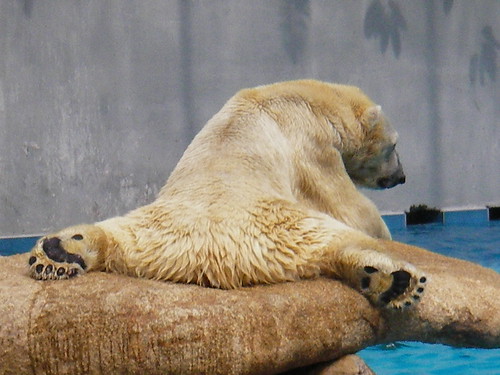
WRS Animal Welfare & Ethics Committee (AWEC) Recommendation for Polar Bear Inuka to stay in SingaporeThe Wildlife Reserves Singapore Animal Welfare & Ethics Committee recommends that Singapore-born polar bear Inuka should remain here and not be sent to an institution in a temperate country, upon the demise of his mother Sheba. This recommendation was made during the Committee’s meeting on 27 January 2007.
Following are the supporting arguments for this recommendation, which considers above all else, what is best for Inuka:
Inuka was born in Singapore and already acclimated to the conditions here.
The life span of both Inuka (16 years old) and his mother Sheba (30 years old) indicate that both polar bears are faring well in this environment.
Male polar bears are solitary by nature and associate with females only during the breeding season. Maintaining Inuka alone at the Singapore Zoo after his mother’s demise is not counter to what occurs naturally in the wild.
The transport of a full grown polar bear to an institution in a temperate country will be a stressful situation and carries its own share of risks; most extreme being that Inuka may die during transportation or during the introduction process in the new facility.
Depending on when Sheba passes on, Inuka may have only limited breeding potential because of his age, and if sent to a temperate institution, will probably not contribute to the captive breeding effort.
Moving Inuka to a temperate facility after losing his mother will add further stress, since he will be removed from an environment that he is already familiar with.
Inuka will continue to be the Singapore Zoo’s ambassador for the conservation and educational thrusts regarding climate change, throughout his whole life here.
The public is invited to give their feedback on the Committee’s recommendation.
The WRS Animal Welfare & Ethics Committee comprises:
Chairman
Following are the supporting arguments for this recommendation, which considers above all else, what is best for Inuka:
Inuka was born in Singapore and already acclimated to the conditions here.
The life span of both Inuka (16 years old) and his mother Sheba (30 years old) indicate that both polar bears are faring well in this environment.
Male polar bears are solitary by nature and associate with females only during the breeding season. Maintaining Inuka alone at the Singapore Zoo after his mother’s demise is not counter to what occurs naturally in the wild.
The transport of a full grown polar bear to an institution in a temperate country will be a stressful situation and carries its own share of risks; most extreme being that Inuka may die during transportation or during the introduction process in the new facility.
Depending on when Sheba passes on, Inuka may have only limited breeding potential because of his age, and if sent to a temperate institution, will probably not contribute to the captive breeding effort.
Moving Inuka to a temperate facility after losing his mother will add further stress, since he will be removed from an environment that he is already familiar with.
Inuka will continue to be the Singapore Zoo’s ambassador for the conservation and educational thrusts regarding climate change, throughout his whole life here.
The public is invited to give their feedback on the Committee’s recommendation.
The WRS Animal Welfare & Ethics Committee comprises:
Chairman
Thursday, July 12, 2007
Mr Wong Family at Zoo
http://wongfamily.wordpress.com/2007/07/01/family-trip-singapore-2007-part-iii
Thankfully the weather was clear but cool, so it was a good substitute for the Night Safari that we missed on Friday.
First off, it was lunch at the food court.
Then the Family went for a proper exploration of the Singapore Zoo.
The entrance itself immediately impressed upon us that this was going to be quite different from Zoo Negara – it was a plank walkway high off the ground with trees on the sides, conjuring an atmosphere of going on a jungle adventure!
By walking and taking the tram, we fully explored the Zoo, visiting Orang Utans, birds, big cats, dogs, reptiles, horses (Ama and May’s animal birth year), bears and all manner of animals that had the Kids in ecstasy.
Aba’s lime flavoured Popsicle with vanilla flavoured ice-cream filling (purchased from zoo vendor) helped cool down the Kids in between rest stops. (The Twins had been walking without the stroller the whole day!)
Finally, it was evening.
We took dinner at the KFC, before going to the Causeway, and back to Good Ol’ Malaysia!
Thankfully the weather was clear but cool, so it was a good substitute for the Night Safari that we missed on Friday.
First off, it was lunch at the food court.
Then the Family went for a proper exploration of the Singapore Zoo.
The entrance itself immediately impressed upon us that this was going to be quite different from Zoo Negara – it was a plank walkway high off the ground with trees on the sides, conjuring an atmosphere of going on a jungle adventure!
By walking and taking the tram, we fully explored the Zoo, visiting Orang Utans, birds, big cats, dogs, reptiles, horses (Ama and May’s animal birth year), bears and all manner of animals that had the Kids in ecstasy.
Aba’s lime flavoured Popsicle with vanilla flavoured ice-cream filling (purchased from zoo vendor) helped cool down the Kids in between rest stops. (The Twins had been walking without the stroller the whole day!)
Finally, it was evening.
We took dinner at the KFC, before going to the Causeway, and back to Good Ol’ Malaysia!
Tuesday, July 10, 2007
Wildlife officials rescue 950 monkeys from smugglers in southern Malaysia, detain 4
Malaysian authorities busted a wildlife smuggling ring, rescuing 950 monkeys believed bound for China and Holland and detaining four men including an Indonesian, an official said Tuesday.
Officials discovered the 950 long-tailed macaques starving and cramped in filthy cages in a raid on a farm in Johor state on Saturday following a two-week investigation, said Wildlife Department assistant director Celescoriano Razond.
"From our initial investigation, they were targeting to send the monkeys to restaurants in China and laboratories in Holland. We are still investigating," Celescoriano said.
The primates were in a pitiful condition, some were eating the carcasses of their young, and another 100 dead monkeys were piled up nearby, he said.
Celescoriano said he believed the macaques had been caught in Malaysian jungles and that they had been caged for at least a month.
"This is the biggest seizure of smuggled monkeys ever," he told The Associated Press, adding that the department has treated the monkeys and released them back into protested forest areas.
Celescoriano said three Malaysians, including one who is believed to be the ring leader, would be charged with unlawful possession and cruelty to wildlife, and that they could be jailed for up to three years or fined up to 6,000 ringgit (US$1,714; €1,428) each if convicted.
The Indonesian, who was a worker at the farm, has been handed over to the immigration department, he said. Immigration officials could not be reached for further details.
Malaysian authorities busted a wildlife smuggling ring, rescuing 950 monkeys believed bound for China and Holland and detaining four men including an Indonesian, an official said Tuesday.
Officials discovered the 950 long-tailed macaques starving and cramped in filthy cages in a raid on a farm in Johor state on Saturday following a two-week investigation, said Wildlife Department assistant director Celescoriano Razond.
"From our initial investigation, they were targeting to send the monkeys to restaurants in China and laboratories in Holland. We are still investigating," Celescoriano said.
The primates were in a pitiful condition, some were eating the carcasses of their young, and another 100 dead monkeys were piled up nearby, he said.
Celescoriano said he believed the macaques had been caught in Malaysian jungles and that they had been caged for at least a month.
"This is the biggest seizure of smuggled monkeys ever," he told The Associated Press, adding that the department has treated the monkeys and released them back into protested forest areas.
Celescoriano said three Malaysians, including one who is believed to be the ring leader, would be charged with unlawful possession and cruelty to wildlife, and that they could be jailed for up to three years or fined up to 6,000 ringgit (US$1,714; €1,428) each if convicted.
The Indonesian, who was a worker at the farm, has been handed over to the immigration department, he said. Immigration officials could not be reached for further details.
Sunday, July 01, 2007
NO GST Increase In FEEs
Open 365 days a year, the Singapore Zoo is a must-see destination on every visitor's attractions list. With the following useful information at hand, you can plan your day of fun and exploration with ease.
Opening hours
8.30am to 6.00pm daily
Entrance fees (admission only):
Adult S$15.00Child S$7.50
All prices include 7% GST
Parking charges:
Car/saloon S$3.90Lorry/Van S$4.90
Parking charges are per entry basis. No grace period.
(Electronic Parking System. Please insert your cashcard with sufficient funds into the vehicle's I/U unit when exiting the carpark.)
Tram & Train (unlimited rides for both weekdays & weekends):
The tram ride covers 2.2km with three stopovers.
Adult S$5.00Child (3-12 years old) S$2.50
Park Hoppers special (admissions only):
Zoo & Night Safari Adult S$30.00Child S$15.00
Zoo, Night Safari & BirdPark Adult S$40.00Child S$20.00
Opening hours
8.30am to 6.00pm daily
Entrance fees (admission only):
Adult S$15.00Child S$7.50
All prices include 7% GST
Parking charges:
Car/saloon S$3.90Lorry/Van S$4.90
Parking charges are per entry basis. No grace period.
(Electronic Parking System. Please insert your cashcard with sufficient funds into the vehicle's I/U unit when exiting the carpark.)
Tram & Train (unlimited rides for both weekdays & weekends):
The tram ride covers 2.2km with three stopovers.
Adult S$5.00Child (3-12 years old) S$2.50
Park Hoppers special (admissions only):
Zoo & Night Safari Adult S$30.00Child S$15.00
Zoo, Night Safari & BirdPark Adult S$40.00Child S$20.00
Friday, June 22, 2007
When an animal dies at a zoo, what do they do with the body?
Responsible zoos have the policy of doing a necropsy (autopsy) on every single animal that dies on site.
This includes a general health assessment as well as identificiation of the cause of death. Not only is there a physical examination, but samples of blood and tissues are sent off for routine testing, as well as testing that may be associated with the cause of death.
Where possible, the necropsy is also used as a teaching tool - vets and vet students will use this opportunity to learn more about that type of animal. For many exotic animals in zoos there may be limited information about their physiology.
For many species, especially those who are endangered, there may also be a collection of sperm or eggs from the animal, for storage or study. This can be done even after the animal has died, in the process of "gamete rescue". Quite a few North American zoos now have this capability, and if they don't they are able to courier the testes/ovaries to a facility that can perform the rescue.
DNA samples (usually hair or a small section of skin) are often taken from the animal as well, to be used in research or frozen away for possible future needs.
Finally, the animal will be disposed of as appropriate for the species. Generally cremation would happen, but some animals would have their skeletons or hides preserved, or in some rare cases they might even be stuffed - for teaching tool purposes. This would be done by the zoo or an associated museum or similar organisation. Extremely large species (like elephants) are usually buried somewhere on the zoo site, space permitting.
Responsible zoos have the policy of doing a necropsy (autopsy) on every single animal that dies on site.
This includes a general health assessment as well as identificiation of the cause of death. Not only is there a physical examination, but samples of blood and tissues are sent off for routine testing, as well as testing that may be associated with the cause of death.
Where possible, the necropsy is also used as a teaching tool - vets and vet students will use this opportunity to learn more about that type of animal. For many exotic animals in zoos there may be limited information about their physiology.
For many species, especially those who are endangered, there may also be a collection of sperm or eggs from the animal, for storage or study. This can be done even after the animal has died, in the process of "gamete rescue". Quite a few North American zoos now have this capability, and if they don't they are able to courier the testes/ovaries to a facility that can perform the rescue.
DNA samples (usually hair or a small section of skin) are often taken from the animal as well, to be used in research or frozen away for possible future needs.
Finally, the animal will be disposed of as appropriate for the species. Generally cremation would happen, but some animals would have their skeletons or hides preserved, or in some rare cases they might even be stuffed - for teaching tool purposes. This would be done by the zoo or an associated museum or similar organisation. Extremely large species (like elephants) are usually buried somewhere on the zoo site, space permitting.
Sunday, June 10, 2007
Animals Die with the Forest
INDONESIA'S tropical rainforests are disappearing 30 per cent faster than previously estimated as illegal loggers raid large national parks, threatening the long-term survival of orang utans, according to a United Nations report released on Monday.
The Indonesian authorities recently intercepted shipments totalling 70,000 cu m - about 3,000 truckloads - of illegal timber and arrested several people, but loggers were clearing an estimated 2.1 million ha of forest a year for timber worth US$4 billion (S$6 billion), said the report by the UN Environment Programme (UNEP).
Only about 7,000 Sumatran orang utans and about 50,000 Borneo orang utans now exist in the wild.
'The populations are crashing dramatically,' said Ms Melanie Virtue of UNEP's Great Apes Survival Project, which carried out the study.
The number of Sumatran orang utans has fallen 91 per cent in the last century, based on studies of the number of apes in today's dense forests, said Mr Ian Redmond, also of the Great Apes Survival Project.
It is not known how much the population of the Borneo orang utans has declined.
Orang utans fleeing overlogged areas have ended up in 'refugee camps' run by the UNEP project.
Indonesian rescue centres now have about 1,000 orang utans, and the illegal trade in young orang utans for private zoos and safari parks has increased to 'significant numbers', the report said, without specifying further.
Earlier forecasts have said Indonesia's natural rainforest would be seriously degraded by 2032.
But projections based on new satellite surveillance suggest that 98 per cent of lowland forest will be destroyed by 2022, and many protected areas will be gone within the next five years, said the report, called 'The Last Stand of the Orang Utan'.
Orang utans breed only once in seven years, meaning their numbers struggle to recover even without the loss of their habitat.
But the report said orang utans have shown they can survive selective logging. Evidence from Ketgambe and Gunung Leuser in Sumatra showed their numbers declined after large trees were extracted from the forest, but rebounded as the forest regenerated.
The report was released at the triennial meeting of the 171-nation Convention on International Trade in Endangered Species (Cites).
The 1975 Cites treaty prohibits all trade in orang utans except by special permit.
The report said illegal loggers were operating in 37 out of 41 Indonesian national parks. Further pressure came from plantation owners clearing forests for palm oil trees to meet the demand for biofuels.
The report estimates that up to 88 per cent of all Indonesian timber is logged illegally and usually shipped abroad after being processed into lumber in saw mills or used as pulp.
The Indonesian authorities recently intercepted shipments totalling 70,000 cu m - about 3,000 truckloads - of illegal timber and arrested several people, but loggers were clearing an estimated 2.1 million ha of forest a year for timber worth US$4 billion (S$6 billion), said the report by the UN Environment Programme (UNEP).
Only about 7,000 Sumatran orang utans and about 50,000 Borneo orang utans now exist in the wild.
'The populations are crashing dramatically,' said Ms Melanie Virtue of UNEP's Great Apes Survival Project, which carried out the study.
The number of Sumatran orang utans has fallen 91 per cent in the last century, based on studies of the number of apes in today's dense forests, said Mr Ian Redmond, also of the Great Apes Survival Project.
It is not known how much the population of the Borneo orang utans has declined.
Orang utans fleeing overlogged areas have ended up in 'refugee camps' run by the UNEP project.
Indonesian rescue centres now have about 1,000 orang utans, and the illegal trade in young orang utans for private zoos and safari parks has increased to 'significant numbers', the report said, without specifying further.
Earlier forecasts have said Indonesia's natural rainforest would be seriously degraded by 2032.
But projections based on new satellite surveillance suggest that 98 per cent of lowland forest will be destroyed by 2022, and many protected areas will be gone within the next five years, said the report, called 'The Last Stand of the Orang Utan'.
Orang utans breed only once in seven years, meaning their numbers struggle to recover even without the loss of their habitat.
But the report said orang utans have shown they can survive selective logging. Evidence from Ketgambe and Gunung Leuser in Sumatra showed their numbers declined after large trees were extracted from the forest, but rebounded as the forest regenerated.
The report was released at the triennial meeting of the 171-nation Convention on International Trade in Endangered Species (Cites).
The 1975 Cites treaty prohibits all trade in orang utans except by special permit.
The report said illegal loggers were operating in 37 out of 41 Indonesian national parks. Further pressure came from plantation owners clearing forests for palm oil trees to meet the demand for biofuels.
The report estimates that up to 88 per cent of all Indonesian timber is logged illegally and usually shipped abroad after being processed into lumber in saw mills or used as pulp.
Monday, June 04, 2007
First Released Panda Died in Wild
A five-year-old panda - who last year became the first to be released into the wild after being bred in captivity - has died, state media and Chinese nature reserve officials said yesterday.
The body of Xiang Xiang was found Feb. 19 on snow-covered ground in the forests of Sichuan province in China's southwest, the Xinhua News Agency said. He survived less than a year in the wild after nearly three years of training in survival techniques and defence tactics.
"Xiang Xiang died of serious internal injuries in the left side of his chest and stomach by falling from a high place," said Heng Yi, an official from the Wolong Giant Panda Research Centre in Sichuan. "The scratches and other minor injuries caused by other wild pandas were found on his body.
So Xiang Xiang may have fallen from trees when being chased by those pandas."Heng said the long delay in announcing Xiang Xiang's death was attributed to the need for a full investigation."We are all sad about Xiang Xiang, but it doesn't mean the project has failed," Zhang Hemin, the centre's head, was quoted as saying by Xinhua. "The lessons we have learned from what happened to Xiang Xiang will help us adapt and improve the project."
The nearly 80-kilogram male panda was released from Wolong in April 2006 and had been trained almost three years to survive in the wild. Xiang Xiang, whose name means auspicious, learned how to build a den, forage for food and mark his territory, experts at Wolong have said. He also developed defensive skills like howling and biting.
Li Desheng, deputy director of the Wolong centre, said Xiang Xiang's case proves that wild-panda communities are reluctant to accept male outsiders."We chose Xiang Xiang because we thought that a strong male panda would have a better chance of surviving in the harsh natural environment," Li was quoted as saying. "But the other male pandas clearly saw Xiang Xiang as a threat.
Next time we will choose a female panda."State media last year said that Xiang Xiang hesitated for a second when the door of his cage was opened, then scampered off into a nearby bamboo forest where he was tracked by a global positioning device attached to his collar.
He has been buried at the foot of a mountain, about 13 kilometres from the Wolong centre, Li said.
The body of Xiang Xiang was found Feb. 19 on snow-covered ground in the forests of Sichuan province in China's southwest, the Xinhua News Agency said. He survived less than a year in the wild after nearly three years of training in survival techniques and defence tactics.
"Xiang Xiang died of serious internal injuries in the left side of his chest and stomach by falling from a high place," said Heng Yi, an official from the Wolong Giant Panda Research Centre in Sichuan. "The scratches and other minor injuries caused by other wild pandas were found on his body.
So Xiang Xiang may have fallen from trees when being chased by those pandas."Heng said the long delay in announcing Xiang Xiang's death was attributed to the need for a full investigation."We are all sad about Xiang Xiang, but it doesn't mean the project has failed," Zhang Hemin, the centre's head, was quoted as saying by Xinhua. "The lessons we have learned from what happened to Xiang Xiang will help us adapt and improve the project."
The nearly 80-kilogram male panda was released from Wolong in April 2006 and had been trained almost three years to survive in the wild. Xiang Xiang, whose name means auspicious, learned how to build a den, forage for food and mark his territory, experts at Wolong have said. He also developed defensive skills like howling and biting.
Li Desheng, deputy director of the Wolong centre, said Xiang Xiang's case proves that wild-panda communities are reluctant to accept male outsiders."We chose Xiang Xiang because we thought that a strong male panda would have a better chance of surviving in the harsh natural environment," Li was quoted as saying. "But the other male pandas clearly saw Xiang Xiang as a threat.
Next time we will choose a female panda."State media last year said that Xiang Xiang hesitated for a second when the door of his cage was opened, then scampered off into a nearby bamboo forest where he was tracked by a global positioning device attached to his collar.
He has been buried at the foot of a mountain, about 13 kilometres from the Wolong centre, Li said.
Friday, June 01, 2007

Wednesday, May 23, 2007
Zoo: When animal attack 4
An orangutan escaped from a Taiwanese zoo and terrified patrons at a nearby restaurant Wednesday, overturning picnic tables and motorbikes and forcing terrified diners to cower inside the eatery.
The orangutan, who pushed his way out of his cage before wandering into the restaurant, was subdued when an official shot him with a tranquilizer dart. He was carted off for treatment in the scoop of a small bulldozer.
Wednesday's incident occurred six weeks after a 440-pound crocodile chewed the forearm off a veterinarian at the same zoo. The vet's limb was reattached in a seven-hour surgery.
Orangutans are native to the forests of Malaysia and Indonesia. They have a shaggy, reddish-brown coat, long arms and no tail.
The orangutan, who pushed his way out of his cage before wandering into the restaurant, was subdued when an official shot him with a tranquilizer dart. He was carted off for treatment in the scoop of a small bulldozer.
Wednesday's incident occurred six weeks after a 440-pound crocodile chewed the forearm off a veterinarian at the same zoo. The vet's limb was reattached in a seven-hour surgery.
Orangutans are native to the forests of Malaysia and Indonesia. They have a shaggy, reddish-brown coat, long arms and no tail.
Monday, May 21, 2007
Zoo: when animals attack 3
A 57-year-old Dutch woman who was attacked by a gorilla at a Rotterdam zoo said the ape was still her favorite even though she felt she was going to die when he bit her.
"I go to the zoo almost every day with my husband, and we're always going to see Bokito. I even have pictures and videos from Berlin when he was only four months old," the woman told Dutch mass-circulation daily Telegraaf.
"He is and remains my darling," the paper quoted the woman as saying from her hospital bed, where she is being treated for bite wounds and a broken arm and wrist. The 11-year old male gorilla burst out of its enclosure on Friday and went on a rampage in the zoo's cafeteria before being recaptured.
"I stood by the small apes in the Africa section when I heard a thud behind me. I turned around and there was Bokito. I had nowhere to go. He gripped me, sat on me with his full weight and began biting me," the woman told the Telegraaf.
"I could only think 'O God, I'm going to die, I'm going to die'."
The Telegraaf said people had since come from across the country to Rotterdam Zoo to see the gorilla.
"I go to the zoo almost every day with my husband, and we're always going to see Bokito. I even have pictures and videos from Berlin when he was only four months old," the woman told Dutch mass-circulation daily Telegraaf.
"He is and remains my darling," the paper quoted the woman as saying from her hospital bed, where she is being treated for bite wounds and a broken arm and wrist. The 11-year old male gorilla burst out of its enclosure on Friday and went on a rampage in the zoo's cafeteria before being recaptured.
"I stood by the small apes in the Africa section when I heard a thud behind me. I turned around and there was Bokito. I had nowhere to go. He gripped me, sat on me with his full weight and began biting me," the woman told the Telegraaf.
"I could only think 'O God, I'm going to die, I'm going to die'."
The Telegraaf said people had since come from across the country to Rotterdam Zoo to see the gorilla.
Friday, May 18, 2007
TCM Singapore Zoo
Acupuncture for a limping elephant? Herbal tea for a constipated orangutan? The Singapore Zoo has tried it all, and it works.
Around 200 animals, including giraffes, elephants, horses, pythons and sea lions, have successfully been treated with acupuncture and traditional herb-based Chinese medicine in the past decade, although Western medicine remains the first line of treatment in the zoo.
"The Western medicine did not always work, so we had to find other solutions," Oh Soon Hock, a senior veterinarian at the zoo told Reuters on Friday.
Earlier this week the zoo received a S$30,000 ($19,700) grant for further research into traditional Chinese medicine (TCM) for animals from a Singapore-based firm that produces TCM.
Oh -- who was trained in Western veterinarian medicine but also studied Chinese medicine -- said this sort of healing is typically used after Western medicine fails to produce results.
He said an orangutan who had received modern medication for constipation for more than a year recovered after drinking an ancient Chinese brew of herbs, ground and dissolved in its honey drink, for just one week.
The zoo has also used acupuncture to reduce the swelling around the fractured leg of a sedated cheetah.
Treating an elephant with acupuncture requires some industrial-size needles to pierce its 2.5 centimeter (one inch) thick hide and sometimes through 15 centimeters of muscles.
The custom-made stainless steel needles are 15 to 20 cm long and 0.6 mm (0.024 inch) thick, Oh said.
"We use stainless steel needles because they bend but won't break," Oh said, adding that the needles need to pierce through the hide and muscles to get close to the bones for the treatment to be most effective.
Acupuncture, an ancient Chinese treatment, stimulates blood circulation by sticking needles at specific points of the body through which the body's energy flows.
According to Chinese medicine, the blood carries "qi", or body energy, that flows along pathways through the body. Acupuncture stimulates the blood by stimulating the "qi".
Around 200 animals, including giraffes, elephants, horses, pythons and sea lions, have successfully been treated with acupuncture and traditional herb-based Chinese medicine in the past decade, although Western medicine remains the first line of treatment in the zoo.
"The Western medicine did not always work, so we had to find other solutions," Oh Soon Hock, a senior veterinarian at the zoo told Reuters on Friday.
Earlier this week the zoo received a S$30,000 ($19,700) grant for further research into traditional Chinese medicine (TCM) for animals from a Singapore-based firm that produces TCM.
Oh -- who was trained in Western veterinarian medicine but also studied Chinese medicine -- said this sort of healing is typically used after Western medicine fails to produce results.
He said an orangutan who had received modern medication for constipation for more than a year recovered after drinking an ancient Chinese brew of herbs, ground and dissolved in its honey drink, for just one week.
The zoo has also used acupuncture to reduce the swelling around the fractured leg of a sedated cheetah.
Treating an elephant with acupuncture requires some industrial-size needles to pierce its 2.5 centimeter (one inch) thick hide and sometimes through 15 centimeters of muscles.
The custom-made stainless steel needles are 15 to 20 cm long and 0.6 mm (0.024 inch) thick, Oh said.
"We use stainless steel needles because they bend but won't break," Oh said, adding that the needles need to pierce through the hide and muscles to get close to the bones for the treatment to be most effective.
Acupuncture, an ancient Chinese treatment, stimulates blood circulation by sticking needles at specific points of the body through which the body's energy flows.
According to Chinese medicine, the blood carries "qi", or body energy, that flows along pathways through the body. Acupuncture stimulates the blood by stimulating the "qi".
Thursday, April 12, 2007
Zoo: When Animals Attack 2
A zoo worker had his forearm reattached Thursday after his colleagues recovered the severed limb from the mouth of a 440-pound Nile crocodile, an official said.
The crocodile severed Chang Po-yu's forearm on Wednesday at the Shaoshan Zoo in the southern city of Kaohsiung when the veterinarian tried to retrieve a tranquilizer dart from the reptile's hide, zoo officials said.
The Liberty Times newspaper said Chang failed to notice the crocodile was not fully anesthetized when he stuck his arm through an iron rail to medicate it.
As Chang was rushed to the hospital on Wednesday, a zoo worker shot two bullets at the crocodile's neck to retrieve the forearm, said Chen Po-tsun, a zoo official.
"The crocodile was unharmed as we didn't find any bullet holes on its hide," Chen said. "It probably was shocked and opened its mouth to let go of the limb."
The 17-year-old reptile is one of a pair of Nile crocodiles kept by the Kaohsiung zoo. The crocodile is listed as an endangered species, and is rapidly disappearing from its native African habitat.
Chen said the zoo purchased the crocodile from a local resident who had kept it as a pet.
The crocodile severed Chang Po-yu's forearm on Wednesday at the Shaoshan Zoo in the southern city of Kaohsiung when the veterinarian tried to retrieve a tranquilizer dart from the reptile's hide, zoo officials said.
The Liberty Times newspaper said Chang failed to notice the crocodile was not fully anesthetized when he stuck his arm through an iron rail to medicate it.
As Chang was rushed to the hospital on Wednesday, a zoo worker shot two bullets at the crocodile's neck to retrieve the forearm, said Chen Po-tsun, a zoo official.
"The crocodile was unharmed as we didn't find any bullet holes on its hide," Chen said. "It probably was shocked and opened its mouth to let go of the limb."
The 17-year-old reptile is one of a pair of Nile crocodiles kept by the Kaohsiung zoo. The crocodile is listed as an endangered species, and is rapidly disappearing from its native African habitat.
Chen said the zoo purchased the crocodile from a local resident who had kept it as a pet.
Friday, March 02, 2007
Singapore Zoo and Night Safari
One of the most often recommended things to do in Singapore is the Zoo and specifically the “Nght Safari”. To be sure not to miss anything, we did both ($22US) and we decided that both is too much. Our recommendation is to do one of the two - you’ll see more animals at the Zoo during the day and it has very impressive collection – from White Bengal Tigers to Manatees to Pygmy Hippos to Black Spitting Cobras.
After a long day of animal watching, the night safari was interesting but more about event production than the animals from our perspective. It includes a “night show” complete with campy humor, a tram ride (done in a dramatic whisper so as not to bother the nocturnal animals) and expensive food and drinks. But, you aren’t melting in the Singapore sun and it is quite entertaining.
Friday, February 23, 2007
Zoo: When Animals Attack
A crocodile attacked a zookeeper at Singapore's zoo, puncturing the 37-year-old's leg in seven places and leaving a tooth stuck in his calf -- the third incident of animals gone amok at the zoo in the year 2005.
The zookeeper was cleaning the crocodile's den when a 1.7 metre (5 ft 7 in) crocodile suddenly charged and bit him, the zoo said on Thursday in a brief statement on the April 10 incident. "When the crocodile bit me, all I could think of was to get my left leg out of the crocodile's mouth," zookeeper Jamaludin Abdul Wahid told The New Paper, an English daily.
On Sunday, a female jaguar escaped from its enclosure before being sedated and captured about an hour later. On Monday, a one metre (3 ft) wild African cat leapt off a stage during a performance and clawed a tourist's foot, causing an infection.
Zoo officials said measures are being taken to ensure the safety of its keepers and visitors.
The zookeeper was cleaning the crocodile's den when a 1.7 metre (5 ft 7 in) crocodile suddenly charged and bit him, the zoo said on Thursday in a brief statement on the April 10 incident. "When the crocodile bit me, all I could think of was to get my left leg out of the crocodile's mouth," zookeeper Jamaludin Abdul Wahid told The New Paper, an English daily.
On Sunday, a female jaguar escaped from its enclosure before being sedated and captured about an hour later. On Monday, a one metre (3 ft) wild African cat leapt off a stage during a performance and clawed a tourist's foot, causing an infection.
Zoo officials said measures are being taken to ensure the safety of its keepers and visitors.
Tuesday, February 20, 2007
Pools for Our Polar...
http://www.zoo.com.sg/whatsnew/PublicPoll_Inuka/index.html
Do your part, pls.
I am in favour of Inuka leaving for a temperate zoo.
1303 (32.74%)
I am NOT in favour of Inuka leaving for a temperate zoo.
2642 (63.90%)
I have no opinion on whether Inuka remains in the Singapore Zoo or gets transferred to a temperate zoo.
144 (3.36%)
Total Poll
4089
Do your part, pls.
I am in favour of Inuka leaving for a temperate zoo.
1303 (32.74%)
I am NOT in favour of Inuka leaving for a temperate zoo.
2642 (63.90%)
I have no opinion on whether Inuka remains in the Singapore Zoo or gets transferred to a temperate zoo.
144 (3.36%)
Total Poll
4089
Thursday, February 01, 2007
GOOD Reviews
1. If you are single, married, or a fmaily group, you should take the time out to go see this zoo! I loved the whole experience and the animals all look happy and well cared for :)
2. I love this place! staff are friendly! It is very clean! the animals are very fun! Everyone will enjoy it, its a very relaxing place.
3. A good place to bring the kids. I would like to suggest that you join as a member if you have young kids and go there at least 3 times a year and you could save a lot. You need not stay too long to actually see all the attraction there at one visit but go there again some other time if you are already a member. Many interesting animals for the kids to see.
4. This is the place to go. It is the BEST ZOO IN THE WORLD. The animals are not in cages, but instead they are in huge, spacious areas with a river or ditch seperating them from us. The enclosures are made to be exactly like the animals natural habitats, and they have done an excellent job at it. The animals are happy and the are places in the zoo where you can touch the animals. Like the goats. At the elephant show, pay only $5.00 and you can feed the elephants a basket of fruit.I HIGHLY recommend this zoo to anyone, whether they are an animal lover or not because this zoo has something for everyone.
5. My previous visit to the Singapore Zoo was about 20 years ago. And I must say that they have done a marvelous job of updating this zoo. Lots of trees and shades, so even if you don't take the tram ride, you can still manage to walk around the whole zoo. We did get the all-day tram ride, which I don't think is quite worth it (since there's only 4 stops, and the zoo is small enough to walk all the way around). Good scenery, surrounded by the Seletar Reservoir. Pretty good variety of animals for a somewhat small zoo, especially primates. Good clean stalls for animals. Good walking paths, easy for baby strollers. Location is abit out of the way from downtown city-centre, though easily accessible by transit. We took the MRT from City Hall station to Khatib station (closest MRT station to the zoo, S$1.50 per person), then a taxi to the zoo (S$8 for ride), which took us about 45min from city-centre (which apparently would cost over S$20 for taxi ride). Cost for entrance is S$15 for adults, with S$5 extra for tram ride. Overall good experience, certainly worth the time and money.
6. The Singapore Zoo beats all zoo's hands down. This place is amazing to see and is huge. It took my wife and I about 6.5 hours to walk every inch of this place, I recommend doing the night safari to those who cant take the heat though.I cant think of any animal that they do not have on display, including most birds, reptiles and rodents.If you want to have one of the greatest experiences you can have and have a day to spend, then I suggest you check out the Singapore Zoo.Its easily accessable from Bus and Taxi.
7. Amazing! This place beats out any zoo you've ever seen before because it's set in the natural rainforest. This means all the tropical animals- monkeys, etc- are in their natural habitat. There are no cages separating you. None of the animals are locked up in steel cages. When I was there a monkey came right up to me and I could touch him and play with him. They would cross the path in front of us, or climb the branches above us and surprise us. You feel like you are in the middle of a wild jungle because, well, you are. The more dangerous animals, like lions, are set off by ditches and things so they can't hurt you.
8. The Singapore Zoo is enormous, and it is practically impossible to see absolutely everything in a single visit. The zoo is set alongside a reservoir in some of Singapore's only remaining natural rainforest.You have the choice of walking the park by yourself, or taking one of the trams aruond the park. For the more athletic, I highly recommend walking the park, as there is a lot to see.Since Singapore's climate is so hot and humid, the zoo has small "air conditioning shelters" scattered throughout the park, for visitors to cool down and get a cool drink from a vending machine. It's touches like this that make the Singapore Zoo so worthwhile to visit.If you are planning a visit to the Singapore Zoo with several people, I do not recommend booking with a tour company. It is much cheaper (with several people) to take a taxi to and from the Zoo, and buy your entry ticket at the gate. Also, if you are planning on visiting the (in my opinion, superior) Night Safari next door during your visit to Singapore, you can buy joint Zoo and Night Safari tickets from either place, and save some money. The tickets do not have to be used on the same day.
2. I love this place! staff are friendly! It is very clean! the animals are very fun! Everyone will enjoy it, its a very relaxing place.
3. A good place to bring the kids. I would like to suggest that you join as a member if you have young kids and go there at least 3 times a year and you could save a lot. You need not stay too long to actually see all the attraction there at one visit but go there again some other time if you are already a member. Many interesting animals for the kids to see.
4. This is the place to go. It is the BEST ZOO IN THE WORLD. The animals are not in cages, but instead they are in huge, spacious areas with a river or ditch seperating them from us. The enclosures are made to be exactly like the animals natural habitats, and they have done an excellent job at it. The animals are happy and the are places in the zoo where you can touch the animals. Like the goats. At the elephant show, pay only $5.00 and you can feed the elephants a basket of fruit.I HIGHLY recommend this zoo to anyone, whether they are an animal lover or not because this zoo has something for everyone.
5. My previous visit to the Singapore Zoo was about 20 years ago. And I must say that they have done a marvelous job of updating this zoo. Lots of trees and shades, so even if you don't take the tram ride, you can still manage to walk around the whole zoo. We did get the all-day tram ride, which I don't think is quite worth it (since there's only 4 stops, and the zoo is small enough to walk all the way around). Good scenery, surrounded by the Seletar Reservoir. Pretty good variety of animals for a somewhat small zoo, especially primates. Good clean stalls for animals. Good walking paths, easy for baby strollers. Location is abit out of the way from downtown city-centre, though easily accessible by transit. We took the MRT from City Hall station to Khatib station (closest MRT station to the zoo, S$1.50 per person), then a taxi to the zoo (S$8 for ride), which took us about 45min from city-centre (which apparently would cost over S$20 for taxi ride). Cost for entrance is S$15 for adults, with S$5 extra for tram ride. Overall good experience, certainly worth the time and money.
6. The Singapore Zoo beats all zoo's hands down. This place is amazing to see and is huge. It took my wife and I about 6.5 hours to walk every inch of this place, I recommend doing the night safari to those who cant take the heat though.I cant think of any animal that they do not have on display, including most birds, reptiles and rodents.If you want to have one of the greatest experiences you can have and have a day to spend, then I suggest you check out the Singapore Zoo.Its easily accessable from Bus and Taxi.
7. Amazing! This place beats out any zoo you've ever seen before because it's set in the natural rainforest. This means all the tropical animals- monkeys, etc- are in their natural habitat. There are no cages separating you. None of the animals are locked up in steel cages. When I was there a monkey came right up to me and I could touch him and play with him. They would cross the path in front of us, or climb the branches above us and surprise us. You feel like you are in the middle of a wild jungle because, well, you are. The more dangerous animals, like lions, are set off by ditches and things so they can't hurt you.
8. The Singapore Zoo is enormous, and it is practically impossible to see absolutely everything in a single visit. The zoo is set alongside a reservoir in some of Singapore's only remaining natural rainforest.You have the choice of walking the park by yourself, or taking one of the trams aruond the park. For the more athletic, I highly recommend walking the park, as there is a lot to see.Since Singapore's climate is so hot and humid, the zoo has small "air conditioning shelters" scattered throughout the park, for visitors to cool down and get a cool drink from a vending machine. It's touches like this that make the Singapore Zoo so worthwhile to visit.If you are planning a visit to the Singapore Zoo with several people, I do not recommend booking with a tour company. It is much cheaper (with several people) to take a taxi to and from the Zoo, and buy your entry ticket at the gate. Also, if you are planning on visiting the (in my opinion, superior) Night Safari next door during your visit to Singapore, you can buy joint Zoo and Night Safari tickets from either place, and save some money. The tickets do not have to be used on the same day.
Subscribe to:
Posts (Atom)