When an animal dies at a zoo, what do they do with the body?
Responsible zoos have the policy of doing a necropsy (autopsy) on every single animal that dies on site.
This includes a general health assessment as well as identificiation of the cause of death. Not only is there a physical examination, but samples of blood and tissues are sent off for routine testing, as well as testing that may be associated with the cause of death.
Where possible, the necropsy is also used as a teaching tool - vets and vet students will use this opportunity to learn more about that type of animal. For many exotic animals in zoos there may be limited information about their physiology.
For many species, especially those who are endangered, there may also be a collection of sperm or eggs from the animal, for storage or study. This can be done even after the animal has died, in the process of "gamete rescue". Quite a few North American zoos now have this capability, and if they don't they are able to courier the testes/ovaries to a facility that can perform the rescue.
DNA samples (usually hair or a small section of skin) are often taken from the animal as well, to be used in research or frozen away for possible future needs.
Finally, the animal will be disposed of as appropriate for the species. Generally cremation would happen, but some animals would have their skeletons or hides preserved, or in some rare cases they might even be stuffed - for teaching tool purposes. This would be done by the zoo or an associated museum or similar organisation. Extremely large species (like elephants) are usually buried somewhere on the zoo site, space permitting.
Friday, June 22, 2007

Sunday, June 10, 2007
Animals Die with the Forest
INDONESIA'S tropical rainforests are disappearing 30 per cent faster than previously estimated as illegal loggers raid large national parks, threatening the long-term survival of orang utans, according to a United Nations report released on Monday.
The Indonesian authorities recently intercepted shipments totalling 70,000 cu m - about 3,000 truckloads - of illegal timber and arrested several people, but loggers were clearing an estimated 2.1 million ha of forest a year for timber worth US$4 billion (S$6 billion), said the report by the UN Environment Programme (UNEP).
Only about 7,000 Sumatran orang utans and about 50,000 Borneo orang utans now exist in the wild.
'The populations are crashing dramatically,' said Ms Melanie Virtue of UNEP's Great Apes Survival Project, which carried out the study.
The number of Sumatran orang utans has fallen 91 per cent in the last century, based on studies of the number of apes in today's dense forests, said Mr Ian Redmond, also of the Great Apes Survival Project.
It is not known how much the population of the Borneo orang utans has declined.
Orang utans fleeing overlogged areas have ended up in 'refugee camps' run by the UNEP project.
Indonesian rescue centres now have about 1,000 orang utans, and the illegal trade in young orang utans for private zoos and safari parks has increased to 'significant numbers', the report said, without specifying further.
Earlier forecasts have said Indonesia's natural rainforest would be seriously degraded by 2032.
But projections based on new satellite surveillance suggest that 98 per cent of lowland forest will be destroyed by 2022, and many protected areas will be gone within the next five years, said the report, called 'The Last Stand of the Orang Utan'.
Orang utans breed only once in seven years, meaning their numbers struggle to recover even without the loss of their habitat.
But the report said orang utans have shown they can survive selective logging. Evidence from Ketgambe and Gunung Leuser in Sumatra showed their numbers declined after large trees were extracted from the forest, but rebounded as the forest regenerated.
The report was released at the triennial meeting of the 171-nation Convention on International Trade in Endangered Species (Cites).
The 1975 Cites treaty prohibits all trade in orang utans except by special permit.
The report said illegal loggers were operating in 37 out of 41 Indonesian national parks. Further pressure came from plantation owners clearing forests for palm oil trees to meet the demand for biofuels.
The report estimates that up to 88 per cent of all Indonesian timber is logged illegally and usually shipped abroad after being processed into lumber in saw mills or used as pulp.
The Indonesian authorities recently intercepted shipments totalling 70,000 cu m - about 3,000 truckloads - of illegal timber and arrested several people, but loggers were clearing an estimated 2.1 million ha of forest a year for timber worth US$4 billion (S$6 billion), said the report by the UN Environment Programme (UNEP).
Only about 7,000 Sumatran orang utans and about 50,000 Borneo orang utans now exist in the wild.
'The populations are crashing dramatically,' said Ms Melanie Virtue of UNEP's Great Apes Survival Project, which carried out the study.
The number of Sumatran orang utans has fallen 91 per cent in the last century, based on studies of the number of apes in today's dense forests, said Mr Ian Redmond, also of the Great Apes Survival Project.
It is not known how much the population of the Borneo orang utans has declined.
Orang utans fleeing overlogged areas have ended up in 'refugee camps' run by the UNEP project.
Indonesian rescue centres now have about 1,000 orang utans, and the illegal trade in young orang utans for private zoos and safari parks has increased to 'significant numbers', the report said, without specifying further.
Earlier forecasts have said Indonesia's natural rainforest would be seriously degraded by 2032.
But projections based on new satellite surveillance suggest that 98 per cent of lowland forest will be destroyed by 2022, and many protected areas will be gone within the next five years, said the report, called 'The Last Stand of the Orang Utan'.
Orang utans breed only once in seven years, meaning their numbers struggle to recover even without the loss of their habitat.
But the report said orang utans have shown they can survive selective logging. Evidence from Ketgambe and Gunung Leuser in Sumatra showed their numbers declined after large trees were extracted from the forest, but rebounded as the forest regenerated.
The report was released at the triennial meeting of the 171-nation Convention on International Trade in Endangered Species (Cites).
The 1975 Cites treaty prohibits all trade in orang utans except by special permit.
The report said illegal loggers were operating in 37 out of 41 Indonesian national parks. Further pressure came from plantation owners clearing forests for palm oil trees to meet the demand for biofuels.
The report estimates that up to 88 per cent of all Indonesian timber is logged illegally and usually shipped abroad after being processed into lumber in saw mills or used as pulp.
Monday, June 04, 2007
First Released Panda Died in Wild
A five-year-old panda - who last year became the first to be released into the wild after being bred in captivity - has died, state media and Chinese nature reserve officials said yesterday.
The body of Xiang Xiang was found Feb. 19 on snow-covered ground in the forests of Sichuan province in China's southwest, the Xinhua News Agency said. He survived less than a year in the wild after nearly three years of training in survival techniques and defence tactics.
"Xiang Xiang died of serious internal injuries in the left side of his chest and stomach by falling from a high place," said Heng Yi, an official from the Wolong Giant Panda Research Centre in Sichuan. "The scratches and other minor injuries caused by other wild pandas were found on his body.
So Xiang Xiang may have fallen from trees when being chased by those pandas."Heng said the long delay in announcing Xiang Xiang's death was attributed to the need for a full investigation."We are all sad about Xiang Xiang, but it doesn't mean the project has failed," Zhang Hemin, the centre's head, was quoted as saying by Xinhua. "The lessons we have learned from what happened to Xiang Xiang will help us adapt and improve the project."
The nearly 80-kilogram male panda was released from Wolong in April 2006 and had been trained almost three years to survive in the wild. Xiang Xiang, whose name means auspicious, learned how to build a den, forage for food and mark his territory, experts at Wolong have said. He also developed defensive skills like howling and biting.
Li Desheng, deputy director of the Wolong centre, said Xiang Xiang's case proves that wild-panda communities are reluctant to accept male outsiders."We chose Xiang Xiang because we thought that a strong male panda would have a better chance of surviving in the harsh natural environment," Li was quoted as saying. "But the other male pandas clearly saw Xiang Xiang as a threat.
Next time we will choose a female panda."State media last year said that Xiang Xiang hesitated for a second when the door of his cage was opened, then scampered off into a nearby bamboo forest where he was tracked by a global positioning device attached to his collar.
He has been buried at the foot of a mountain, about 13 kilometres from the Wolong centre, Li said.
The body of Xiang Xiang was found Feb. 19 on snow-covered ground in the forests of Sichuan province in China's southwest, the Xinhua News Agency said. He survived less than a year in the wild after nearly three years of training in survival techniques and defence tactics.
"Xiang Xiang died of serious internal injuries in the left side of his chest and stomach by falling from a high place," said Heng Yi, an official from the Wolong Giant Panda Research Centre in Sichuan. "The scratches and other minor injuries caused by other wild pandas were found on his body.
So Xiang Xiang may have fallen from trees when being chased by those pandas."Heng said the long delay in announcing Xiang Xiang's death was attributed to the need for a full investigation."We are all sad about Xiang Xiang, but it doesn't mean the project has failed," Zhang Hemin, the centre's head, was quoted as saying by Xinhua. "The lessons we have learned from what happened to Xiang Xiang will help us adapt and improve the project."
The nearly 80-kilogram male panda was released from Wolong in April 2006 and had been trained almost three years to survive in the wild. Xiang Xiang, whose name means auspicious, learned how to build a den, forage for food and mark his territory, experts at Wolong have said. He also developed defensive skills like howling and biting.
Li Desheng, deputy director of the Wolong centre, said Xiang Xiang's case proves that wild-panda communities are reluctant to accept male outsiders."We chose Xiang Xiang because we thought that a strong male panda would have a better chance of surviving in the harsh natural environment," Li was quoted as saying. "But the other male pandas clearly saw Xiang Xiang as a threat.
Next time we will choose a female panda."State media last year said that Xiang Xiang hesitated for a second when the door of his cage was opened, then scampered off into a nearby bamboo forest where he was tracked by a global positioning device attached to his collar.
He has been buried at the foot of a mountain, about 13 kilometres from the Wolong centre, Li said.
Friday, June 01, 2007

Wednesday, May 23, 2007
Zoo: When animal attack 4
An orangutan escaped from a Taiwanese zoo and terrified patrons at a nearby restaurant Wednesday, overturning picnic tables and motorbikes and forcing terrified diners to cower inside the eatery.
The orangutan, who pushed his way out of his cage before wandering into the restaurant, was subdued when an official shot him with a tranquilizer dart. He was carted off for treatment in the scoop of a small bulldozer.
Wednesday's incident occurred six weeks after a 440-pound crocodile chewed the forearm off a veterinarian at the same zoo. The vet's limb was reattached in a seven-hour surgery.
Orangutans are native to the forests of Malaysia and Indonesia. They have a shaggy, reddish-brown coat, long arms and no tail.
The orangutan, who pushed his way out of his cage before wandering into the restaurant, was subdued when an official shot him with a tranquilizer dart. He was carted off for treatment in the scoop of a small bulldozer.
Wednesday's incident occurred six weeks after a 440-pound crocodile chewed the forearm off a veterinarian at the same zoo. The vet's limb was reattached in a seven-hour surgery.
Orangutans are native to the forests of Malaysia and Indonesia. They have a shaggy, reddish-brown coat, long arms and no tail.
Monday, May 21, 2007
Zoo: when animals attack 3
A 57-year-old Dutch woman who was attacked by a gorilla at a Rotterdam zoo said the ape was still her favorite even though she felt she was going to die when he bit her.
"I go to the zoo almost every day with my husband, and we're always going to see Bokito. I even have pictures and videos from Berlin when he was only four months old," the woman told Dutch mass-circulation daily Telegraaf.
"He is and remains my darling," the paper quoted the woman as saying from her hospital bed, where she is being treated for bite wounds and a broken arm and wrist. The 11-year old male gorilla burst out of its enclosure on Friday and went on a rampage in the zoo's cafeteria before being recaptured.
"I stood by the small apes in the Africa section when I heard a thud behind me. I turned around and there was Bokito. I had nowhere to go. He gripped me, sat on me with his full weight and began biting me," the woman told the Telegraaf.
"I could only think 'O God, I'm going to die, I'm going to die'."
The Telegraaf said people had since come from across the country to Rotterdam Zoo to see the gorilla.
"I go to the zoo almost every day with my husband, and we're always going to see Bokito. I even have pictures and videos from Berlin when he was only four months old," the woman told Dutch mass-circulation daily Telegraaf.
"He is and remains my darling," the paper quoted the woman as saying from her hospital bed, where she is being treated for bite wounds and a broken arm and wrist. The 11-year old male gorilla burst out of its enclosure on Friday and went on a rampage in the zoo's cafeteria before being recaptured.
"I stood by the small apes in the Africa section when I heard a thud behind me. I turned around and there was Bokito. I had nowhere to go. He gripped me, sat on me with his full weight and began biting me," the woman told the Telegraaf.
"I could only think 'O God, I'm going to die, I'm going to die'."
The Telegraaf said people had since come from across the country to Rotterdam Zoo to see the gorilla.
Friday, May 18, 2007
TCM Singapore Zoo
Acupuncture for a limping elephant? Herbal tea for a constipated orangutan? The Singapore Zoo has tried it all, and it works.
Around 200 animals, including giraffes, elephants, horses, pythons and sea lions, have successfully been treated with acupuncture and traditional herb-based Chinese medicine in the past decade, although Western medicine remains the first line of treatment in the zoo.
"The Western medicine did not always work, so we had to find other solutions," Oh Soon Hock, a senior veterinarian at the zoo told Reuters on Friday.
Earlier this week the zoo received a S$30,000 ($19,700) grant for further research into traditional Chinese medicine (TCM) for animals from a Singapore-based firm that produces TCM.
Oh -- who was trained in Western veterinarian medicine but also studied Chinese medicine -- said this sort of healing is typically used after Western medicine fails to produce results.
He said an orangutan who had received modern medication for constipation for more than a year recovered after drinking an ancient Chinese brew of herbs, ground and dissolved in its honey drink, for just one week.
The zoo has also used acupuncture to reduce the swelling around the fractured leg of a sedated cheetah.
Treating an elephant with acupuncture requires some industrial-size needles to pierce its 2.5 centimeter (one inch) thick hide and sometimes through 15 centimeters of muscles.
The custom-made stainless steel needles are 15 to 20 cm long and 0.6 mm (0.024 inch) thick, Oh said.
"We use stainless steel needles because they bend but won't break," Oh said, adding that the needles need to pierce through the hide and muscles to get close to the bones for the treatment to be most effective.
Acupuncture, an ancient Chinese treatment, stimulates blood circulation by sticking needles at specific points of the body through which the body's energy flows.
According to Chinese medicine, the blood carries "qi", or body energy, that flows along pathways through the body. Acupuncture stimulates the blood by stimulating the "qi".
Around 200 animals, including giraffes, elephants, horses, pythons and sea lions, have successfully been treated with acupuncture and traditional herb-based Chinese medicine in the past decade, although Western medicine remains the first line of treatment in the zoo.
"The Western medicine did not always work, so we had to find other solutions," Oh Soon Hock, a senior veterinarian at the zoo told Reuters on Friday.
Earlier this week the zoo received a S$30,000 ($19,700) grant for further research into traditional Chinese medicine (TCM) for animals from a Singapore-based firm that produces TCM.
Oh -- who was trained in Western veterinarian medicine but also studied Chinese medicine -- said this sort of healing is typically used after Western medicine fails to produce results.
He said an orangutan who had received modern medication for constipation for more than a year recovered after drinking an ancient Chinese brew of herbs, ground and dissolved in its honey drink, for just one week.
The zoo has also used acupuncture to reduce the swelling around the fractured leg of a sedated cheetah.
Treating an elephant with acupuncture requires some industrial-size needles to pierce its 2.5 centimeter (one inch) thick hide and sometimes through 15 centimeters of muscles.
The custom-made stainless steel needles are 15 to 20 cm long and 0.6 mm (0.024 inch) thick, Oh said.
"We use stainless steel needles because they bend but won't break," Oh said, adding that the needles need to pierce through the hide and muscles to get close to the bones for the treatment to be most effective.
Acupuncture, an ancient Chinese treatment, stimulates blood circulation by sticking needles at specific points of the body through which the body's energy flows.
According to Chinese medicine, the blood carries "qi", or body energy, that flows along pathways through the body. Acupuncture stimulates the blood by stimulating the "qi".
Thursday, April 12, 2007
Zoo: When Animals Attack 2
A zoo worker had his forearm reattached Thursday after his colleagues recovered the severed limb from the mouth of a 440-pound Nile crocodile, an official said.
The crocodile severed Chang Po-yu's forearm on Wednesday at the Shaoshan Zoo in the southern city of Kaohsiung when the veterinarian tried to retrieve a tranquilizer dart from the reptile's hide, zoo officials said.
The Liberty Times newspaper said Chang failed to notice the crocodile was not fully anesthetized when he stuck his arm through an iron rail to medicate it.
As Chang was rushed to the hospital on Wednesday, a zoo worker shot two bullets at the crocodile's neck to retrieve the forearm, said Chen Po-tsun, a zoo official.
"The crocodile was unharmed as we didn't find any bullet holes on its hide," Chen said. "It probably was shocked and opened its mouth to let go of the limb."
The 17-year-old reptile is one of a pair of Nile crocodiles kept by the Kaohsiung zoo. The crocodile is listed as an endangered species, and is rapidly disappearing from its native African habitat.
Chen said the zoo purchased the crocodile from a local resident who had kept it as a pet.
The crocodile severed Chang Po-yu's forearm on Wednesday at the Shaoshan Zoo in the southern city of Kaohsiung when the veterinarian tried to retrieve a tranquilizer dart from the reptile's hide, zoo officials said.
The Liberty Times newspaper said Chang failed to notice the crocodile was not fully anesthetized when he stuck his arm through an iron rail to medicate it.
As Chang was rushed to the hospital on Wednesday, a zoo worker shot two bullets at the crocodile's neck to retrieve the forearm, said Chen Po-tsun, a zoo official.
"The crocodile was unharmed as we didn't find any bullet holes on its hide," Chen said. "It probably was shocked and opened its mouth to let go of the limb."
The 17-year-old reptile is one of a pair of Nile crocodiles kept by the Kaohsiung zoo. The crocodile is listed as an endangered species, and is rapidly disappearing from its native African habitat.
Chen said the zoo purchased the crocodile from a local resident who had kept it as a pet.
Friday, March 02, 2007
Singapore Zoo and Night Safari
One of the most often recommended things to do in Singapore is the Zoo and specifically the “Nght Safari”. To be sure not to miss anything, we did both ($22US) and we decided that both is too much. Our recommendation is to do one of the two - you’ll see more animals at the Zoo during the day and it has very impressive collection – from White Bengal Tigers to Manatees to Pygmy Hippos to Black Spitting Cobras.
After a long day of animal watching, the night safari was interesting but more about event production than the animals from our perspective. It includes a “night show” complete with campy humor, a tram ride (done in a dramatic whisper so as not to bother the nocturnal animals) and expensive food and drinks. But, you aren’t melting in the Singapore sun and it is quite entertaining.
Friday, February 23, 2007
Zoo: When Animals Attack
A crocodile attacked a zookeeper at Singapore's zoo, puncturing the 37-year-old's leg in seven places and leaving a tooth stuck in his calf -- the third incident of animals gone amok at the zoo in the year 2005.
The zookeeper was cleaning the crocodile's den when a 1.7 metre (5 ft 7 in) crocodile suddenly charged and bit him, the zoo said on Thursday in a brief statement on the April 10 incident. "When the crocodile bit me, all I could think of was to get my left leg out of the crocodile's mouth," zookeeper Jamaludin Abdul Wahid told The New Paper, an English daily.
On Sunday, a female jaguar escaped from its enclosure before being sedated and captured about an hour later. On Monday, a one metre (3 ft) wild African cat leapt off a stage during a performance and clawed a tourist's foot, causing an infection.
Zoo officials said measures are being taken to ensure the safety of its keepers and visitors.
The zookeeper was cleaning the crocodile's den when a 1.7 metre (5 ft 7 in) crocodile suddenly charged and bit him, the zoo said on Thursday in a brief statement on the April 10 incident. "When the crocodile bit me, all I could think of was to get my left leg out of the crocodile's mouth," zookeeper Jamaludin Abdul Wahid told The New Paper, an English daily.
On Sunday, a female jaguar escaped from its enclosure before being sedated and captured about an hour later. On Monday, a one metre (3 ft) wild African cat leapt off a stage during a performance and clawed a tourist's foot, causing an infection.
Zoo officials said measures are being taken to ensure the safety of its keepers and visitors.
Tuesday, February 20, 2007
Pools for Our Polar...
http://www.zoo.com.sg/whatsnew/PublicPoll_Inuka/index.html
Do your part, pls.
I am in favour of Inuka leaving for a temperate zoo.
1303 (32.74%)
I am NOT in favour of Inuka leaving for a temperate zoo.
2642 (63.90%)
I have no opinion on whether Inuka remains in the Singapore Zoo or gets transferred to a temperate zoo.
144 (3.36%)
Total Poll
4089
Do your part, pls.
I am in favour of Inuka leaving for a temperate zoo.
1303 (32.74%)
I am NOT in favour of Inuka leaving for a temperate zoo.
2642 (63.90%)
I have no opinion on whether Inuka remains in the Singapore Zoo or gets transferred to a temperate zoo.
144 (3.36%)
Total Poll
4089
Thursday, February 01, 2007
GOOD Reviews
1. If you are single, married, or a fmaily group, you should take the time out to go see this zoo! I loved the whole experience and the animals all look happy and well cared for :)
2. I love this place! staff are friendly! It is very clean! the animals are very fun! Everyone will enjoy it, its a very relaxing place.
3. A good place to bring the kids. I would like to suggest that you join as a member if you have young kids and go there at least 3 times a year and you could save a lot. You need not stay too long to actually see all the attraction there at one visit but go there again some other time if you are already a member. Many interesting animals for the kids to see.
4. This is the place to go. It is the BEST ZOO IN THE WORLD. The animals are not in cages, but instead they are in huge, spacious areas with a river or ditch seperating them from us. The enclosures are made to be exactly like the animals natural habitats, and they have done an excellent job at it. The animals are happy and the are places in the zoo where you can touch the animals. Like the goats. At the elephant show, pay only $5.00 and you can feed the elephants a basket of fruit.I HIGHLY recommend this zoo to anyone, whether they are an animal lover or not because this zoo has something for everyone.
5. My previous visit to the Singapore Zoo was about 20 years ago. And I must say that they have done a marvelous job of updating this zoo. Lots of trees and shades, so even if you don't take the tram ride, you can still manage to walk around the whole zoo. We did get the all-day tram ride, which I don't think is quite worth it (since there's only 4 stops, and the zoo is small enough to walk all the way around). Good scenery, surrounded by the Seletar Reservoir. Pretty good variety of animals for a somewhat small zoo, especially primates. Good clean stalls for animals. Good walking paths, easy for baby strollers. Location is abit out of the way from downtown city-centre, though easily accessible by transit. We took the MRT from City Hall station to Khatib station (closest MRT station to the zoo, S$1.50 per person), then a taxi to the zoo (S$8 for ride), which took us about 45min from city-centre (which apparently would cost over S$20 for taxi ride). Cost for entrance is S$15 for adults, with S$5 extra for tram ride. Overall good experience, certainly worth the time and money.
6. The Singapore Zoo beats all zoo's hands down. This place is amazing to see and is huge. It took my wife and I about 6.5 hours to walk every inch of this place, I recommend doing the night safari to those who cant take the heat though.I cant think of any animal that they do not have on display, including most birds, reptiles and rodents.If you want to have one of the greatest experiences you can have and have a day to spend, then I suggest you check out the Singapore Zoo.Its easily accessable from Bus and Taxi.
7. Amazing! This place beats out any zoo you've ever seen before because it's set in the natural rainforest. This means all the tropical animals- monkeys, etc- are in their natural habitat. There are no cages separating you. None of the animals are locked up in steel cages. When I was there a monkey came right up to me and I could touch him and play with him. They would cross the path in front of us, or climb the branches above us and surprise us. You feel like you are in the middle of a wild jungle because, well, you are. The more dangerous animals, like lions, are set off by ditches and things so they can't hurt you.
8. The Singapore Zoo is enormous, and it is practically impossible to see absolutely everything in a single visit. The zoo is set alongside a reservoir in some of Singapore's only remaining natural rainforest.You have the choice of walking the park by yourself, or taking one of the trams aruond the park. For the more athletic, I highly recommend walking the park, as there is a lot to see.Since Singapore's climate is so hot and humid, the zoo has small "air conditioning shelters" scattered throughout the park, for visitors to cool down and get a cool drink from a vending machine. It's touches like this that make the Singapore Zoo so worthwhile to visit.If you are planning a visit to the Singapore Zoo with several people, I do not recommend booking with a tour company. It is much cheaper (with several people) to take a taxi to and from the Zoo, and buy your entry ticket at the gate. Also, if you are planning on visiting the (in my opinion, superior) Night Safari next door during your visit to Singapore, you can buy joint Zoo and Night Safari tickets from either place, and save some money. The tickets do not have to be used on the same day.
2. I love this place! staff are friendly! It is very clean! the animals are very fun! Everyone will enjoy it, its a very relaxing place.
3. A good place to bring the kids. I would like to suggest that you join as a member if you have young kids and go there at least 3 times a year and you could save a lot. You need not stay too long to actually see all the attraction there at one visit but go there again some other time if you are already a member. Many interesting animals for the kids to see.
4. This is the place to go. It is the BEST ZOO IN THE WORLD. The animals are not in cages, but instead they are in huge, spacious areas with a river or ditch seperating them from us. The enclosures are made to be exactly like the animals natural habitats, and they have done an excellent job at it. The animals are happy and the are places in the zoo where you can touch the animals. Like the goats. At the elephant show, pay only $5.00 and you can feed the elephants a basket of fruit.I HIGHLY recommend this zoo to anyone, whether they are an animal lover or not because this zoo has something for everyone.
5. My previous visit to the Singapore Zoo was about 20 years ago. And I must say that they have done a marvelous job of updating this zoo. Lots of trees and shades, so even if you don't take the tram ride, you can still manage to walk around the whole zoo. We did get the all-day tram ride, which I don't think is quite worth it (since there's only 4 stops, and the zoo is small enough to walk all the way around). Good scenery, surrounded by the Seletar Reservoir. Pretty good variety of animals for a somewhat small zoo, especially primates. Good clean stalls for animals. Good walking paths, easy for baby strollers. Location is abit out of the way from downtown city-centre, though easily accessible by transit. We took the MRT from City Hall station to Khatib station (closest MRT station to the zoo, S$1.50 per person), then a taxi to the zoo (S$8 for ride), which took us about 45min from city-centre (which apparently would cost over S$20 for taxi ride). Cost for entrance is S$15 for adults, with S$5 extra for tram ride. Overall good experience, certainly worth the time and money.
6. The Singapore Zoo beats all zoo's hands down. This place is amazing to see and is huge. It took my wife and I about 6.5 hours to walk every inch of this place, I recommend doing the night safari to those who cant take the heat though.I cant think of any animal that they do not have on display, including most birds, reptiles and rodents.If you want to have one of the greatest experiences you can have and have a day to spend, then I suggest you check out the Singapore Zoo.Its easily accessable from Bus and Taxi.
7. Amazing! This place beats out any zoo you've ever seen before because it's set in the natural rainforest. This means all the tropical animals- monkeys, etc- are in their natural habitat. There are no cages separating you. None of the animals are locked up in steel cages. When I was there a monkey came right up to me and I could touch him and play with him. They would cross the path in front of us, or climb the branches above us and surprise us. You feel like you are in the middle of a wild jungle because, well, you are. The more dangerous animals, like lions, are set off by ditches and things so they can't hurt you.
8. The Singapore Zoo is enormous, and it is practically impossible to see absolutely everything in a single visit. The zoo is set alongside a reservoir in some of Singapore's only remaining natural rainforest.You have the choice of walking the park by yourself, or taking one of the trams aruond the park. For the more athletic, I highly recommend walking the park, as there is a lot to see.Since Singapore's climate is so hot and humid, the zoo has small "air conditioning shelters" scattered throughout the park, for visitors to cool down and get a cool drink from a vending machine. It's touches like this that make the Singapore Zoo so worthwhile to visit.If you are planning a visit to the Singapore Zoo with several people, I do not recommend booking with a tour company. It is much cheaper (with several people) to take a taxi to and from the Zoo, and buy your entry ticket at the gate. Also, if you are planning on visiting the (in my opinion, superior) Night Safari next door during your visit to Singapore, you can buy joint Zoo and Night Safari tickets from either place, and save some money. The tickets do not have to be used on the same day.
Saturday, January 13, 2007
I am Proud Of My ZOO
The Singapore zoo is a model of the 'open zoo' concept. The animals are kept in spacious, landscaped enclosures, separated from the visitors by either dry or wet moats. The moats are concealed with vegetation or dropped below the line of vision. In the case of dangerous animals which can climb very well, moat barriers are not used. Instead, these animals are housed in landscaped glass-fronted enclosures.
The zoo has not expanded beyond the original 28 hectares. However, 40 hectares of secondary forest were later developed into the Night Safari. The remaining undeveloped land has been kept as wooded land. This and the waters of Upper Seletar Reservoir contribute to the Zoo, giving it a sense of natural, unrestricted space.
The zoo also has a "friends of the zoo" programme, where people can sign up for a yearly pass which grants them special privileges such as:
The zoo has not expanded beyond the original 28 hectares. However, 40 hectares of secondary forest were later developed into the Night Safari. The remaining undeveloped land has been kept as wooded land. This and the waters of Upper Seletar Reservoir contribute to the Zoo, giving it a sense of natural, unrestricted space.
The zoo also has a "friends of the zoo" programme, where people can sign up for a yearly pass which grants them special privileges such as:
Free and unlimited entry to Singapore Zoo for whole year
Free Zoo tram rides and parking
A free once every 3 months "Wildlife wonders" magazine
10% discount at some participating retail outlets
Among various attractions that the zoo offers, a highlight is the "Breakfast with an Orangutan" programme which allow visitors to meet and interact closely with the orangutans in the zoo, including the famous primate Ah Meng who is an icon of the Singapore tourism industry. Animal shows, as well as token feedings coupled with live commentaries by keepers, are also the daily staple in the Singapore zoo.
The zoo also offers various modes of transportation within the premises: trams, buggies, and horse carriage rides. Additional modes of transportation which can only be rented include: strollers, motorised wheelchairs and wheelchairs.
Singapore zoo also can facilitate weddings, banquets and private events at the Forest Lodge.
Friday, January 12, 2007
History Of My ZOO
The Singapore Zoo (Chinese: 新加坡动物园), formerly known as the Singapore Zoological Gardens and commonly known locally as the Mandai Zoo, occupies 28 hectares (0.28 km²) of land on the margins of Upper Seletar Reservoir within Singapore's heavily forested central catchment area. The zoo was built at a cost of $9m granted by the government of Singapore and opened on 23 June 1973. It is operated by Wildlife Reserves Singapore, who also manage the neighbouring Night Safari and the Jurong Bird Park.
From the beginning, Singapore Zoo followed the modern trend of displaying animals in naturalistic, 'open' exhibits, i.e. with hidden barriers, behind moats and shrubbery etc. It also houses the largest captive colony of orangutans in the world.
The conception of the Singapore Zoo dates from 1969. At the time, the Public Utilities Board (PUB) decided to use some of its land holdings around reservoirs for parks and open recreational facilities. The then Executive Chairman of PUB, Dr Ong Swee Law, set aside 88 hectares of land for the construction of a zoological garden.
In 1970, consultants and staff were hired, and in 1971, the construction of the basic 50 enclosures started. Animals were collected from dealers and donated by sponsors. The Director of the Colombo Zoo in Sri Lanka, Lyn de Alwis, was hired as a special consultant to work out problems inherent in tropical zoos.
On 23 June 1973, the Singapore Zoo opened its gates for the first time with a collection of 270 animals from over 72 species, and a staff of 130. By 1990, 1,600 animals from more than 160 species lived in social groups, housed in 65 landscaped exhibits with boundaries conceived to look as natural as possible.
From the beginning, Singapore Zoo followed the modern trend of displaying animals in naturalistic, 'open' exhibits, i.e. with hidden barriers, behind moats and shrubbery etc. It also houses the largest captive colony of orangutans in the world.
The conception of the Singapore Zoo dates from 1969. At the time, the Public Utilities Board (PUB) decided to use some of its land holdings around reservoirs for parks and open recreational facilities. The then Executive Chairman of PUB, Dr Ong Swee Law, set aside 88 hectares of land for the construction of a zoological garden.
In 1970, consultants and staff were hired, and in 1971, the construction of the basic 50 enclosures started. Animals were collected from dealers and donated by sponsors. The Director of the Colombo Zoo in Sri Lanka, Lyn de Alwis, was hired as a special consultant to work out problems inherent in tropical zoos.
On 23 June 1973, the Singapore Zoo opened its gates for the first time with a collection of 270 animals from over 72 species, and a staff of 130. By 1990, 1,600 animals from more than 160 species lived in social groups, housed in 65 landscaped exhibits with boundaries conceived to look as natural as possible.
Wednesday, December 27, 2006

Tuesday, December 26, 2006
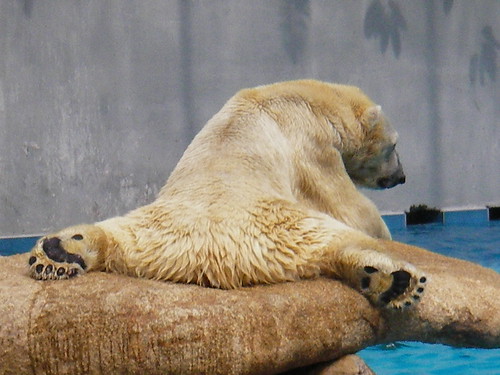
Polar Bear Inuka
Singapore Zoo's polar bear Inuka celebrates 16th birthday Singapore Zoo's Inuka the Polar bear turned 16 on Tuesday and he celebrated it in style with family and friends.A polar bear ice carving and a birthday cake, made of ice, carrots and frozen fish, were presented to the birthday boy.
His mother, Sheba, at 29, is four years over the average 25-year lifespan for polar bears in captivity.
The Zoo has made plans to relocate Inuka to another zoo when his mother dies.
It has to do this, it says, as it will now be focusing more on species from the tropical rainforest in line with its Rainforest Zoo positioning.
This means, it will no longer bring in Arctic animals.
Tuesday's birthday event was also part of a series of conservation and educational activities the zoo has organised from December to end of February next year.
Apart from seeing Inuka and his mother, visitors would learn more about polar bears and the effects of global warming on the Arctic.
His mother, Sheba, at 29, is four years over the average 25-year lifespan for polar bears in captivity.
The Zoo has made plans to relocate Inuka to another zoo when his mother dies.
It has to do this, it says, as it will now be focusing more on species from the tropical rainforest in line with its Rainforest Zoo positioning.
This means, it will no longer bring in Arctic animals.
Tuesday's birthday event was also part of a series of conservation and educational activities the zoo has organised from December to end of February next year.
Apart from seeing Inuka and his mother, visitors would learn more about polar bears and the effects of global warming on the Arctic.
Tuesday, November 21, 2006
Enjoy @ Zoo
Protect those peepers!
Sensitive to sunlight? We recommend that you bring sunshades, sunglasses or visors to keep the glare away. Better yet, soothe on some sunblock for added skin protection.
Rain, rain, go away!
The rain sometimes makes an unexpected appearance. Having an umbrella or raincoat handy will ensure you remain dry should this happen. Many parts of the zoo are sheltered though, and you'll still be able to enjoy excellent views of the animals from there.
Mozzie alert?
Although the zoo does take preventive measures to keep the mosquitoes and other creepy crawlies at bay, you might want to consider bringing some insect repellant to make sure they stay away! The zoo is after all situated in a secondary rainforest and many animals treat this as a haven.
Take your time!
There's always something happening at the zoo. Allow at least half a day to enjoy what's available, but a full day would be even better. Make sure you pick up a map as you enter so you won't miss out on the many presentations, token feeding sessions, keeper talks, rides and photography opportunities that happen during the day.
Feet first!
Taking a leisurely stroll is the ideal way to enjoy everything the zoo has to offer. Comfortable footwear will ensure you get to explore the park endlessly minus sore and tired feet.
Tired of walking?
Then hop onto a tram to rest your soles. Or take a break at one of the air-conditioned shelters while you get your wind back. Many of our exhibits also have viewing galleries that allow you to observe the animals comfortably.Wheels galore! We realise long walks might be taxing for little feet. Parents can rent strollers and wagons for their children. Wheelchairs, both motorised and otherwise, are also available.
Stay hydrated!
As the weather in Singapore tends to be hot and humid year-round, do remember to bring enough drinking water, and keep drinking throughout the day. An ample supply is on sale at our numerous F&B outlets if you happen to run out.
Munch time!
Our food outlets serve a variety of cuisines to tickle every tastebud:
KFC and Pizzafari – Great for kids
Jungle Tandoor – Perfect for spice-lovers
Jungle Flavours and Forest Fare – For the undecided, Asian and Western delights are available
Jungle Breakfast – A delightfully unique dining experience with the animals
Remember though, to savour the food for yourselves and not to share with any of the animals. Their diets are well taken care of.Service with a smile If in doubt at any time, do approach any of our guest relations officers, or any of our staff in fact. They will be more than happy to answer any questions you might have. Repeat, please. Remember to visit the zoo often. New and exciting things are always waiting to be discovered.
See you again soon!
Sensitive to sunlight? We recommend that you bring sunshades, sunglasses or visors to keep the glare away. Better yet, soothe on some sunblock for added skin protection.
Rain, rain, go away!
The rain sometimes makes an unexpected appearance. Having an umbrella or raincoat handy will ensure you remain dry should this happen. Many parts of the zoo are sheltered though, and you'll still be able to enjoy excellent views of the animals from there.
Mozzie alert?
Although the zoo does take preventive measures to keep the mosquitoes and other creepy crawlies at bay, you might want to consider bringing some insect repellant to make sure they stay away! The zoo is after all situated in a secondary rainforest and many animals treat this as a haven.
Take your time!
There's always something happening at the zoo. Allow at least half a day to enjoy what's available, but a full day would be even better. Make sure you pick up a map as you enter so you won't miss out on the many presentations, token feeding sessions, keeper talks, rides and photography opportunities that happen during the day.
Feet first!
Taking a leisurely stroll is the ideal way to enjoy everything the zoo has to offer. Comfortable footwear will ensure you get to explore the park endlessly minus sore and tired feet.
Tired of walking?
Then hop onto a tram to rest your soles. Or take a break at one of the air-conditioned shelters while you get your wind back. Many of our exhibits also have viewing galleries that allow you to observe the animals comfortably.Wheels galore! We realise long walks might be taxing for little feet. Parents can rent strollers and wagons for their children. Wheelchairs, both motorised and otherwise, are also available.
Stay hydrated!
As the weather in Singapore tends to be hot and humid year-round, do remember to bring enough drinking water, and keep drinking throughout the day. An ample supply is on sale at our numerous F&B outlets if you happen to run out.
Munch time!
Our food outlets serve a variety of cuisines to tickle every tastebud:
KFC and Pizzafari – Great for kids
Jungle Tandoor – Perfect for spice-lovers
Jungle Flavours and Forest Fare – For the undecided, Asian and Western delights are available
Jungle Breakfast – A delightfully unique dining experience with the animals
Remember though, to savour the food for yourselves and not to share with any of the animals. Their diets are well taken care of.Service with a smile If in doubt at any time, do approach any of our guest relations officers, or any of our staff in fact. They will be more than happy to answer any questions you might have. Repeat, please. Remember to visit the zoo often. New and exciting things are always waiting to be discovered.
See you again soon!
Friday, November 10, 2006
Happy birthday Party!

Come face-to-face with the world’s biggest bear
This year-end school holidays, Singapore Zoo has planned a series of fun conservation and educational activities centred on the polar bear, the largest of all bear species and the largest land carnivore. This is also in conjunction with the 16th birthday celebration for Inuka, the Zoo’s captive-bred polar bear, on 26 December.
Enrichment activities, incorporating an enlightening commentary, will be conducted for Sheba and Inuka, our polar bears. Learn more about the plight of the species and discover how the Zoo keeps them busy with innovative toys.Venue: Polar Bear Underwater Viewing ExhibitDate: 18 November – 31 DecemberTime: 10.05am, 1.05pm and 4.45pm daily (additional 3.10pm session on Sundays and public holidays)
I thought they are giving away our beloved polar bears?
Saturday, November 04, 2006
Le Long sell calendar

Singapore Zoo and Night Safari’s 2007 Calendar Available Now
Get Singapore Zoo and Night Safari’s stylish 2007 desk calendar now, and do your part for wildlife conservation. Depletion of natural habitat, illegal animal trade and poaching have made it vital for progressive zoos to adopt conservation programmes. Featured in this calendar are some of the endangered Southeast Asian animals at Singapore Zoo and Night Safari, such as the orang utan, Douc langur, Malayan sun bear, Indian rhino and Asian elephant.Carrying the theme of Singapore Zoo’s tagline “Extinction is Forever. Conserve”, each page features a close-up photograph and conservation bites on an endangered Southeast Asian animal. Proceeds from the sale of the calendars will go to the Wildlife Conservation Singapore Fund.The calendar retails at $8 each and is available at retail outlets at the Zoo and Night Safari, as well as on the Zoo and Night Safari’s online e-store at www.safarizooshop.com
Sunday, October 29, 2006
Cute Girl In Sing!
Bindi Irwin was in Singapore to film a show for Kids Discovery Networks!
The family was spotted in Singapore Jurong Bird Park.
Steve Irwin is a fan of the Singapore Zoo.
The family was spotted in Singapore Jurong Bird Park.
Steve Irwin is a fan of the Singapore Zoo.
Subscribe to:
Posts (Atom)