Killer whale tries to drown trainer
http://www.youtube.com/watch?v=MK3MNN_rsNk
SeaWorld park in San Diego California, a killer whale suddenly tried drowning its trainer.
Friday, July 27, 2012

Thursday, July 12, 2012
Baby giant panda's death in Tokyo sparks grief

The death of a baby panda in Japan stopped regular television programming and brought a Tokyo zoo director to tears on Wednesday, a week after its birth sent ripples of excitement across the nation.
Newscasts had dedicated a nightly segment to the male cub's daily activities since his birth on July 5, with retailers unveiling a host of panda-themed products in celebration.
The unnamed cub was initially hailed as a rare success for Japan's captive breeding programme as it was the zoo's first panda born in 24 years and the only one conceived from natural sexual intercourse.
But the enthusiasm turned to grief on Wednesday after Ueno zoo in the Japanese capital said the tiny, 144-gram male infant had died of pneumonia, bringing zoo director Toshimitsu Doi to tears. "We are very disappointed," Doi said as he wiped his eyes.
Newscasters interrupted regular programming to report the death of the cub, whose birth had been embraced as happy news for a country still struggling to recover from last year's quake-tsunami disaster.
Prime Minister Yoshihiko Noda described the death as "very disappointing".
"We were all looking forward" to the cub's development, he told reporters in Tokyo.
Matsuzakaya, a major Japanese department store, had planned a "Happy Panda Week" celebration, offering special discounts following the birth, but the event was canceled on Wednesday.
The zoo said keepers found the baby lying on its back against its mother Shin Shin's stomach.
"They administered a cardiac massage and other treatment, but unfortunately they confirmed its death at 8:30 am (2330 GMT Tuesday)," the zoo said.
Shin Shin and her mate Ri Ri were leased from China last year at an annual cost of about one million dollars to the zoo operated by the Tokyo Metropolitan government.
The baby was hailed in China, which has sometimes hostile relations with neighbouring Japan.
"We lament the loss of the cub and believe that the Japanese people, who have been looking forward to seeing the cub, will also lament this loss," said foreign ministry spokesman Liu Weimin in a statement Wednesday.
Last week Beijing expressed hope "people-to-people sentiment and overall relations between China and Japan" could be promoted by the cub's birth.
China is famed for its "panda diplomacy", using the bears as diplomatic gifts to other countries. About 1,600 remain in the wild in China, with some 300 others in captivity worldwide -- mostly in China.
As many as 16 giant pandas have been born in Japan, according to reports.
So Sad! Panda cub dies at Ueno Zoo

The first panda cub born at Tokyo's Ueno Zoo in 24 years died of pneumonia Wednesday, the Tokyo metropolitan government said. The baby panda was born on Thursday at the zoo in Taito Ward to 7-year-old female giant panda Shin Shin and 6-year-old male Ri Ri. It was the first panda born through natural breeding at the zoo. The zoo had been monitoring the cub after reuniting it with Shin Shin in a maternity room around 3:30 p.m. Tuesday. The zoo said it confirmed the cub's cries at around 6:45 a.m. Wednesday. However, at around 7:30 a.m., a zoo attendant picked the cub up from where it was lying on its back on Shin Shin's belly and found it was in cardiac arrest. The cub was moved to an incubator and given cardiac massage, but was confirmed dead at around 8:30 a.m. Ueno Zoo Director Toshimitsu Doi had stressed that panda cubs need to be carefully watched for at least a week since it takes that long to determine whether a baby panda will be able to thrive. This is because there have been many cases in which baby pandas, blind and covered only with downy hair, die several days after birth. Shin Shin nursed the cub after giving birth Thursday. Shin Shin, however, stopped taking care of the cub around midnight Friday, and the cries of the baby, left on the concrete floor of the maternity room, became weaker. A zoo attendant warmed the baby using a hot water bottle and moved it to an incubator after wrapping it in a towel. While feeding Shin Shin an apple Saturday morning, zoo staff used a pump to collect her milk to feed the cub. The cub regained its strength when it was given the breast milk through a bottle. Its weight, which was 133 grams Friday, increased to 144 grams Tuesday. It sometime happens that a giant panda will stop taking care of its baby. There are also cases in which the tiny baby dies under the large body of a mother panda. In June 1985, Chu Chu, the first panda born in Japan, died at the zoo at the age of just 43 hours.
Wednesday, July 11, 2012
Copenhagen Zoo Siberian tigers fatally maul man

It was unclear how or why the 21-year-old Afghan-born man had entered the Siberian tiger den, but investigators could not exclude suicide as a motive, police spokesman Lars Borg said.
The man sustained multiple bite wounds to the throat, face, chest and a thigh. "We don't know why he went in and why he ended up in the enclosure," Borg told The Associated Press. The man was granted Danish citizenship last month and his family has identified him, Borg said.
Police declined to release his name. His body was found surrounded by the zoo's three Siberian tigers by a zookeeper early Wednesday.
Borg said the man appeared to have entered the tiger area late Tuesday from a low wall surrounding the den and then ended up in the moat inside the enclosure. "He has been in the water and the animals must have seen that and attacked him," Borg said.
"He was killed in the water." Police were trying to piece together the man's movements inside the zoo, but haven't had any luck with security cameras. There were no surveillance cameras at the tiger enclosure. The man only had his old residence permit and keys to his Copenhagen apartment on him, Borg said. Copenhagen Zoo manager Steffen Straede said it was the first time in the zoo's 152-year history that such an incident has occurred, and there were no plans to reassess its security or to put the tigers down.
"If a person really wants to get in (there), we cannot prevent it from happening," he said.
**** Recalled: A cleaner at Singapore Zoo has died after being mauled by three tigers Nov 2008, Nordin Bin Montong was attacked by the white Bengal tigers after crossing a moat surrounding their enclosure. He was reportedly acting erratically.
Singapore Zoo welcomes new baby white rhino

Jumaane, which means "born on Tuesday", arrived on April 10 this year, which of course, was a Tuesday.
He was undoubtedly one of the biggest bundles of joy Singapore Zoo has welcomed to date, weighing in at approximately 70kg at birth.
Baby Jumaane can be seen rolling around in the mud in his exhibit at the Wild Africa region of the Zoo.
His mother, Shova is always close by though, keeping a watchful eye on her baby.
White rhinos are considered near threatened in the wild on the International Union for the Conservation of Nature Red List of Threatened species.
They are hunted for their horns, which some believe as having medicinal properties.
However, there has been no scientific evidence to suggest that their horns are a cure for anything as they are actually made of keratin, the same type of protein that makes up hair and fingernails.
Singapore Zoo boasts the most number of white rhinos bred in a single zoo in Southeast Asia, with eight of these majestic creatures in its collection.
Of the 13 babies born here, some have been sent to Indonesia, Australia, Thailand and Korea as part of the Zoo's ex-situ conservation efforts through its worldwide exchange programme.
Friday, July 06, 2012
Giant panda Shin Shin gives birth at Ueno Zoo
Giant panda Shin Shin has given birth to a cub,
officials at Ueno Zoo in Tokyo said Thursday. It is the first to be born
at the nation's oldest zoo in 24 years, and the first there to be
conceived naturally.
 |
| Eating for two: Female giant panda Shin Shin feeds on bamboo at Ueno Zoo in Tokyo last month. |
The cub, whose sex has yet to be determined, was
born at 12:27 p.m. and both the mother and baby are in good health, an
official at the Tokyo Metropolitan Government said. The baby's father is
Ri Ri.
"Shin Shin has been holding the cub to her
chest" and showing signs of feeding the baby, the official said. Zoo
staff have been monitoring the pandas by camera. Neither the weight nor
size of the cub are yet known.
Because a second cub is sometimes born as long as
a day after the first, Shin Shin will continue to be monitored closely,
the official said.
Shin Shin and Ri Ri are on a 10-year loan
from China that started in February 2011. Under the terms of the
agreement, the cub is owned by China and will be sent there in two
years, according to the metropolitan government.
Shin Shin and Ri Ri were placed in the same cage on March 25, and it was confirmed they had mated a day later.
The zoo removed Shin Shin from public view on
June 30, when it appeared she was pregnant. However, the zoo was unable
to confirm her condition because changes in hormonal level can mimic
signs of pregnancy.
The gestation period is usually 80 to 200 days. Shin Shin gave birth 102 days after first mating with Ri Ri.
The cub is the fourth born at the zoo. The last, Yu Yu, was born in 1988.
Information from Kyodo added
Thursday, June 28, 2012
Adult chimpanzee kills baby chimp in front of shocked Los Angeles Zoo visitors
Los Angeles Zoo visitors were scared and shocked to witness a 3-month-old chimpanzee mauled to death by an adult male chimp.
Witnesses told CBS Los Angeles that about 100 or so people saw the tragedy, some so horrified they had to leave the zoo. Others were so enthralled that they captured parts of the incident on their cell phone cameras.
"Chimpanzee behavior can sometimes be aggressive and violent and the zoo is sorry that visitors had to be exposed to this," the facility said in a statement.
The unnamed infant chimpanzee, born March 6, was the daughter of a chimp named Gracie.
Zoo officials told CBS Los Angeles they aren't sure why this particular male went after the baby and that there had been no aggressive behavior against the chimp since its birth. Male adult chimpanzees, however, have been known to kill young offspring when they fancy an adult female. They are also known to fight and try to kill existing partners of the desired female and direct their anger at baby chimps.
Los Angeles residents and tourists became alarmed as soon as they heard wild animal screeches.
"A bunch of screaming -- like the monkeys getting crazy," said one zoo visitor, Sylvia De Leon. "We did get scared because we were around that area."
One witness said the male chimp held the baby away from the rest of the troop and repeatedly hit its head.
Another family said they only heard the commotion, but the loud noises scared them enough to leave.
"All I heard was screaming," said Alex Sanchez, one of the family's sons. "They stopped for a while, but then they started going again."
Officials said that zoo staff was not allowed to immediately enter the exhibit for their own safety. Gracie, the mother, was allowed to keep the infant's body overnight to allow her the opportunity to grieve.
"This is a heartbreaking a tragic loss for the zoo and especially for the Great Ape Team who have worked diligently to care for the infant and its mother since its birth," the zoo said in a statement.
The chimpanzee troop at the Los Angeles exhibit is one of the largest in a North American zoo.
Witnesses told CBS Los Angeles that about 100 or so people saw the tragedy, some so horrified they had to leave the zoo. Others were so enthralled that they captured parts of the incident on their cell phone cameras.
"Chimpanzee behavior can sometimes be aggressive and violent and the zoo is sorry that visitors had to be exposed to this," the facility said in a statement.
The unnamed infant chimpanzee, born March 6, was the daughter of a chimp named Gracie.
Zoo officials told CBS Los Angeles they aren't sure why this particular male went after the baby and that there had been no aggressive behavior against the chimp since its birth. Male adult chimpanzees, however, have been known to kill young offspring when they fancy an adult female. They are also known to fight and try to kill existing partners of the desired female and direct their anger at baby chimps.
Los Angeles residents and tourists became alarmed as soon as they heard wild animal screeches.
"A bunch of screaming -- like the monkeys getting crazy," said one zoo visitor, Sylvia De Leon. "We did get scared because we were around that area."
One witness said the male chimp held the baby away from the rest of the troop and repeatedly hit its head.
Another family said they only heard the commotion, but the loud noises scared them enough to leave.
"All I heard was screaming," said Alex Sanchez, one of the family's sons. "They stopped for a while, but then they started going again."
Officials said that zoo staff was not allowed to immediately enter the exhibit for their own safety. Gracie, the mother, was allowed to keep the infant's body overnight to allow her the opportunity to grieve.
"This is a heartbreaking a tragic loss for the zoo and especially for the Great Ape Team who have worked diligently to care for the infant and its mother since its birth," the zoo said in a statement.
The chimpanzee troop at the Los Angeles exhibit is one of the largest in a North American zoo.
Sunday, June 24, 2012
Singapore Wildlife conservation on Wild boar
News that a wild boar wandered out of the forest around Lower Peirce Reservoir and charged at a security guard and a five-year-old boy at Bishan-Ang Mo Kio Park last Friday may have raised concerns in some quarters.
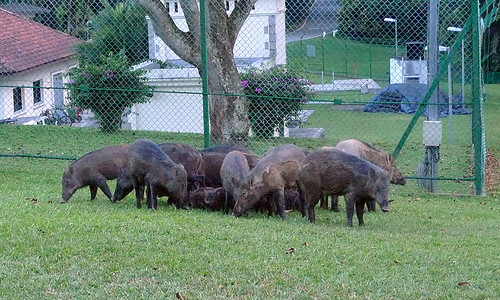
But now a wild life researcher says wild boars moving out of the woods does not necessarily mean that there is an overpopulation of them.
Mr Ong Say Lin, Research Student, Department of Biological Sciences at the National University of Singapore, said: "This may not just be a sign that their numbers are increasing too quickly. We don't know that for sure yet, and I can't deny that as well. They are coming out and they are spreading to bigger areas. And they can't tell the difference between a natural area and a housing estate that has planted fruit trees. To them it's really all the same, and it's just their normal foraging behaviour."
And observing wild boars' foraging behaviour has become a new past-time for some of the residents at Upper Thomson.
They say wild boars foraging for food by the roadside is now almost a daily occurrence, which attracted many drivers to take snapshots of them.
One resident even turned his home-grown jackfruit tree into an 'observation post', where he spends up to two hours watching the wild boars from a safe distance.
To better understand wild boars, Mr Ong has put in place more than 30 camera traps to track the animals.
He has also set up a webpage and Facebook page where he published his research findings, to be shared with the public.
The public can share their sightings or knowledge of wild boars on the Facebook page to help others learn more about the habits and behaviour of the animals.
But now a wild life researcher says wild boars moving out of the woods does not necessarily mean that there is an overpopulation of them.
Mr Ong Say Lin, Research Student, Department of Biological Sciences at the National University of Singapore, said: "This may not just be a sign that their numbers are increasing too quickly. We don't know that for sure yet, and I can't deny that as well. They are coming out and they are spreading to bigger areas. And they can't tell the difference between a natural area and a housing estate that has planted fruit trees. To them it's really all the same, and it's just their normal foraging behaviour."
And observing wild boars' foraging behaviour has become a new past-time for some of the residents at Upper Thomson.
They say wild boars foraging for food by the roadside is now almost a daily occurrence, which attracted many drivers to take snapshots of them.
One resident even turned his home-grown jackfruit tree into an 'observation post', where he spends up to two hours watching the wild boars from a safe distance.
To better understand wild boars, Mr Ong has put in place more than 30 camera traps to track the animals.
He has also set up a webpage and Facebook page where he published his research findings, to be shared with the public.
The public can share their sightings or knowledge of wild boars on the Facebook page to help others learn more about the habits and behaviour of the animals.
Wednesday, June 20, 2012
This pack of wolves tasted human
Pack of eight wolves maul woman keeper to death at Sweden's most popular zoo
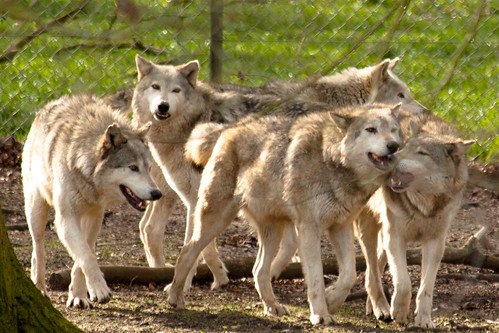
A crisis group assembled to provide support for Kolmarden park’s employees, and the woman's relatives have been notified, reported news agency TT.
The incident occurred just after 11am on Sunday morning. According to eye-witness reports, the woman went into the enclosure, was surrounded and then attacked, wrote the Aftonbladet newspaper.
Emergency services were alerted at 11.11am, and were initially unable to approach the woman.
“You can’t just go in to a pack of wolves. Police and ambulance staff couldn’t get close to the victim until later,” said Norrköping’s emergency services coordinator Jan Tengeborg to the newspaper.
According to Aftonbladet, emergency services are currently attempting to sedate the other wolves nearby.
“It’s very unusual for something like this to happen, but it has happened before," Olof Liberg, wolf expert at Sweden’s University of Agricultural Sciences (Sveriges lantbruksuniversitet, SLU) said to TT.
“Zoo animals aren’t afraid of humans and accidents can happen,” he continued.
Liberg has yet to familiarize himself with this specific case, but said that accidents like this one often occur because of a breach in routine, and notes that wolves are especially dangerous when a zookeeper goes in alone.
A crisis group assembled to provide support for Kolmarden park’s employees, and the woman's relatives have been notified, reported news agency TT.
The incident occurred just after 11am on Sunday morning. According to eye-witness reports, the woman went into the enclosure, was surrounded and then attacked, wrote the Aftonbladet newspaper.
Emergency services were alerted at 11.11am, and were initially unable to approach the woman.
“You can’t just go in to a pack of wolves. Police and ambulance staff couldn’t get close to the victim until later,” said Norrköping’s emergency services coordinator Jan Tengeborg to the newspaper.
According to Aftonbladet, emergency services are currently attempting to sedate the other wolves nearby.
“It’s very unusual for something like this to happen, but it has happened before," Olof Liberg, wolf expert at Sweden’s University of Agricultural Sciences (Sveriges lantbruksuniversitet, SLU) said to TT.
“Zoo animals aren’t afraid of humans and accidents can happen,” he continued.
Liberg has yet to familiarize himself with this specific case, but said that accidents like this one often occur because of a breach in routine, and notes that wolves are especially dangerous when a zookeeper goes in alone.
Sunday, June 17, 2012
Precious Panda
Of course, the panda diplomacy hit its peak when Chairman Mao gave Hsing-Hsing and Ling-Ling to US President Richard Nixon in 1972 after their meeting, ending 25 years of isolation between China and United States. US reciprocate with a pair of musk oxen, though one dies immediately while the other loses all of its fur. Poor oxen, I supposed they are more sensitive than panda after they learnt about being exported. Hence the relatively peaceful period when the Americans busy admiring pandas and Bruce Lee.
Proven to be successful as a diplomatic tool, China presented two of the cute animals (Ching-Ching and Chia-Chia) to United Kingdom 2 years later. It was such a successful tool that French throw a tantrum, insulted because the US got their pandas before them, and China had to give Yen-Yen and Li-Li to the French in 1973 to prevent them from resurrect their mighty Napoleon Bonaparte (*grin*). Even Taiwan, China’s nearest enemy, was given a pair of Tuan-Tuan and Yuan-Yuan in 2008, as a symbol of diplomatic ties being mended between the countries.
However in 1984, the Chinese discovered that there could be a better business model from the panda diplomacy concept. Thanks to capitalism, China found a new formula to profit from the diplomatic tool – now everybody can “Lease a Panda” instead of “Own a Panda”. Here’s the marketing concept – Pandas will be loaned abroad in pairs for cooperative research (*ahem*) with Chinese scientists. The fee – USD1 million per year, payable to China, for a period of 10 years. And if somehow you’re lucky that the loan pair of pandas produce offspring, all the cubs become the property of Peoples Republic of China.
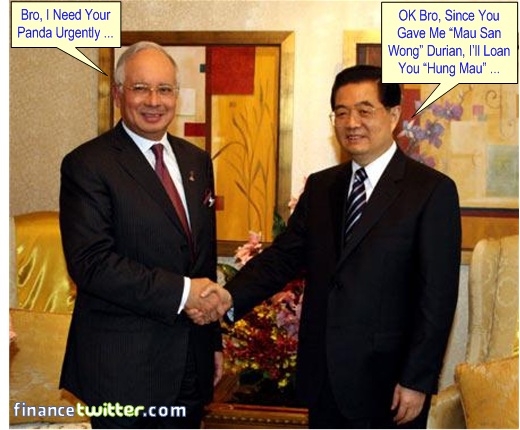
Hoping to use the same panda diplomacy to win local ethnic-Chinese votes as the election-window is getting smaller, the desperate Malaysia PM Najib Razak proudly trumpet that China had decided to loan two endangered baby pandas for a 10-year period. Almost 40-years ago Najib’s father met and shook hands with Mao Zedong in China and thereafter came back home to call a snap election. It brought a landslide victory to the BN. Some said it was a clever plan to win the Chinese votes after the 13 May 1969 racial riots. And now his son PM Najib hopes to reuse the same stunt to his advantage (*grin*).
Conveniently, Najib didn’t tell the public that the cost of loaning the pandas alone would come to a cool USD20 million for the 10-year period, excluding huge cost of building air-conditioned enclosures, maintenance, training and grade-A tender bamboo shoots which need to be imported. The pandas will be placed in a special exhibit in Taman Wetland, Putrajaya. The problem is this wetland is so far away that it would be a miracle if it can attacts large enough number of visitors to offset the cost. But knowing how Najib’s Barisan Nasional previous bailout works, the cost of maintenance and return on investments never cross their minds.
If a pair of white and black bear can swing some Chinese votes, so much the better. Otherwise cronies can still make (guaranteed) profit with Najib Panda Sdn Bhd project which includes infrastructure building, commissioning, maintaining, importing (bamboo shoots) and collecting revenues from the new superstars. The contract probably would be bias with the government guarantee a fix number of visitors else compensation plan kicks in, the same way highway concessionaires make the kill. However you see it, this exclusive “panda concessionaire” will be laughing its way to the bank, pocketing taxpayers money.
Actually, Najib should save the embarrassment with the contest to name the two pandas. If his Ah-Jib-Gor Chinese-language Facebook page is any indicator, the contest doesn’t help but backfires badly with majority of comments ridicule the prime minister with sarcastic names. Names like “Bersih”, “Lynas”, “Altantuya”, “Cincin”, “BagBag”, “Berkin”, “RaRa”, “SuaSuah” and many others were suggested, specifically targeted at PM Najib’s tainted administration from lavish spending to murder allegation. Maybe Najib could attract visitors and prove the critics wrong by naming the pandas “Toto” and “Magnum”. Surely gamblers would not mind paying super expensive ticket price just for a blessing from the animals (*grin*).
Netizens also used the opportunity to tease Najib administration by relating the pandas to NFC’s RM250 million scandal, suggesting that the pandas should stay in multi-million luxury condominium, since cows stay in such environment as well. Obviously majority were skeptical that the pandas would be taken care of, when they can’t even take care of cows in the first place. One wonder if there will be new scandal where the precious pandas be re-leased elsewhere and the money used to buy properties in Singapore.
Critics also slammed Najib administration for wasting taxpayers’ money on pandas when the country’s own tiger, Borneo rhinoceros, orangutan, “pygmy” elephants are equally on the edge of extinction. Many are pessimistic if the pair of pandas can ever graduate from the 10-year period and emerge alive, judging from how the animals were abused and neglected in the local zoos. Of course, Najib administration can always claim that the pandas committed suicide if they were to die while in Putrajaya Wetland. On the fun side, Najib administration should perhaps negotiate secretly (by whisper) with China to lower the pandas leasing cost by reciprocate Malaysia’s delicacies.
Many may not know this but the biggest Goliath frog species in the world came from Malaysia. There’re two very rare species – scientific name Pyxicephalus Ibra-Ali and Pyxicephalus Hee-Apa-Nama. While the fomer is Malaysian former prime minister’s favourite pet, the latter is so special that it can even spray pepper at its enemies (*gulp*). If China pandas are considered an endangered species with only 1600 left in the wild, Malaysia frogs are even more precious considering only a handful known to survive the Mar 2008 election aftermath, with Ibra-Ali and Hee-Apa-Nama the only species alive (*grin*) from the Pyxicephalus family. Heck, US10 million a piece per year for such national treasure is a steal should China accept the exchange.
On a serious note, let’s hope that the pair of pandas shortlisted will not die in vain in Malaysia, a country infamous for its third-world mentality when comes to maintenance. In order to cut cost and make more profit, the cronies shortlisted to manage the welfare of the pandas could just mix local bamboo with other local ingredients such as sambal belacan. Nevertheless, PM Najib will not be here for the next 10-year to ensure the pandas are in one piece to be returned to China so he does not care. What is certain is the taxpayers money to the tune of tens of millions of dollars will be wasted due to desperation of one person’s effort to win Chinese support. And this whole Panda Marketing plan isn’t working at all.
Saturday, May 26, 2012
Pandas' arrival from China set for year-end

Authorities said Kai Kai and Jia Jia may now only set foot in Singapore at the end of the year.
The two are in good shape and are getting ready for their stint together in Singapore.
Kai Kai and Jia Jia's enclosures have been placed side by side, so they can get used to each other's smell.
But the final details of their migration and their new homes are still being worked out.
Li Desheng, director at Sichuan Wolong Nature Reserve Administration, said: "For instance, (details include) where the surveillance camera is placed, the height of the panda weighing machine. The control of the emergency exit is crucial because the zoo keepers have to enter to clean the enclosure and train the pandas. The pandas may behave violently when they are unhappy."
The duo are on a 10-year loan to foster good ties between China and Singapore.
Claire Chiang, chairwoman of Wildlife Reserves Singapore, said: "There are details that deal with the air conditioning, the lighting, the planting etc. I think we've met all the conditions. What we hope to do is to be sure that the entire precinct around the panda will be in the best state when they come."
And Singapore's Minister of State for Trade and Industry, Teo Ser Luck, who's visiting the pair in Chengdu, said it's important that they're well taken care of.
Mr Teo said: "I think if it takes a longer amount of time to get prepared and to learn their skill sets and the knowledge, I think we should (wait). We should take that time because at the end of the day, this is a national treasure of China and we have to take it very seriously. We have an even heavier responsibility to make sure the pandas are in good hands."
The China Wildlife Conservation Association is planning to make a fourth trip to Singapore sometime in July.
A date will only be set after they have made sure all the modifications are done and everything is in order.
Both Singapore and China are hoping the Giant Pandas can fly to Singapore by the end of the year.
After arriving in Singapore, the pandas need another two months for quarantine and conditioning to the new environment.
Sunday, April 01, 2012
Where is our Polar bears?
River Safari, Asia’s first river-themed wildlife park, today released details of the new home of Singapore’s beloved polar bears, Inuka and Sheba. The 1,400 sq metre habitat will be three and a half times the size of the existing one, featuring indoor and outdoor areas from which the public can see the great white carnivores, and pools for the bears to swim in.
The polar bears’ new home will be housed within River Safari’s Frozen Tundra exhibit, which aims to educate visitors on the importance of glaciers and semi-frozen freshwater ecosystems, amongst the most threatened of the world’s biomes.
The polar bear dens and indoor areas will be climate controlled, with temperatures that simulate the Arctic north. Three viewing elevations will be available for visitors, including the hugely popular underwater view, and visitors can admire the animals through windows cut into frozen rocks.
Modelled closely after their natural habitat, Inuka and Sheba’s new home is part of WRS’ commitment in upgrading these bears’ living space. In 2006, the Animal Welfare and Ethics Committee (AWEC) decided that it was in the polar bears’ best interest for them to remain in Singapore. This decision was reached after considering the animal’s ages, their familiarity with their keepers and environment, and the uncertainty of whether other facilities would be able to provide the same high level of care that Inuka and Sheba are used to. It was also at this time that WRS started the conceptualisation of the Frozen Tundra exhibit, to further upgrade the polar bears’ habitat.
Native to the Arctic Circle, polar bears are the world’s largest land carnivore and adult males can weigh up to 650 to 700 kg. Classified as vulnerable by the IUCN, the bear occupies a narrow ecological niche and preys almost exclusively on seals. Polar bears hunt mostly on ice floes in winter months and retreating sea ice due to global warming has resulted in the diminishing of their hunting grounds and food sources. If global temperatures continue to rise, polar bears may become extinct across most of their range within a hundred years.
Some of the innovative features of Frozen Tundra include “ice rocks” where our polar bears can soak in the coolness of “freezed” rocks and also an ice cave where both Sheba and Inuka can retire to, so as to enjoy a polar siesta. The new habitat also incorporates a large freezer unit able to produce huge blocks of ice as enrichment for the bears. Natural substrates, trees, and also pools and streams will be incorporated, to provide the bears with a rich and varied home.
As construction begins on the Frozen Tundra exhibit, the polar bear enclosure at the Singapore Zoo will be closed from 30 August 2010. Inuka and Sheba look forward to seeing everyone again in 2012 with the opening of River Safari.
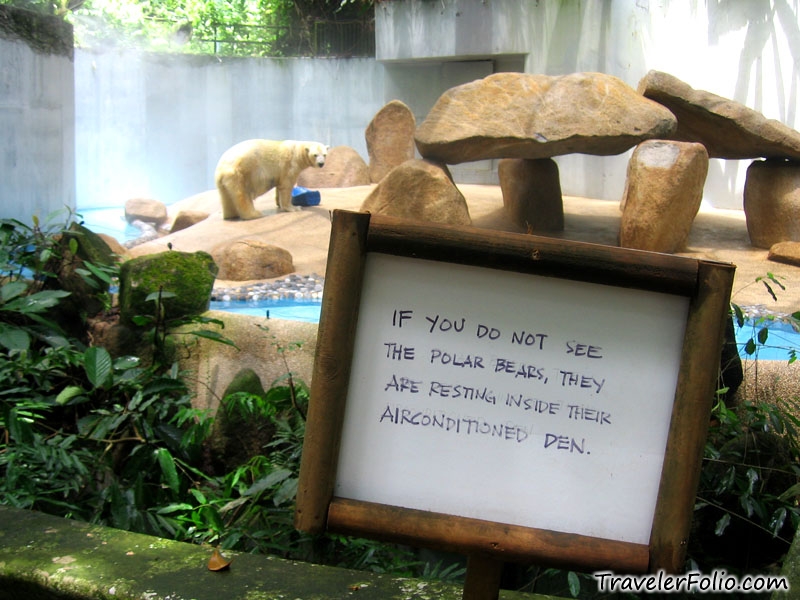
New habitat for Singapore’s polar bears will be three and a half times bigger and feature innovative climate-controlled features
The polar bears’ new home will be housed within River Safari’s Frozen Tundra exhibit, which aims to educate visitors on the importance of glaciers and semi-frozen freshwater ecosystems, amongst the most threatened of the world’s biomes.
The polar bear dens and indoor areas will be climate controlled, with temperatures that simulate the Arctic north. Three viewing elevations will be available for visitors, including the hugely popular underwater view, and visitors can admire the animals through windows cut into frozen rocks.
Modelled closely after their natural habitat, Inuka and Sheba’s new home is part of WRS’ commitment in upgrading these bears’ living space. In 2006, the Animal Welfare and Ethics Committee (AWEC) decided that it was in the polar bears’ best interest for them to remain in Singapore. This decision was reached after considering the animal’s ages, their familiarity with their keepers and environment, and the uncertainty of whether other facilities would be able to provide the same high level of care that Inuka and Sheba are used to. It was also at this time that WRS started the conceptualisation of the Frozen Tundra exhibit, to further upgrade the polar bears’ habitat.
Native to the Arctic Circle, polar bears are the world’s largest land carnivore and adult males can weigh up to 650 to 700 kg. Classified as vulnerable by the IUCN, the bear occupies a narrow ecological niche and preys almost exclusively on seals. Polar bears hunt mostly on ice floes in winter months and retreating sea ice due to global warming has resulted in the diminishing of their hunting grounds and food sources. If global temperatures continue to rise, polar bears may become extinct across most of their range within a hundred years.
Some of the innovative features of Frozen Tundra include “ice rocks” where our polar bears can soak in the coolness of “freezed” rocks and also an ice cave where both Sheba and Inuka can retire to, so as to enjoy a polar siesta. The new habitat also incorporates a large freezer unit able to produce huge blocks of ice as enrichment for the bears. Natural substrates, trees, and also pools and streams will be incorporated, to provide the bears with a rich and varied home.
As construction begins on the Frozen Tundra exhibit, the polar bear enclosure at the Singapore Zoo will be closed from 30 August 2010. Inuka and Sheba look forward to seeing everyone again in 2012 with the opening of River Safari.
New habitat for Singapore’s polar bears will be three and a half times bigger and feature innovative climate-controlled features
Saturday, March 03, 2012
In come new CEO
New CEO for Wildlife Reserves Singapore


Wildlife Reserves Singapore (WRS) will be headed by Mr Lee Meng Tat
from May. He will take over from current Chief Executive Officer (CEO)
Isabella Loh.
Mr Lee was formerly the Chief Corporate Development Officer of the food and beverage division at the Fraser and Neave group.
In a media statement on Friday, WRS said of its
incoming CEO: 'His diverse skill-sets and business experience in
Singapore and China will be invaluable to WRS's growth plans as we
integrate our 4 parks.'
WRS is the parent company of the Singapore Zoo, the Night Safari, Jurong Bird Park and the upcoming River Safari.
Monday, February 27, 2012
CEO run road after creating unhappiness
Wildlife Reserves to get new CEO: Sources

Wildlife Reserves Singapore (WRS) is understood to be getting a new
chief executive, as interim head Isabella Loh heads back to the group's
board, say sources.
The Sunday Times understands that the new
group CEO has been identified, and is from a multi-brand company listed
on the Singapore Exchange. He is said to be joining WRS in a few months'
time.
Ms Loh, 51, took over last July, a week after former group CEO Fanny Lai resigned unexpectedly.
Asked about this last night, WRS would only
say that Ms Loh was appointed interim CEO while the board conducted a
search for a permanent chief executive.
Monday, January 02, 2012
Singapore Zoo an expensive family outing...
Why I'm back...
The changes to the Singapore Zoo made me start to blog again. Entrance fee increased! Lesser exhibit due to renovation, expensive food outlets. Luckily there is still lots of fun.
The changes to the Singapore Zoo made me start to blog again. Entrance fee increased! Lesser exhibit due to renovation, expensive food outlets. Luckily there is still lots of fun.
Opening Hours
8.30am to 6.00pm daily
(Last ticket sale at 5.30pm)
Adult S$20.00
Child (3 to 12 years old) S$13.00
8.30am to 6.00pm daily
(Last ticket sale at 5.30pm)
Adult S$20.00
Child (3 to 12 years old) S$13.00
Park Hopper Package Deal
|
Admission
|
Adult
|
Child
| |
| 3-in-1 | Jurong Bird Park Night Safari* Singapore Zoo |
S$58.00 | S$38.00 |
| 2-in-1 | Jurong Bird Park Singapore Zoo |
S$32.00 | S$21.00 |
| 2-in-1 | Night Safari* Singapore Zoo |
S$42.00 | S$28.00 |
|


Sunday, September 25, 2011
Misusing the name of President
Wildlife Reserves S'pore apologises to President
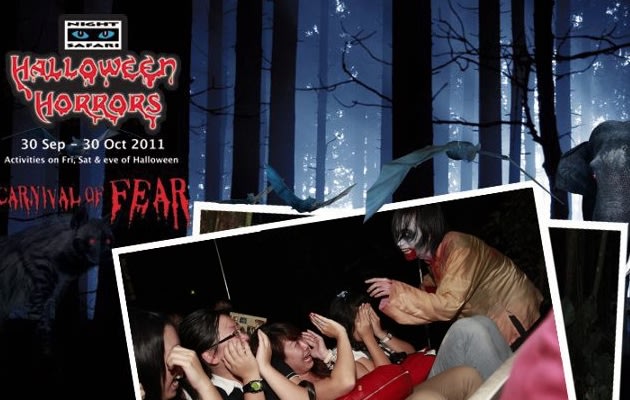
Wildlife Reserves Singapore (WRS) has apologised to President Tony Tan for using his comments when announcing the decision to cancel its award-winning Halloween event.Chief executive Isabella Loh said in a statement on Saturday, "I would like re-emphasise that (the) President had nothing to do with Wildlife Reserves Singapore decision to cancel Halloween Horrors.
"I would like to apologise for bringing in his comments from the Mid Autumn Festival 'Moon Night' celebrations into this issue," she was quoted as saying by The Straits Times.
Reiterating that the decision was due to feedback and "not due to any religious beliefs", Loh added, "The decision to review and reset the calendar of events was discussed and decided even before Moon Night."
While previous media reports quoted sources saying she called the activity "devil worship" and online forums speculated that she cancelled the event because she was a Christian, Loh clarified to The Sunday Times she is a Buddhist.
She said when she took over from Fanny Lai in July, she already felt Hollaween Horrers did not fit in and there were not enough family activities.
After visiting the haunted house, which was part of the spook fest, she felt "uncomfortable with the idea because it was too scary".
While explaining to some members of the team why the event did not fit into a family theme, she said in an e-mail that it's "a lot of money spent on an infrastructure (Haunted House) of devil worship".
"That's the context of my remarks," she said, adding that she also alerted the team to controversies about the 31 October festival, where some U.S. schools even ban Halloween events.
Loh also issued a clarification on WRS' Facebook page on Saturday, repeating her apology to the Singapore Polytechnic students involved in the planning of the event.
Meanwhile Principal Private Secretary to the President Tan Eng Beng issued a statementon the president's Facebook page on Saturday evening.
"The president's comments were made in the context of a visit to the Zoo's Mid-Autumn Festival celebrations," the statement said.
"Wildlife Reserves Singapore is an independent company. Its operations and programming decisions rest with its management and board without external intervention."
In last week's announcement, Loh said WRS agreed with comments made by Tan that "WRS' parks should have more family-bonding and wholesome activities".
Tan made the comments last Sunday at the Singapore Zoo while celebrating the Mid-Autumn Festival.
Halloween Horrors, an annual Night Safari event since 2006, was supposed to be held on weekends between 30 September and 30 October.
Saturday, September 24, 2011
Bring back Halloween Horrors: Not fair to cancel it when many fans have bought tix
You call this fun?

STOMPer Isaac is calling for the reinstatement of the Halloween Horrors event which has suddenly been cancelled after being held in the Night Safari for the last five years.
Said the STOMPer:
"Going by recent reports in the media, the new CEO of WRS is not a very popular person right now.
"She suddenly cancelled an event that had ran for the last five years at the Night Safari, upsetting many people in the process, particularly people who has purchased tickets for the event and people linked with the event in one form and another, some going back months.
"The apparent reason given by her was: 'The Halloween Horrors event is cancelled because of the negative feedback received from corporations, the public and the media about the event, especially over it relevance in relation to conservation.'
"If this is the case, what has the WRS board been doing for the past five years apparently endorsing this event under the previous CEO?
"Ms Loh was reported to have also to link President Tony Tan's comment made at the Singapore Zoo's Mid Autumn Festival 'Moon Night' celebrations to the decision to close Halloween Horrors but had to back down with an apology.
"In my view, Ms Loh has the right to change the direction of a corporation that is not moving in the 'right' direction but to do it a manner has caused some much consternation certainly leaves a bad taste in most people mouths.
"I would think the right thing to do under the present circumstances is for WRS to reverse the decision and re-instate the event and make an apology for Ms Loh 'mistake'.
"WRS could make a graceful exit by not holding the event next year without the negative publicity!"
Monday, September 19, 2011
Night Safari management cancels Halloween Horrors event last minute
Halloween Horrors, a highly successful event that has been running
for six years, was to be held at the Night Safari on September 30th, but
the Wildlife Reserves Singapore (WRS) management decided to to yank it 2
weeks before launch.
The event is run by students from Singapore Polytechnic's Diploma in
Events and Project Management as their final year project.
Seven months of hard work, almost $1 million dollars spent, 1000 tickets sold, all down the tubes.
Apparently, the new CEO, Isabella Loh, said that there was negative
feedback from "corporations, friends of the zoo, the public and the
media about the event, especially over the relevance in relation to
conservation".
CEO Isabella Loh also said that it would focus on more multi-cultural
family bonding events, and that the Halloween event was canceled
because it clashed with a Deepavali event in October.
What was particularly disturbing was a report from the SP team that
someone in the senior management said, in response to why the event was
canceled, 'We should not worship the devil. We can be creative and turn
the bad for good."
Sunday, March 20, 2011
KungFu Panda!
MEET “KAI KAI” (凯凯) AND “JIA JIA” (嘉嘉) – SINGAPORE’S GIANT PANDAS
WILDLIFE RESERVES SINGAPORE ANNOUNCES NAMES CHOSEN FROM NATIONWIDE SEARCH

The seven-person judging panel consisted of representatives from different agencies and organisations, namely Mr Chen Jiang, Cultural Counsellor, Embassy of the People’s Republic of China in Singapore; Professor Tommy Koh, Ambassador-at-Large, Ministry of Foreign Affairs; Ms Aw Kah Peng, Chief Executive, Singapore Tourism Board; Professor Wang Gungwu, Chairman, East Asian Institute, National University of Singapore; Mr Liew Mun Leong, President and CEO, CapitaLand Group; Ms Jennie Chua, Chief Corporate Officer, CapitaLand Limited; and Ms Claire Chiang, Chairman, Wildlife Reserves Singapore.
“Kai Kai”, the name for the male giant panda, was chosen as it means ‘victorious’ in Chinese (as in 凯旋, 凯歌) and is a testament to the 20 triumphant years of Sino-Singapore relations. For the female giant panda, ‘Jia Jia’ which means beautiful and fine, is a reflection of the excellent ties between Singapore and China. On another level, the Chinese character ‘Jia’ (嘉) was used in the old Chinese reference for Singapore (星嘉坡) and the phonetic pronunciation of ‘Jia’ is equivalent to the Mandarin pronunciation of the Chinese character ‘加’, which is not only an integral part of Singapore’s current Chinese name (新加坡), but also means ‘to add’ – representing the wish to expand the giant panda family in Singapore through a successful breeding programme at WRS.
“We can refer to our giant pandas by name, and that is an exciting development for us, especially since these names were submitted by Singaporeans. These are meaningful and beautiful names, chosen to reflect the symbolic ties we have with China, and the future these pandas will have in Singapore. People here have shown tremendous support for our giant panda conservation programme and we hope the community will continue to demonstrate their commitment to wildlife conservation,” said Ms Claire Chiang, Chairman, WRS.
Added Mr Chen Jiang, Cultural Counsellor, Embassy of the People’s Republic of China in Singapore: “The bond between Singapore and China is one that is built on mutual trust and respect, and the two giant pandas are an expression of that close friendship. They also mark the commitment to conserve and safeguard the existence of these endangered animals.”
Mr Lim Chin Beng, Chairman of CapitaLand Hope Foundation, the philanthropic arm of CapitaLand, said: “These symbolic names reflect the strong bilateral relationship between Singapore and China over the last 20 years, and will further strengthen the close friendship and economic ties between the two countries going forward. The Giant Panda collaborative programme will raise cultural exchange and understanding between Singapore and China, and also promote wildlife conservation education among the young. It is against this backdrop that CapitaLand, as a responsible corporate citizen in Singapore and China, is proud to be the Presenting Sponsor and Conservation Donor of the programme.”
The duo – a three-year-old male and his two-year-old female companion – will arrive in Singapore next year, as part of a joint collaboration between WRS and China Wildlife Conservation Association (CWCA) to raise awareness for the conservation of these gentle creatures, and the development of a breeding programme for these critically endangered animals. The pandas also represent the close diplomatic relations between Singapore and China. Singapore is the seventh country to receive giant pandas from China since 1994.
The person whose entry was picked by the judges is a 38 year old Singaporean, Ms Angeline Fong, who will receive a complimentary three-night stay at any Ascott serviced residence worldwide, an exclusive preview of the giant panda exhibit when it opens in 2012, and other attractive prizes.
The two furry black and white envoys are due to arrive in early 2012 and will be housed at WRS’ upcoming attraction, the River Safari, Asia’s first river-themed park. Visitors at the River Safari will be able to observe the giant pandas up close in an environment similar to that of their natural habitat, naturally landscaped with a lush bamboo forest, shallow streams, trees and boulders for the animals to explore and play.
Giant Pandas are among the rarest bear species in the world with less than 1,600 left in the wild. They are classified as endangered under the IUCN (International Union for Conservation of Nature) Red List of Threatened Species. The population of giant pandas in the wild continues to dwindle due to the loss and destruction of their natural habitat.
For more information, please visit www.riversafari.com.sg
Saturday, July 17, 2010
River Safari

The River Safari ground-breaking ceremony was held at one of the development
sites fronting the Upper Seletar Reservoir. The ceremony was attended by (from
left to right) Guest-of-Honour Mr S Iswaran, Senior Minister of State for Trade
and Industry and Education, Ms Aw Kah Peng, CEO, Singapore Tourism Board, Ms
Claire Chiang, Chairperson, Wildlife Reserves Singapore and Ms Fanny Lai, Group
CEO, Wildlife Reserves Singapore. The groundbreaking was marked by a symbolic
pouring of water by all four VIPs.
Subscribe to:
Posts (Atom)