The National Environment Agency has given itself a pat on the shoulder for raising the hygiene standards of Singapore’s food stalls.
More than 90 per cent of Singapore’s food stalls have achieved either an A or B grading for hygiene standards, and there was no stall with D grading, it said.
NEA officers have been actively visiting stalls and distributing educational pamphlets on hygiene to the stall holders in the aftermath of Singapore’s worst mass food poisoning outbreak in April this year.
Three Singaporeans died from eating contaminated food from an Indian Rojak stall which was graded a “B” by NEA. There was one miscarriage and over 100 casualties.
It turned out that it was in fact graded a “C” but somehow the stall holder did not receive the new label. The lapse in surveillance had dealt a blow to NEA’s reputation.
The temporary market committee which was supposed to oversee the cleanliness of the site was not taken to task.
Neither did NEA’s CEO Andrew Tan or the Minister of Environment Yaacob Ibrahim offer Singaporeans any apology. Instead, Singaporeans were blamed for their poor hygiene standards.
The Indian rojak man was subsequently charged in court. There were no updates about his case so far.
Following public furore over the standard of public hygiene at hawker centers and markets, the NEA introduced a series of stringent measures to raise the hygiene level.
Singapore is famous for her cleanliness and efficiency.
Sunday, August 30, 2009

Thursday, August 20, 2009
Feeling Poorer during Singapore trip
People feels that Singapore is getting too expensive. Do you think so?
After our 30 days in Indonesia, our next stop was Singapore.
What a difference a day makes!
After the bedlam, chaos and frenetic activity of Medan we arrived in Singapore – it was like stepping on to a different planet – clean, organised, manicured and ordered.
We had 2 reasons to visit Singapore, one to see the sites and the other to meet some of Paul’s old workmates from the Philippines’ who have now moved to Singapore. We were met at the airport by our guide for our visit - Paul’s old team mate Pretty Pink Mitz (PPM)! Unfortunately PPM is not known for her sense of direction and before we even left the airport, she managed to get us lost trying to find our way to the train to the city!
For the first day and a half I partook in some retail therapy. Singapore has an incredible number of shops – where as London has Oxford Street, Singapore has Orchard Road. The difference is Oxford Street is a road of shops, Orchard Road is a street of malls, they go on and on and on – clothes, electronics, gadgets, tailors and boutiques, Singapore has them all from top end brands to bargain basement. After all that shopping we headed to the Long Room in Raffles to relax and have a famous Singapore Sling – we closed our eyes to the fact that each drink was the same as one day’s budget on Lake Maninjau but we enjoyed it nonetheless.
The weekend arrived and PPM became our full time tour guide taking us to Sentosa Island and Singapore Zoo and wildlife parks. Sentosa Island is a mini-theme park and the highlight was a water fountain, light, laser and firework show over the bay. Difficult to explain but a must see on any visit to Singapore. The zoo was also great fun and the highlight was seeing the Polar Bears and feedings some of the giraffes (I’m not sure that PPM was quite as sure about the Giraffes as Paul was though!). On Saturday evening we met up with loads of Paul’s old work colleagues, many who he had not seen since his first visit too Manila in 2003. They very kindly introduced us to some Singapore delicacies and some drinks in the evening. Thanks for the great night - PPM, Dennis, Roly, Rach, Andrew, Mark, Jaz, Nilo, Mel, Louise, and Charot.
We found we didn’t have enough time in Singapore so extended our trip for one more day but still didn’t manage to see everything.
Singapore is a great city – another one we would consider living in. If you can cope with the retail overload there is so much to see and do a very, very nice city! But Expensive.
After our 30 days in Indonesia, our next stop was Singapore.
What a difference a day makes!
After the bedlam, chaos and frenetic activity of Medan we arrived in Singapore – it was like stepping on to a different planet – clean, organised, manicured and ordered.
We had 2 reasons to visit Singapore, one to see the sites and the other to meet some of Paul’s old workmates from the Philippines’ who have now moved to Singapore. We were met at the airport by our guide for our visit - Paul’s old team mate Pretty Pink Mitz (PPM)! Unfortunately PPM is not known for her sense of direction and before we even left the airport, she managed to get us lost trying to find our way to the train to the city!
For the first day and a half I partook in some retail therapy. Singapore has an incredible number of shops – where as London has Oxford Street, Singapore has Orchard Road. The difference is Oxford Street is a road of shops, Orchard Road is a street of malls, they go on and on and on – clothes, electronics, gadgets, tailors and boutiques, Singapore has them all from top end brands to bargain basement. After all that shopping we headed to the Long Room in Raffles to relax and have a famous Singapore Sling – we closed our eyes to the fact that each drink was the same as one day’s budget on Lake Maninjau but we enjoyed it nonetheless.
The weekend arrived and PPM became our full time tour guide taking us to Sentosa Island and Singapore Zoo and wildlife parks. Sentosa Island is a mini-theme park and the highlight was a water fountain, light, laser and firework show over the bay. Difficult to explain but a must see on any visit to Singapore. The zoo was also great fun and the highlight was seeing the Polar Bears and feedings some of the giraffes (I’m not sure that PPM was quite as sure about the Giraffes as Paul was though!). On Saturday evening we met up with loads of Paul’s old work colleagues, many who he had not seen since his first visit too Manila in 2003. They very kindly introduced us to some Singapore delicacies and some drinks in the evening. Thanks for the great night - PPM, Dennis, Roly, Rach, Andrew, Mark, Jaz, Nilo, Mel, Louise, and Charot.
We found we didn’t have enough time in Singapore so extended our trip for one more day but still didn’t manage to see everything.
Singapore is a great city – another one we would consider living in. If you can cope with the retail overload there is so much to see and do a very, very nice city! But Expensive.
Sunday, August 09, 2009
Singapore Zoo
If you have written all Zoos off as sad, inhumane places then maybe consider having your mind changed by Singapore Zoo, which was endorsed by the late Steve Irwin and is used by Animal Planet for some of its documentaries. The animals are kept in spacious, landscaped enclosures, separated from the visitors by dry or wet moats. Most, except the poor old panting polar bear confined to his air-con den by the blazing heat outside, seem happy with their lot and no more psychologically damaged than some of the creatures on the other sides of the moats. For a cooler experience, board the little train that trundles through the park. Kids will love the Jungle Breakfast, where visitors are joined at a 9am buffet by a host of exotic animals such as orangutans, otters and elephants.
Visit the Singapore Zoo. Happy National Day Singapore.
Visit the Singapore Zoo. Happy National Day Singapore.
Thursday, August 06, 2009
'National Zoo's mortality rate among the lowest'
MALAYSIA: The majority of deaths that occur at Zoo Negara are short-living birds and rodents as well as sick and injured animals received from the public.
Malaysian Zoological Society (MZS), which manages the zoo, said despite this, the zoo's animal mortality rate at four per cent is among the lowest compared to other zoos in the country.
MZS president Datuk Ismail Hutson said large animals such as elephants, tigers, giraffes, hippopotamus were outliving their counterparts in the jungles.
"In fact, the true indication of animal health is their fertility rate and we're faced with a birth boom, especially among the Nile hippopotamus.
"Our resident milky and painted storks which were once close to extinction have been successfully bred to a healthy population of about 70 and 361 respectively."
He said the milky storks with a worldwide population of 5,550 in 2002, were being distributed from breeding grounds in the zoo, to sanctuaries all over the country.
Ismail was responding to allegations by sources in the New Sunday Times that large numbers of rare animals and birds at the zoo had died due to unsuitable living conditions and failure to upgrade amenities.
"These sources who are bringing up this issue and trying to smear our good name are former council members and MZS life members.
"They should bring up whatever issues they have with us and not try to make an issue of the whole thing."
Ismail also criticised former zoo assistant director and veterinary division head Dr S. Vellayan, who was quoted saying the cause of animal deaths was due to water contamination.
"We should note that during Dr Vellayan's time, the animal mortality rate was 9.5 per cent and after he left the figure has dropped to about four per cent over the last three years."
Ismail said one of the zoo's founding members, Mohd Khan Momin Khan, who suggested the authorities regularly check on the welfare of animals there, had received 17 Sambar deer from the zoo for his farm in 2001.
"If he felt Zoo Negara was not taking good care of its animals why was he interested in getting animals from us?" he asked.
Ismail confirmed the Malaysian Anti Corruption Council was investigating allegations of corruption and mismanagement of funds at the zoo involving a RM8.1 million (S$3.3 million) government allocation under the Eighth Malaysia Plan.
"We'll wait for the MACC to complete its investigations."
Ismail said at present, the zoo's gate collection, sponsorship and other income were sufficient to cover the RM9 million (S$3.7 million) cost in maintaining its 5,437 animal exhibits.
He said it was hoping to get government allocation of about RM2 million (S$820, 000) a year for development works.
Malaysian Zoological Society (MZS), which manages the zoo, said despite this, the zoo's animal mortality rate at four per cent is among the lowest compared to other zoos in the country.
MZS president Datuk Ismail Hutson said large animals such as elephants, tigers, giraffes, hippopotamus were outliving their counterparts in the jungles.
"In fact, the true indication of animal health is their fertility rate and we're faced with a birth boom, especially among the Nile hippopotamus.
"Our resident milky and painted storks which were once close to extinction have been successfully bred to a healthy population of about 70 and 361 respectively."
He said the milky storks with a worldwide population of 5,550 in 2002, were being distributed from breeding grounds in the zoo, to sanctuaries all over the country.
Ismail was responding to allegations by sources in the New Sunday Times that large numbers of rare animals and birds at the zoo had died due to unsuitable living conditions and failure to upgrade amenities.
"These sources who are bringing up this issue and trying to smear our good name are former council members and MZS life members.
"They should bring up whatever issues they have with us and not try to make an issue of the whole thing."
Ismail also criticised former zoo assistant director and veterinary division head Dr S. Vellayan, who was quoted saying the cause of animal deaths was due to water contamination.
"We should note that during Dr Vellayan's time, the animal mortality rate was 9.5 per cent and after he left the figure has dropped to about four per cent over the last three years."
Ismail said one of the zoo's founding members, Mohd Khan Momin Khan, who suggested the authorities regularly check on the welfare of animals there, had received 17 Sambar deer from the zoo for his farm in 2001.
"If he felt Zoo Negara was not taking good care of its animals why was he interested in getting animals from us?" he asked.
Ismail confirmed the Malaysian Anti Corruption Council was investigating allegations of corruption and mismanagement of funds at the zoo involving a RM8.1 million (S$3.3 million) government allocation under the Eighth Malaysia Plan.
"We'll wait for the MACC to complete its investigations."
Ismail said at present, the zoo's gate collection, sponsorship and other income were sufficient to cover the RM9 million (S$3.7 million) cost in maintaining its 5,437 animal exhibits.
He said it was hoping to get government allocation of about RM2 million (S$820, 000) a year for development works.
Sunday, August 02, 2009

Friday, July 31, 2009
Singapore Zoo Tree Walk

Singapore Zoo is a world class zoo situated in the north of Singapore. This tree walk is fairly close to the entrance to the zoo and allows you to walk among the tops of the trees and look down at some of the alligators in the water below.
The Singapore Zoo is well known not only for the fantastic collection of animals in the Zoo, but also for the Singapore Night Safari, which allows visitors to watch nocturnal behaviour of some of the animals.
Personally, I enjoyed the walk a lot, where you can not only watch the many different birds and monkeys jumping from tree to tree, but also the Alligators right below your feet swimming through the shallow water.
Have fun!
Saturday, July 25, 2009


Friday, July 10, 2009
Zoo has a white baby rhino

IT'S a girl!
A white rhino baby is a new addition recently to the Singapore Zoo.
The sixth calf was born to mum Shova on July 2 weighing about 60 kg.
The gestation period of a white rhino is 16 months. Shova has now given birth to four males and two females.
Four of these calves have been exported to Zoos and Safari Parks in Australia, Indonesia and Thailand but this latest female will remain at the zoo.
She will go on show in a few weeks time.
The white rhino is the largest of the species. It can weigh up to 3,600 kg and reach a height of 1.85m.
It can be found in Africa but is threatened by poachers after its horns.
Tuesday, June 23, 2009
Tiger prawns set for Europe, US
A company in Malaysia hopes to export millions of ringgit worth of tiger prawns to Europe and Japan from October when its hatchery and processing plant is operational in Kerpan.
Blue Archipelago Bhd chief executive officer Dr Shahridan Faiez Mohideen Abdul Kader said the Kerpan monodons and white prawns, which would also be exported to the United States, had recently received the seal of acceptance from European nations in the form of a registration number from the European Union.
The company operates a prawn farm which produces about 2,000 tonnes of white prawns and up to 6,000 tonnes of tiger prawns.
"We have some of the finest prawns in the world and we are confident our home-reared crustaceans will place Malaysia on the global map as a major producer of tiger and white prawns," he said after the signing of a memorandum of understanding between the operator of the prawn farm and Universiti Putera Malaysia here on Sunday.
Witnessing the event were Minister in the Prime Minister's Department Tan Sri Nor Mohamed Yakcop and Deputy International Trade and Industry Minister Datuk Mukhriz Mahathir.
Under the agreement, about 200 employees of Blue Archipelago will undergo diploma-level training at the university to improve their knowledge and skills in prawn breeding technology.
"Once our hatchery and processing plant are ready, we can further boost our production. This will also be good for the nation's foreign exchange."
He said the construction of the plant was part of Blue Archipelago's efforts to boost the yield of the prawn farm, set up 15 years ago.
"We have the capacity and know-how and we aim to exploit all opportunities to tap our potential."
Blue Archipelago Bhd chief executive officer Dr Shahridan Faiez Mohideen Abdul Kader said the Kerpan monodons and white prawns, which would also be exported to the United States, had recently received the seal of acceptance from European nations in the form of a registration number from the European Union.
The company operates a prawn farm which produces about 2,000 tonnes of white prawns and up to 6,000 tonnes of tiger prawns.
"We have some of the finest prawns in the world and we are confident our home-reared crustaceans will place Malaysia on the global map as a major producer of tiger and white prawns," he said after the signing of a memorandum of understanding between the operator of the prawn farm and Universiti Putera Malaysia here on Sunday.
Witnessing the event were Minister in the Prime Minister's Department Tan Sri Nor Mohamed Yakcop and Deputy International Trade and Industry Minister Datuk Mukhriz Mahathir.
Under the agreement, about 200 employees of Blue Archipelago will undergo diploma-level training at the university to improve their knowledge and skills in prawn breeding technology.
"Once our hatchery and processing plant are ready, we can further boost our production. This will also be good for the nation's foreign exchange."
He said the construction of the plant was part of Blue Archipelago's efforts to boost the yield of the prawn farm, set up 15 years ago.
"We have the capacity and know-how and we aim to exploit all opportunities to tap our potential."
Monday, June 22, 2009
10kg python takes bite out of its catcher
A staff member of the Civil Defence Department (JPA3) was rushed to Seberang Jaya Hospital yesterday after he was bitten by a python while he and three other colleagues tried to catch the reptile in Prai, early yesterday.
Although the bite was not poisonous, the JPA3 members rushed Mazlan Abdullah, who is in his 20s, to the hospital for outpatient treatment.
The 4.20am drama unfolded when Mazlan and his colleagues received a call that the three-metre long python, weighing 10kg was spotted in a factory at the Prai industrial area.
JPA3 officer Jimmy Alberto said they subsequently managed to subdue the snake before sending Mazlan to the hospital.
Jimmy said prior to that, the team had caught another python in Titi Mukim, Teluk Air Tawar on Saturday.
He said the four-metre reptile was nabbed in a chicken coop.
He added that this month alone, seven pythons and four king cobras had been caught.
Although the bite was not poisonous, the JPA3 members rushed Mazlan Abdullah, who is in his 20s, to the hospital for outpatient treatment.
The 4.20am drama unfolded when Mazlan and his colleagues received a call that the three-metre long python, weighing 10kg was spotted in a factory at the Prai industrial area.
JPA3 officer Jimmy Alberto said they subsequently managed to subdue the snake before sending Mazlan to the hospital.
Jimmy said prior to that, the team had caught another python in Titi Mukim, Teluk Air Tawar on Saturday.
He said the four-metre reptile was nabbed in a chicken coop.
He added that this month alone, seven pythons and four king cobras had been caught.
Tuesday, June 16, 2009
Fish can learn despite small brains
A small fish found in streams across Europe has a human-like ability to learn, British scientists reported on Wednesday.
The nine-spined stickleback could be the first animal to exhibit a key human social learning strategy that allows it to compare the behaviour of others to its own experience and make choices that lead it to better food supplies.
"Small fish may have small brains but they still have some surprising cognitive abilities," said Jeremy Kendal of Durham University.
Kendal and colleagues from St. Andrews University found in tests that 75 percent of sticklebacks were clever enough to know from watching others that a feeder in a tank was rich in food, even though they had previously got little from it themselves.
This ability represents an unusually sophisticated social learning skill not yet found in other animals, they reported in the journal Behavioral Ecology.
The nine-spined stickleback could be the first animal to exhibit a key human social learning strategy that allows it to compare the behaviour of others to its own experience and make choices that lead it to better food supplies.
"Small fish may have small brains but they still have some surprising cognitive abilities," said Jeremy Kendal of Durham University.
Kendal and colleagues from St. Andrews University found in tests that 75 percent of sticklebacks were clever enough to know from watching others that a feeder in a tank was rich in food, even though they had previously got little from it themselves.
This ability represents an unusually sophisticated social learning skill not yet found in other animals, they reported in the journal Behavioral Ecology.
Sunday, June 07, 2009
New Born Baby Pygmy Hippo
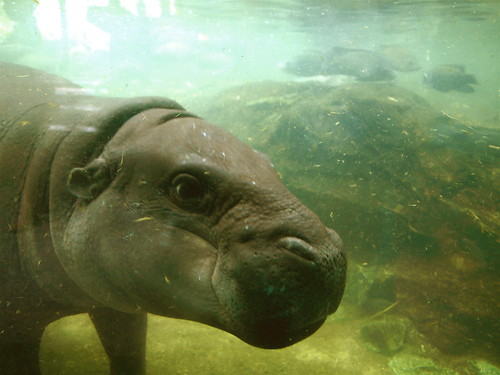
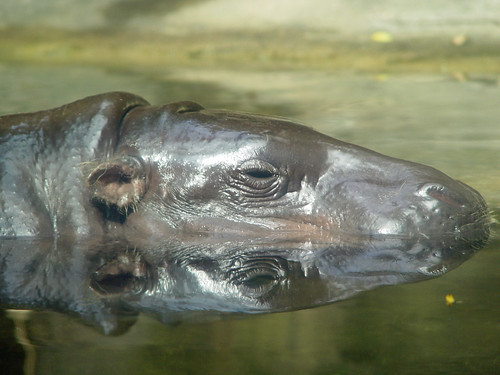
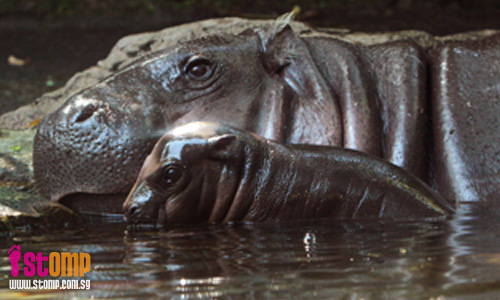
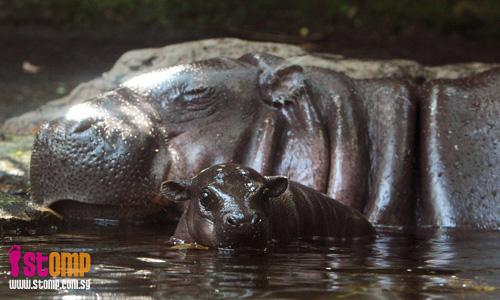
Born on 4th June 2009, this calf is the latest addition to the Singapore Zoo! Weighing 6.2 kg at birth, Divo is the eighth successful birth for proud parents Mina and Babu.Found most in West Africa, with slightly over 3,000 left, pygmy hippos have dwindled in numbers due to deforestation and poaching.
Thursday, June 04, 2009
INFLUENZA A (H1N1) MEASURES IN Singapore Zoo
What is influenza A (H1N1) flu?
The new strain of influenza A (H1N1) involved in the current flu outbreak in humans is a reassortment of several strains of influenza A virus subtype H1N1 that are, separately, endemic in humans, endemic in birds and endemic in swine.
World Organization for Animal Health (OIE) reports that it has not been isolated in swine. It passes with apparent ease from human to human, an ability attributed to an as-yet unidentified mutation. Influenza A (H1N1) is not found in any swine or human in Singapore so far. To prevent the outbreak of pandemic, the focus is in prevention of spread from human to human, and human to our animals.
Are there any live pigs in WRS parks?
Yes, we have live pigs in both Singapore Zoo and Night Safari.
How many pigs are there in WRS parks?
We have a total of 55 pigs at the Singapore Zoo and Night Safari. These include babirusa, warthogs, red river hogs and Malayan bearded pigs.
Is it safe to come into contact with live pigs at WRS parks?
So far, there are no known cases of influenza A (H1N1) in Singapore. However, proper hygiene practices, such as washing of hands after contact with animals including pigs, should be maintained. No visitors are allowed to come into contact with pigs in WRS parks, as the exhibits are fronted by water or dry moats.
Will WRS be closing the exhibits for these animals, especially with the recent case of human to pig transmission in Alberta, Canada?
To date, there are no known cases of influenza A (H1N1) in Singapore. Thus there are no plans to close our exhibits as yet.
The pig population in WRS parks is confined within the parks. Our specimens do not have any contact with other pigs. However, to safeguard out endangered species, WRS parks will confine our babirusa, warthogs and bearded pigs behind the scenes if there is a confirmed outbreak of influenza A (H1N1) in Singapore.
In the event of an outbreak in Singapore, will WRS be putting down the pigs?
We would like to assure the public that WRS parks practise strict biosecurity surveillance in consultation with AVA. Our pigs are confined within the parks and our collection; and they do not have any contact with other pigs. The current influenza A (H1N1) infection is spread from human to human, and we will be ensuring that our pigs are properly protected from such transmissions by maintaining our continuous vigilance and sound biosecurity practices.
What measures are being taken to ensure the safety of visitors?
Wildlife Reserves Singapore parks are in the process of putting up signages to reinforce the need for visitors to wash their hands thoroughly and frequently, especially after using the toilets and if they have come into contact with any animal. We are working with the Agri-Food and Veterinary Authority (AVA) to monitor the influenza A (H1N1) situation closely. Hygiene, and the safety of our animals, visitors and staff are of utmost importance to us.
Keepers are also reminding guests to wash their hands after all animal token feeding sessions.
The parks have also increased the frequency of their cleaning schedules for various facilities. This includes wiping down of all rental equipment such as wagons and strollers with a sanitizer every time they are used, instead of just once daily.
In addition, we are also monitoring the condition of our visitors and keepers, and those who show symptoms of coughing, sneezing and other flu-like symptoms will be asked to consult with a doctor immediately.
Are WRS parks taking the temperatures of their guests?
As there are no known cases of influenza A (H1N1) in Singapore to date, we do not want to alarm our visitors by adopting such measures at this time. Furthermore, our parks are in open areas so visitors are not restricted to confined spaces.
Will the water play area at Rainforest Kidzworld be closed?
There are no plans to close the attraction as yet as there are no known cases of influenza A (H1N1) in Singapore.
Will the animal petting section at Rainforest Kidzworld be closed?
So far, there are no known cases of influenza A (H1N1) flu in Singapore. We encourage our visitors to practise proper hygiene practices, such as washing of hands after contact with animals.
The new strain of influenza A (H1N1) involved in the current flu outbreak in humans is a reassortment of several strains of influenza A virus subtype H1N1 that are, separately, endemic in humans, endemic in birds and endemic in swine.
World Organization for Animal Health (OIE) reports that it has not been isolated in swine. It passes with apparent ease from human to human, an ability attributed to an as-yet unidentified mutation. Influenza A (H1N1) is not found in any swine or human in Singapore so far. To prevent the outbreak of pandemic, the focus is in prevention of spread from human to human, and human to our animals.
Are there any live pigs in WRS parks?
Yes, we have live pigs in both Singapore Zoo and Night Safari.
How many pigs are there in WRS parks?
We have a total of 55 pigs at the Singapore Zoo and Night Safari. These include babirusa, warthogs, red river hogs and Malayan bearded pigs.
Is it safe to come into contact with live pigs at WRS parks?
So far, there are no known cases of influenza A (H1N1) in Singapore. However, proper hygiene practices, such as washing of hands after contact with animals including pigs, should be maintained. No visitors are allowed to come into contact with pigs in WRS parks, as the exhibits are fronted by water or dry moats.
Will WRS be closing the exhibits for these animals, especially with the recent case of human to pig transmission in Alberta, Canada?
To date, there are no known cases of influenza A (H1N1) in Singapore. Thus there are no plans to close our exhibits as yet.
The pig population in WRS parks is confined within the parks. Our specimens do not have any contact with other pigs. However, to safeguard out endangered species, WRS parks will confine our babirusa, warthogs and bearded pigs behind the scenes if there is a confirmed outbreak of influenza A (H1N1) in Singapore.
In the event of an outbreak in Singapore, will WRS be putting down the pigs?
We would like to assure the public that WRS parks practise strict biosecurity surveillance in consultation with AVA. Our pigs are confined within the parks and our collection; and they do not have any contact with other pigs. The current influenza A (H1N1) infection is spread from human to human, and we will be ensuring that our pigs are properly protected from such transmissions by maintaining our continuous vigilance and sound biosecurity practices.
What measures are being taken to ensure the safety of visitors?
Wildlife Reserves Singapore parks are in the process of putting up signages to reinforce the need for visitors to wash their hands thoroughly and frequently, especially after using the toilets and if they have come into contact with any animal. We are working with the Agri-Food and Veterinary Authority (AVA) to monitor the influenza A (H1N1) situation closely. Hygiene, and the safety of our animals, visitors and staff are of utmost importance to us.
Keepers are also reminding guests to wash their hands after all animal token feeding sessions.
The parks have also increased the frequency of their cleaning schedules for various facilities. This includes wiping down of all rental equipment such as wagons and strollers with a sanitizer every time they are used, instead of just once daily.
In addition, we are also monitoring the condition of our visitors and keepers, and those who show symptoms of coughing, sneezing and other flu-like symptoms will be asked to consult with a doctor immediately.
Are WRS parks taking the temperatures of their guests?
As there are no known cases of influenza A (H1N1) in Singapore to date, we do not want to alarm our visitors by adopting such measures at this time. Furthermore, our parks are in open areas so visitors are not restricted to confined spaces.
Will the water play area at Rainforest Kidzworld be closed?
There are no plans to close the attraction as yet as there are no known cases of influenza A (H1N1) in Singapore.
Will the animal petting section at Rainforest Kidzworld be closed?
So far, there are no known cases of influenza A (H1N1) flu in Singapore. We encourage our visitors to practise proper hygiene practices, such as washing of hands after contact with animals.
Tuesday, June 02, 2009
Anteaters caught (human) H1N1 flu in zoo outbreak
Humans, horses, dogs, whales, seals, birds, cats, ferrets and even raccoons are known to be susceptible to the tiny eight-gene viruses. Researchers in Tennessee have now added giant anteaters to that list.
"Who would have thunk it?" senior author Dr. Melissa Kennedy says with a laugh. "We were pretty amazed."
The February 2007 outbreak, involving 11 adult giant anteaters at Tennessee's Nashville zoo, is reported in an article that will be published in the July issue of the journal Emerging Infectious Diseases. All the anteaters survived the illness.
Branswell's story makes it clear that the anteaters caught the "old" human form of H1N1, not the current strain.
"Who would have thunk it?" senior author Dr. Melissa Kennedy says with a laugh. "We were pretty amazed."
The February 2007 outbreak, involving 11 adult giant anteaters at Tennessee's Nashville zoo, is reported in an article that will be published in the July issue of the journal Emerging Infectious Diseases. All the anteaters survived the illness.
Branswell's story makes it clear that the anteaters caught the "old" human form of H1N1, not the current strain.
Monday, June 01, 2009
Don't stay at home during the June holidays
It's that time of the year again; the time where the weather becomes unbareably hot, the kids are set loose and suddenly, malls are over-run with screaming children.
Though traveling will most probably be out of the question this year, fret not! Singapore is filled with a barrage of exciting promotions for you and your child, this June, you'll never be bored.
National Museum
1) Get Real, Kids: Let there be Clothes! (In collaboration with Project Omelette)
Specially developed for active young learners, these half-day workshops incorporate all the necessary ingredients to ignite the passion of discovery, fuel the process of learning, while inculcating thoughtful values and life skills in children.
Let the hidden designer in your child bloom as they are introduced to the history of world fashion and discover the identity of clothes through play, while exploring the National Museum of Singapore’s Fashion Gallery.
They can also, design their own t-shirts from skills and knowledge acquired at the workshop.
Where: National Museum Canning Visitor Services Counter (Level 2)
When: 5-6 Jun 2009 Fri & Sat
Timing: 09:00AM & 02:00PM
Ticket pricing: Standard - S$70
Book your tickets at sistic.
2) Cook up your Singapore Flavour
What was a street hawker’s life like in the 1950s and what hawker foods were popular then? Introduce your child to a slice of history through this workshop that includes a tour of the Food Gallery and hands-on craftwork with clay. Let your child experience the bustling street life through the sounds and smells in the gallery, then re-create a local food with play clay and lots of inspiration gathered from the tour!
Where: Stamford Visitor Services Counter, Level 1
When: Wed 3 Jun – Sun 7 Jun, Wed 10 Jun – Sun 14 Jun, Wed 17 Jun – Sun 21 Jun 09
Timing: 11am – 12.15pm
Prices: S$25 per child
For more information check out sistic.
3) Design Future Fashions From Past Styles
What did your grandmother wear when she was a young lady? How is that different from what we wear today?
Your child will be introduced to fashion trends and traditional costumes worn by women in Singapore from the 1950s to 1970s in the National Museum of Singapore’s Fashion Gallery.
Where: National Museum Stamford Visitor Services Counter (Level 1)
When: 3-21 Jun 2009
Timing: 1:30PM
Prices: S$25
For more information check out sistic.
4) Get Real, Kids: Sensing Food
Sensing Food educates children on the global issue of starvation around the world and how they can play a part to help the less fortunate.
Here, they will find out where their favourite burger originates from, discern what constitutes a healthy meal, and express their creativity by designing a healthy burger complete with a presentation kit to promote their product!
Where: National Museum Canning Visitor Services Counter (Level 2)
When: 19-20 Jun 2009 Fri & Sat
Timing: 09:00AM & 02:00PM
Prices: S$70
For more information check out sistic.
5) Children Season returns to the National Museum of Singapore
The National Museum of Singapore is bringing in a performance entitled Dinosaurs in the Garden by Erth Visual & Physical (Australia) . Interect with a herd of "dinosaurs" at the National Museum this holiday.
Where: National Museum Gallery Theatre
When: 4-7 June 2009
Timing: 11am, 2pm and 5pm
Prices: $20 with additional $1 booking fee.
Call Sistic at 6384-5555 for tickets
Park Hopper: Night Safari, Jurong Bird Park and Singapore Zoo
Explore all three of Singapore's most famous parks at a special price of one ticket at $40 (adult) and $20 (child).
Join all three parks on a prehistoric adventure through Jurong Bird Park's new exhibition 'Dinosaur Descendants'. You can also take part in the Dino Trail contest, which will run across the three parks and involve participants answering questions relating to exhibits.
Spend your morning and afternoon at the Zoo and at the bird park and end of the day with a tram ride through Night Safari.
Check out the websites for more information on other events:
Night Safari Singapore Zoo
Jurong Bird Park
"Sleep with the Penguins" Family Camp
Join the bird park in celebrating one of the world's most beloved birds, the penguins.
In this 2 days 1 night camp, it's fun for the whole family as you gather your sleeping bags around the camp fire to have a thrilling encounter with the penguins.
Perfect for toddlers to grandparents, you'll have a fun-packed camp with the bird park.
Where: Jurong Bird Park
When: 13-14 June
Prices: $110 per adult (13 & Above)
$90 per child (3 - 12 years)
*As only tents will be provided, you are encouraged to bring your own sleeping bags, pillows, blankets, picnic mats, mini portable fan, toiletries, insect repellent and additional torchlight.
Check out the camp's itinerary for registration.
Though traveling will most probably be out of the question this year, fret not! Singapore is filled with a barrage of exciting promotions for you and your child, this June, you'll never be bored.
National Museum
1) Get Real, Kids: Let there be Clothes! (In collaboration with Project Omelette)
Specially developed for active young learners, these half-day workshops incorporate all the necessary ingredients to ignite the passion of discovery, fuel the process of learning, while inculcating thoughtful values and life skills in children.
Let the hidden designer in your child bloom as they are introduced to the history of world fashion and discover the identity of clothes through play, while exploring the National Museum of Singapore’s Fashion Gallery.
They can also, design their own t-shirts from skills and knowledge acquired at the workshop.
Where: National Museum Canning Visitor Services Counter (Level 2)
When: 5-6 Jun 2009 Fri & Sat
Timing: 09:00AM & 02:00PM
Ticket pricing: Standard - S$70
Book your tickets at sistic.
2) Cook up your Singapore Flavour
What was a street hawker’s life like in the 1950s and what hawker foods were popular then? Introduce your child to a slice of history through this workshop that includes a tour of the Food Gallery and hands-on craftwork with clay. Let your child experience the bustling street life through the sounds and smells in the gallery, then re-create a local food with play clay and lots of inspiration gathered from the tour!
Where: Stamford Visitor Services Counter, Level 1
When: Wed 3 Jun – Sun 7 Jun, Wed 10 Jun – Sun 14 Jun, Wed 17 Jun – Sun 21 Jun 09
Timing: 11am – 12.15pm
Prices: S$25 per child
For more information check out sistic.
3) Design Future Fashions From Past Styles
What did your grandmother wear when she was a young lady? How is that different from what we wear today?
Your child will be introduced to fashion trends and traditional costumes worn by women in Singapore from the 1950s to 1970s in the National Museum of Singapore’s Fashion Gallery.
Where: National Museum Stamford Visitor Services Counter (Level 1)
When: 3-21 Jun 2009
Timing: 1:30PM
Prices: S$25
For more information check out sistic.
4) Get Real, Kids: Sensing Food
Sensing Food educates children on the global issue of starvation around the world and how they can play a part to help the less fortunate.
Here, they will find out where their favourite burger originates from, discern what constitutes a healthy meal, and express their creativity by designing a healthy burger complete with a presentation kit to promote their product!
Where: National Museum Canning Visitor Services Counter (Level 2)
When: 19-20 Jun 2009 Fri & Sat
Timing: 09:00AM & 02:00PM
Prices: S$70
For more information check out sistic.
5) Children Season returns to the National Museum of Singapore
The National Museum of Singapore is bringing in a performance entitled Dinosaurs in the Garden by Erth Visual & Physical (Australia) . Interect with a herd of "dinosaurs" at the National Museum this holiday.
Where: National Museum Gallery Theatre
When: 4-7 June 2009
Timing: 11am, 2pm and 5pm
Prices: $20 with additional $1 booking fee.
Call Sistic at 6384-5555 for tickets
Park Hopper: Night Safari, Jurong Bird Park and Singapore Zoo
Explore all three of Singapore's most famous parks at a special price of one ticket at $40 (adult) and $20 (child).
Join all three parks on a prehistoric adventure through Jurong Bird Park's new exhibition 'Dinosaur Descendants'. You can also take part in the Dino Trail contest, which will run across the three parks and involve participants answering questions relating to exhibits.
Spend your morning and afternoon at the Zoo and at the bird park and end of the day with a tram ride through Night Safari.
Check out the websites for more information on other events:
Night Safari Singapore Zoo
Jurong Bird Park
"Sleep with the Penguins" Family Camp
Join the bird park in celebrating one of the world's most beloved birds, the penguins.
In this 2 days 1 night camp, it's fun for the whole family as you gather your sleeping bags around the camp fire to have a thrilling encounter with the penguins.
Perfect for toddlers to grandparents, you'll have a fun-packed camp with the bird park.
Where: Jurong Bird Park
When: 13-14 June
Prices: $110 per adult (13 & Above)
$90 per child (3 - 12 years)
*As only tents will be provided, you are encouraged to bring your own sleeping bags, pillows, blankets, picnic mats, mini portable fan, toiletries, insect repellent and additional torchlight.
Check out the camp's itinerary for registration.
Saturday, May 30, 2009
Australian Festival 2009 @ Singapore Zoo: May 30-June 28
Starting every Saturday & Sunday from 30 May - 28 June, hop into the Australian Festival at the Singapore Zoo this June Holidays to experience the beauty and culture of the vast semi-arid land of the Australian Outback!
Meet the Wild Aussies - a star-studded crew of a wallaby and her friends - a cockatoo and a frilled neck lizard as they sing and dance their way around Australia to help you learn more about their endangered animals.
Witness how the Outback is buzzing with well-adapted wildlife such as kangaroos, wallabies, reptiles, emu, brolga, breaded dragon, frilled-neck lizard and more. Get up close and personal with the kangaroos and wallabies in the Great Outback drawing competition and join in a token feeding session right after.
And don’t miss our exciting Australian bazaar every weekend! With exciting stalls featuring Australian performances, art and crafts and face-painting, families and kids can celebrate all things Australian and enjoy a wide spectrum of family entertainment.
Ticketing of Australian Festival 2009
Adult : $18, Child $9
Meet the Wild Aussies - a star-studded crew of a wallaby and her friends - a cockatoo and a frilled neck lizard as they sing and dance their way around Australia to help you learn more about their endangered animals.
Witness how the Outback is buzzing with well-adapted wildlife such as kangaroos, wallabies, reptiles, emu, brolga, breaded dragon, frilled-neck lizard and more. Get up close and personal with the kangaroos and wallabies in the Great Outback drawing competition and join in a token feeding session right after.
And don’t miss our exciting Australian bazaar every weekend! With exciting stalls featuring Australian performances, art and crafts and face-painting, families and kids can celebrate all things Australian and enjoy a wide spectrum of family entertainment.
Ticketing of Australian Festival 2009
Adult : $18, Child $9
Dragons attack Indonesians
Komodo dragons have shark-like teeth and poisonous venom that can kill a person within hours of a bite. Yet villagers who have lived for generations alongside the world's largest lizard were not afraid _ until the dragons started to attack.
The stories spread quickly across this smattering of tropical islands in southeastern Indonesia, the only place the endangered reptiles can still be found in the wild: Two people were killed since 2007 _ a young boy and a fisherman _ and others were badly wounded after being charged unprovoked.
Komodo dragon attacks are still rare, experts note. But fear is swirling through the fishing villages, along with questions on how best to live with the dragons in the future.
Main, a 46-year-old park ranger, who like many Indonesians goes by a single name, was doing paperwork when a dragon slithered up the stairs of his wooden hut in Komodo National Park and went for his ankles dangling beneath the desk. When the ranger tried to pry open the beast's powerful jaws, it locked its teeth into his hand.
"I thought I wouldn't survive... I've spent half my life working with Komodos and have never seen anything like it," said Main, pointing to his jagged gashes, sewn up with 55 stitches and still swollen three months later. "Luckily, my friends heard my screams and got me to hospital in time."
Komodos, which are popular at zoos in the United States to Europe, grow to be 10 feet (3 meters) long and 150 pounds (70 kilograms). All of the estimated 2,500 left in the wild can be found within the 700-square-mile (1,810-square-kilometer) Komodo National Park, mostly on its two largest islands, Komodo and Rinca. The lizards on neighboring Padar were wiped out in the 1980s when hunters killed their main prey, deer.
Though poaching is illegal, the sheer size of the park _ and a shortage of rangers _ makes it almost impossible to patrol, said Heru Rudiharto, a biologist and reptile expert. Villagers say the dragons are hungry and more aggressive toward humans because their food is being poached, though park officials are quick to disagree.
The giant lizards have always been dangerous, said Rudiharto. However tame they may appear, lounging beneath trees and gazing at the sea from white-sand beaches, they are fast, strong and deadly.
The animals are believed to have descended from a larger lizard on Indonesia's main island Java or Australia around 30,000 years ago. They can reach speeds of up to 18 miles (nearly 30 kilometers) per hour, their legs winding around their low, square shoulders like egg beaters.
When they catch their prey, they carry out a frenzied biting spree that releases venom, according to a new study this month in the journal Proceedings of the National Academy of Sciences. The authors, who used surgically excised glands from a terminally ill dragon at the Singapore Zoo, dismissed the theory that prey die from blood poisoning caused by toxic bacteria in the lizard's mouth.
The long, jagged teeth are the lizard's primary weapons, said Bryan Fry of the University of Melbourne.
"They deliver these deep, deep wounds," he said. "But the venom keeps it bleeding and further lowers the blood pressure, thus bringing the animal closer to unconsciousness."
Four people have been killed in the last 35 years (2009, 2007, 2000 and 1974) and at least eight injured in just over a decade. But park officials say these numbers aren't overly alarming given the steady stream of tourists and the 4,000 people who live in their midst.
"Any time there's an attack, it gets a lot of attention," Rudiharto said. "But that's just because this lizard is exotic, archaic, and can't be found anywhere but here."
Still, the recent attacks couldn't have come at a worse time.
The government is campaigning hard to get the park onto a new list of the Seven Wonders of Nature _ a long shot, but an attempt to at least raise awareness. The park's rugged hills and savannahs are home to orange-footed scrub fowl, wild boar and small wild horses, and the surrounding coral reefs and bays harbor more than a dozen whale species, dolphins and sea turtles.
Claudio Ciofi, who works at the Department of Animal Biology and Genetics at the University of Florence in Italy, said if komodos are hungry, they may be attracted to villages by the smell of drying fish and cooking, and "encounters can become more frequent."
Villagers wish they knew the answer.
They say they've always lived peacefully with Komodos. A popular traditional legend tells of a man who once married a dragon "princess." Their twins, a human boy, Gerong, and a lizard girl, Orah, were separated at birth.
When Gerong grew up, the story goes, he met a fierce-looking beast in the forest. But just as he was about to spear it, his mother appeared, revealing to him that the two were brother and sister.
"How could the dragons get so aggressive?" Hajj Amin, 51, taking long slow drags off his clove cigarettes, as other village elders gathering beneath a wooden house on stilts nodded. Several dragons lingered nearby, drawn by the rancid smell of fish drying on bamboo mats beneath the blazing sun. Also strolling by were dozens of goats and chickens.
"They never used to attack us when we walked alone in the forest, or attack our children," Amin said. "We're all really worried about this."
The dragons eat 80 percent of their weight and then go without food for several weeks. Amin and others say the dragons are hungry partly because of a 1994 policy that prohibits villagers from feeding them.
"We used to give them the bones and skin of deer," said the fisherman.
Villagers recently sought permission to feed wild boar to the Komodos several times a year, but park officials say that won't happen.
"If we let people feed them, they will just get lazy and lose their ability to hunt," said Jeri Imansyah, another reptile expert. "One day, that will kill them. "
The attack that first put villagers on alert occurred two years ago, when 8-year-old Mansyur was mauled to death while defecating in the bushes behind his wooden hut.
People have since asked for a 6-foot-high (2-meter) concrete wall to be built around their villages, but that idea, too, has been rejected. The head of the park, Tamen Sitorus, said: "It's a strange request. You can't build a fence like that inside a national park!"
Residents have made a makeshift barrier out of trees and broken branches, but they complain it's too easy for the animals to break through.
"We're so afraid now," said 11-year-old Riswan, recalling how just a few weeks ago students screamed when they spotted one of the giant lizards in a dusty field behind their school. "We thought it was going to get into our classroom. Eventually we were able to chase it up a hill by throwing rocks and yelling 'Hoohh Hoohh.'"
Then, just two months ago, 31-year-old fisherman Muhamad Anwar was killed when he stepped on a lizard in the grass as he was heading to a field to pick fruit from a sugar tree.
Even park rangers are nervous.
Gone are the days of goofing around with the lizards, poking their tails, hugging their backs and running in front of them, pretending they're being chased, said Muhamad Saleh, who has worked with the animals since 1987.
"Not any more," he says, carrying a 6-foot-long (2-meter) stick wherever he goes for protection. Then, repeating a famous line by Indonesia's most renowned poet, he adds: "I want to live for another thousand of years."
The stories spread quickly across this smattering of tropical islands in southeastern Indonesia, the only place the endangered reptiles can still be found in the wild: Two people were killed since 2007 _ a young boy and a fisherman _ and others were badly wounded after being charged unprovoked.
Komodo dragon attacks are still rare, experts note. But fear is swirling through the fishing villages, along with questions on how best to live with the dragons in the future.
Main, a 46-year-old park ranger, who like many Indonesians goes by a single name, was doing paperwork when a dragon slithered up the stairs of his wooden hut in Komodo National Park and went for his ankles dangling beneath the desk. When the ranger tried to pry open the beast's powerful jaws, it locked its teeth into his hand.
"I thought I wouldn't survive... I've spent half my life working with Komodos and have never seen anything like it," said Main, pointing to his jagged gashes, sewn up with 55 stitches and still swollen three months later. "Luckily, my friends heard my screams and got me to hospital in time."
Komodos, which are popular at zoos in the United States to Europe, grow to be 10 feet (3 meters) long and 150 pounds (70 kilograms). All of the estimated 2,500 left in the wild can be found within the 700-square-mile (1,810-square-kilometer) Komodo National Park, mostly on its two largest islands, Komodo and Rinca. The lizards on neighboring Padar were wiped out in the 1980s when hunters killed their main prey, deer.
Though poaching is illegal, the sheer size of the park _ and a shortage of rangers _ makes it almost impossible to patrol, said Heru Rudiharto, a biologist and reptile expert. Villagers say the dragons are hungry and more aggressive toward humans because their food is being poached, though park officials are quick to disagree.
The giant lizards have always been dangerous, said Rudiharto. However tame they may appear, lounging beneath trees and gazing at the sea from white-sand beaches, they are fast, strong and deadly.
The animals are believed to have descended from a larger lizard on Indonesia's main island Java or Australia around 30,000 years ago. They can reach speeds of up to 18 miles (nearly 30 kilometers) per hour, their legs winding around their low, square shoulders like egg beaters.
When they catch their prey, they carry out a frenzied biting spree that releases venom, according to a new study this month in the journal Proceedings of the National Academy of Sciences. The authors, who used surgically excised glands from a terminally ill dragon at the Singapore Zoo, dismissed the theory that prey die from blood poisoning caused by toxic bacteria in the lizard's mouth.
The long, jagged teeth are the lizard's primary weapons, said Bryan Fry of the University of Melbourne.
"They deliver these deep, deep wounds," he said. "But the venom keeps it bleeding and further lowers the blood pressure, thus bringing the animal closer to unconsciousness."
Four people have been killed in the last 35 years (2009, 2007, 2000 and 1974) and at least eight injured in just over a decade. But park officials say these numbers aren't overly alarming given the steady stream of tourists and the 4,000 people who live in their midst.
"Any time there's an attack, it gets a lot of attention," Rudiharto said. "But that's just because this lizard is exotic, archaic, and can't be found anywhere but here."
Still, the recent attacks couldn't have come at a worse time.
The government is campaigning hard to get the park onto a new list of the Seven Wonders of Nature _ a long shot, but an attempt to at least raise awareness. The park's rugged hills and savannahs are home to orange-footed scrub fowl, wild boar and small wild horses, and the surrounding coral reefs and bays harbor more than a dozen whale species, dolphins and sea turtles.
Claudio Ciofi, who works at the Department of Animal Biology and Genetics at the University of Florence in Italy, said if komodos are hungry, they may be attracted to villages by the smell of drying fish and cooking, and "encounters can become more frequent."
Villagers wish they knew the answer.
They say they've always lived peacefully with Komodos. A popular traditional legend tells of a man who once married a dragon "princess." Their twins, a human boy, Gerong, and a lizard girl, Orah, were separated at birth.
When Gerong grew up, the story goes, he met a fierce-looking beast in the forest. But just as he was about to spear it, his mother appeared, revealing to him that the two were brother and sister.
"How could the dragons get so aggressive?" Hajj Amin, 51, taking long slow drags off his clove cigarettes, as other village elders gathering beneath a wooden house on stilts nodded. Several dragons lingered nearby, drawn by the rancid smell of fish drying on bamboo mats beneath the blazing sun. Also strolling by were dozens of goats and chickens.
"They never used to attack us when we walked alone in the forest, or attack our children," Amin said. "We're all really worried about this."
The dragons eat 80 percent of their weight and then go without food for several weeks. Amin and others say the dragons are hungry partly because of a 1994 policy that prohibits villagers from feeding them.
"We used to give them the bones and skin of deer," said the fisherman.
Villagers recently sought permission to feed wild boar to the Komodos several times a year, but park officials say that won't happen.
"If we let people feed them, they will just get lazy and lose their ability to hunt," said Jeri Imansyah, another reptile expert. "One day, that will kill them. "
The attack that first put villagers on alert occurred two years ago, when 8-year-old Mansyur was mauled to death while defecating in the bushes behind his wooden hut.
People have since asked for a 6-foot-high (2-meter) concrete wall to be built around their villages, but that idea, too, has been rejected. The head of the park, Tamen Sitorus, said: "It's a strange request. You can't build a fence like that inside a national park!"
Residents have made a makeshift barrier out of trees and broken branches, but they complain it's too easy for the animals to break through.
"We're so afraid now," said 11-year-old Riswan, recalling how just a few weeks ago students screamed when they spotted one of the giant lizards in a dusty field behind their school. "We thought it was going to get into our classroom. Eventually we were able to chase it up a hill by throwing rocks and yelling 'Hoohh Hoohh.'"
Then, just two months ago, 31-year-old fisherman Muhamad Anwar was killed when he stepped on a lizard in the grass as he was heading to a field to pick fruit from a sugar tree.
Even park rangers are nervous.
Gone are the days of goofing around with the lizards, poking their tails, hugging their backs and running in front of them, pretending they're being chased, said Muhamad Saleh, who has worked with the animals since 1987.
"Not any more," he says, carrying a 6-foot-long (2-meter) stick wherever he goes for protection. Then, repeating a famous line by Indonesia's most renowned poet, he adds: "I want to live for another thousand of years."
Friday, May 29, 2009
Porcupine, python strut catwalk for Russian zoo
Leggy models shared the catwalk with a porcupine, a python and a yak on Sunday at a fashion show to raise public awareness of animal welfare and Saint Petersburg's zoo.
About a dozen animals in all -- some on leashes, others in the models' arms -- strutted their stuff for the zoo, one of the oldest in Europe but hard-pressed for funds.
"Casting the models was not easy," Tatiana Fedorishenko, the zoo's deputy director, told AFP, referring to the human kind. "The animals in the show are tame, but the models have to be without fear, and comfortable with them."
"It was hard," confided one of the models, Natasha. "My fox was always trying to run away. I had trouble finishing my walk."
The show was the idea of fashion designers in Russia's second city, in solidarity with the 410 species and 2,000 animals at the zoo in Alexander Park that was founded in 1865.
"I'm taking part because of my compassion for animals," said designer Vladislav Aksyonov. "I am flatly opposed to the use of natural fur and I also want to help our zoo." - AFP
About a dozen animals in all -- some on leashes, others in the models' arms -- strutted their stuff for the zoo, one of the oldest in Europe but hard-pressed for funds.
"Casting the models was not easy," Tatiana Fedorishenko, the zoo's deputy director, told AFP, referring to the human kind. "The animals in the show are tame, but the models have to be without fear, and comfortable with them."
"It was hard," confided one of the models, Natasha. "My fox was always trying to run away. I had trouble finishing my walk."
The show was the idea of fashion designers in Russia's second city, in solidarity with the 410 species and 2,000 animals at the zoo in Alexander Park that was founded in 1865.
"I'm taking part because of my compassion for animals," said designer Vladislav Aksyonov. "I am flatly opposed to the use of natural fur and I also want to help our zoo." - AFP
Thursday, May 28, 2009
Bears 'celebrate' Jewish holiday
Bears at an Israeli zoo are given a festive meal of cheese as part of the celebrations of the Jewish holiday of Shavuot.
Normally accustomed to fruit, the bears are instead enjoying blocks of
cheese.
In modern Jewish Israeli custom families gather to eat a dairy-based meal.
And the keepers at the zoo thought the bears should be able to join in with
the celebrations.
SHAI DAVID, ZOO KEEPER, SAYING:
"This is a special breakfast, specially made for Shavuot, the
Jewish holiday. It's basically made of cheese, cream cheese, and fruits as a
custom - just like we do it on this holiday."
Shavuot celebrates the giving of the Torah by God to the Jewish people on
Mount Sinai, seven weeks after their exodus from slavery in Egypt.
Traditionally, Jewish residents of Israel visit the Western Wall in
Jerusalem's Old City - one of Judaism's holiest sites.
And while it's unlikely the bears will be making any such pilgrimage, they
certainly got into the spirit of the holiday where the food was concerned.
Normally accustomed to fruit, the bears are instead enjoying blocks of
cheese.
In modern Jewish Israeli custom families gather to eat a dairy-based meal.
And the keepers at the zoo thought the bears should be able to join in with
the celebrations.
SHAI DAVID, ZOO KEEPER, SAYING:
"This is a special breakfast, specially made for Shavuot, the
Jewish holiday. It's basically made of cheese, cream cheese, and fruits as a
custom - just like we do it on this holiday."
Shavuot celebrates the giving of the Torah by God to the Jewish people on
Mount Sinai, seven weeks after their exodus from slavery in Egypt.
Traditionally, Jewish residents of Israel visit the Western Wall in
Jerusalem's Old City - one of Judaism's holiest sites.
And while it's unlikely the bears will be making any such pilgrimage, they
certainly got into the spirit of the holiday where the food was concerned.
Wednesday, May 27, 2009
New Zealand zookeeper killed by white tiger
(AFP) - A zookeeper was mauled to death by a white tiger at a New Zealand wildlife park Wednesday in an attack witnessed by horrified tourists, police said.
The male wildlife keeper was attacked by the animal while cleaning an enclosure in Whangarei's Zion Wildlife Gardens in New Zealand's north.
Eight foreign tourists at the park were understood to have seen the mauling, a police spokeswoman added.
"It was very, very frightening," an Auckland man told a Fairfax reporter, without giving his name.
Two keepers had gone into an enclosure containing two white tigers, when one of the animals attacked, the police spokeswoman said.
"Despite the best efforts of the second keeper and a rapid response from other wildlife park staff, the tiger would not let the park worker go and he died at the scene," she said.
The tiger was later destroyed by staff and the wildlife park was closed.
Another employee of the park, which is home to around 40 rare lions and tigers, required surgery after he was attacked in February by a white tiger after it was startled by a pride of lions.
Zion Wildlife Gardens are well known in New Zealand as the home of the Lion Man television series, which followed the work of Craig Busch, who was dismissed from the park controlled by his mother last year.
On Tuesday, Busch claimed in a court hearing over his dismissal that animal care and safety standards had slipped at the park since the breakdown of his relationship with his mother.
"I became very concerned with animal welfare issues," he said. Ministry of Agriculture and Forestry documents released to Television New Zealand last year expressed concerns over animals kept in crowded, unsanitary conditions.
Inspectors were at one stage so concerned by conditions at Zion Wildlife Gardens they considered having 40 lions and tigers put down.
I thought such things only happen in Singapore.
The male wildlife keeper was attacked by the animal while cleaning an enclosure in Whangarei's Zion Wildlife Gardens in New Zealand's north.
Eight foreign tourists at the park were understood to have seen the mauling, a police spokeswoman added.
"It was very, very frightening," an Auckland man told a Fairfax reporter, without giving his name.
Two keepers had gone into an enclosure containing two white tigers, when one of the animals attacked, the police spokeswoman said.
"Despite the best efforts of the second keeper and a rapid response from other wildlife park staff, the tiger would not let the park worker go and he died at the scene," she said.
The tiger was later destroyed by staff and the wildlife park was closed.
Another employee of the park, which is home to around 40 rare lions and tigers, required surgery after he was attacked in February by a white tiger after it was startled by a pride of lions.
Zion Wildlife Gardens are well known in New Zealand as the home of the Lion Man television series, which followed the work of Craig Busch, who was dismissed from the park controlled by his mother last year.
On Tuesday, Busch claimed in a court hearing over his dismissal that animal care and safety standards had slipped at the park since the breakdown of his relationship with his mother.
"I became very concerned with animal welfare issues," he said. Ministry of Agriculture and Forestry documents released to Television New Zealand last year expressed concerns over animals kept in crowded, unsanitary conditions.
Inspectors were at one stage so concerned by conditions at Zion Wildlife Gardens they considered having 40 lions and tigers put down.
I thought such things only happen in Singapore.
Subscribe to:
Posts (Atom)