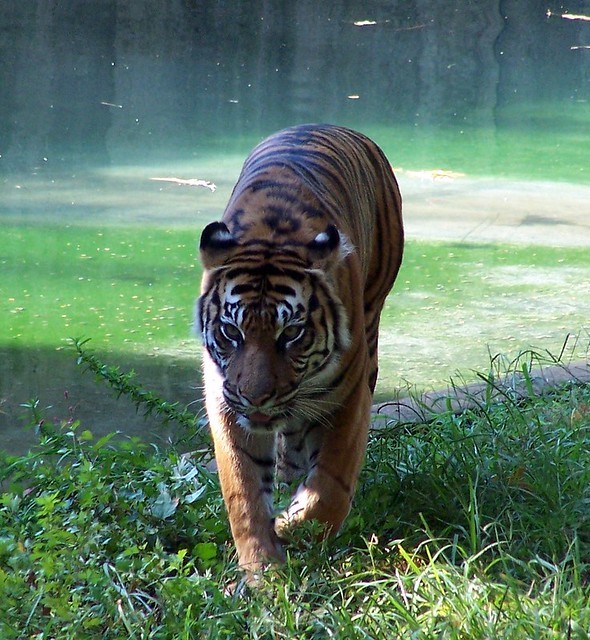
Check out the River Safari's main attractions ahead of its opening on 3rd April. The S$160m, 12-hectare complex lies right between the Singapore Zoo and Night Safari, and is the first of its kind in Asia.
Tickets are priced at S$35 for adults, S$23 for children aged 3-12 and S$17.50 for senior citizens above 60. With some attractions yet to be complete, daily admission during this soft opening phase will cost S$25, S$16 and S$12.50 for the respective categories.
Time to spend some $$$.
I have been Friends of the Singapore Zoo for many years, if you want it to continue giving us the fun and joy of animals, please visit the Singapore Zoo. Singapore Zoo, 80 Mandai Lake Road (Bus 138 from Ang Mo Kio MRT or 171 from City). Opening hours are 8.30am-6.00pm daily and adult admission is S$28, children is $18. *Park Hooper packages are more worth it. Check them out first before you purchase those tickets. Zoo, Night Safari, Jurong Bird Park or River Safari.
Tuesday, March 26, 2013
Wednesday, March 20, 2013
Musical ZOO
Yogyakarta experimental rock band ZOO kick off their regional tour in Singapore with their singular blend of math rock, noise, tribal and reconfigured traditional music. Their live performances are intense, charismatic and wild. This is a band to be experienced in the flesh.
with AWK WAH (Shark Fung)
and CACTUS (Jordan & Marina)
21 Mar 2013 (Thu)
Night & Day, 139 Selegie Road
8pm
$15 (includes 1 drink)
Presented by Ujikaji and the Independent Archive & Resource Center
Venue hosted by Night & Day
ZOO:
The band was formed in 2005 after a year of building the concept. In the first EP Kebun Binatang (2007), Zoo was still playing fast, mathematic, and noisy music as often seen in Boredoms, Ruins, Melt Banana, or Hella. But in their first full album, Trilogi Peradaban (2009), elements of ethnic music was introduced, and then in their latest release, Prasasti (2012), Zoo’s music has now progressed toward significant direction; ethnic and tribal elements are no longer elements but has becoming an integral part of Zoo as a band and therefore creating a new undefined music. All these contrast crossovers of many different influences are there in order to align the music with theme that they try to put forward.
The theme behind every lyrics are all about modern civilization, human ambition of immortality, deterioration of cultural roots and some theme that encourage optimism.
PERSONNEL
RULLY SHABARA– VOKAL, DJEMBE, REBANA, SYNTH
BHAKTI PRASETYO– BASS
RAMBERTO AGOZALIE– DRUMS
DIMAS BUDI SATYA– DRUMS, CUSTOM PERCUSSION
CACTUS:
Cactus is the brainchild of producer-composer and multi-instrumentalist Jordan Johari Rais (b. 1978) and his wife, vocalist and bass and percussion player Marina Abu Hassan (b. 1982).
Cactus was born on the slopes of tea plantation in Cameron Highlands, Malaysia in April 2011 when the duo decided to interpret the colours, sights and sounds of the nature and life around them then into a creative product they can call their own.
They play an eclectic mix of analog and digital sounds wrapped in traditional harmonies and percussive beats, this time accompanied by two other musicians Matt Raham on drums and Maggot Isa on bass. Also joining them in full spirit and physical prowess inspiration yada yada, “Django”, the unborn child to mother Marina and Jordan.
AWK WAH:
Shark from Engineered Beautiful Blood, Amino Acid Orchestra and I\D started this solo project which resulted in the cult favourite Opera Box (2010), blowing our minds with its rhythmic noise and harsh miasmic darkness. When he reappeared at the inaugural Earthbound gig in 2012 unveiling a new set up of drums, effects, synth and sampler and creating a schizo mix of dirty noise and hypnotic beats, practically inventing a new genre that we like to call “distraught techno”. Awk Wah releases his second album on LP and download with Ujikaji in the middle of the year.
Friday, March 15, 2013
Manatees in Singapore Zoo relocate to new home
Singapore Zoo staff members move a 400 kg, 33-year-old male manatee during the move to its new enclosure at the River Safari in Singapore, March 13, 2013. Singapore Zoo relocated the manatees to a new enclosure "Amazon Flooded Forest" at the River Safari.
Singapore Zoo staff members transfer oxygen to an 8-year-old female manatee during the move to its new enclosure at the River Safari in Singapore, March 13, 2013. Singapore Zoo relocated the manatees to a new enclosure "Amazon Flooded Forest" at the River Safari.
New enclosure for them.
Singapore Zoo staff members transfer oxygen to an 8-year-old female manatee during the move to its new enclosure at the River Safari in Singapore, March 13, 2013. Singapore Zoo relocated the manatees to a new enclosure "Amazon Flooded Forest" at the River Safari.
New enclosure for them.
Saturday, March 09, 2013
Singapore Zoo turns 40
Singapore Zoo celebrates its 40th birthday this year with a series of events. The zoo is looking for people who were born on the day the zoo began operations on 27 June 1973.
These people will be invited for a special Singapore Zoo Birthday Bash and be taken on an exclusive tour with a zoo pioneer.
The zoo is also giving a 40 per cent discount on its admission ticket prices for Singaporeans and permanent residents who turn 40 this year. But these individuals must visit with four other friends during the birthday month. The discount is valid from now till the end of the year.
The zoo is also organizing a 40th Birthday Bash Zoo Hunt on 16 and 17 March.
Singapore Zoo 40th Birthday Promotion
Celebrate with us! Enjoy 40% off admission ticket prices when you celebrate your 40th with us. From 1 March until 31 December 2013, Singaporeans and Permanent Residents born in 1973 can enjoy 40% off admission ticket prices for themselves and four other friends when they visit during their birthday month.
Terms & Conditions
Promotion is valid from 1 Mar – 31 Dec 2013.
Present original IC or passport to enjoy offer.
Maximum purchase of 5 discounted tickets per identity card/passport, per transaction.
Promotion is only valid for Singaporeans and Permanent Residents.
Promotion is only valid for tickets bought over the ticketing counters at Singapore Zoo.
Offer applies to admission on day of ticket purchase.
Offer is not valid with any other promotions, discounts or online ticket purchase.
Admission ticket purchased is not refundable or exchangeable for cash or kind.
No claims will be entertained for any lost, torn, defaced or expired ticket.
Sunday, February 17, 2013
Safari Zoo Run 2013
An 8,000 strong crowd took a run on the wild side when they took part in the Safari Zoo Run 2013, held on the first weekend of the Year of the Snake.
Participants got to run amidst the lush greenery of the Singapore Zoo and Night Safari as wild creatures watched. The race was flagged off Guest-of-Honour Mr Liang Eng Hwa (Member of Parliament, Holland-Bukit Timah GRC) along with Mr Lee Meng Tat, CEO, Wildlife Reserves Singapore and Ms Isabel Cheng, Chief Marketing Officer, Wildlife Reserves Singapore.
Participants also took part in snake-tivities after the run, such as visiting a snake-themed educational booth, viewing an auspicious snake showcase at Singapore Zoo’s Rainforest Walk, and engaging in hand painting activities.
Many participants also visited the Reptile Garden and where over 20 species of snakes were on display. Now in its fifth year, Safari Zoo Run was conceptualised in memory of orang utan Ah Meng, one of Singapore’s most adored animal personalities.
The objectives of Safari Zoo Run are to encourage family bonding and promote healthy lifestyle amongst Singaporeans. The run also aids in wildlife conservation, with S$100,000 from the run going towards the care of endangered animals in Night Safari and Singapore Zoo, as well as the adoption of orang utan Ah Meng Junior.
Wednesday, February 06, 2013
OF ZOOS
OF ZOOS is an electronic literary journal by Singaporeans for Singaporeans, and everyone else. We publish poetry and its sub-branches.
Description
OF ZOOS believes that the poem is created out of a regular grammar of lines, rhyme and rhythm as much as it is created from holes cut out in books or newspaper clippings patched together. By the phrase “poetry and its sub-branches”, we mean (or try to mean) poems (from the sonnet to the haiku to the cento), flash fiction pretending to be prose poems, flash fiction that are prose poems (who can tell the difference anyway), illustrated poems, mixed media forms disguised as poems, a photograph of your dog etc. The only thing we do not allow are plagiarized poems.
Since we are pretty much embryonic at this stage, the journal’s final appearance will be dictated by you, our readers and contributors, and by the discerning eye of our editors.
OF ZOOS loves literature and art; invention and tradition; artificiality and verisimilitude; outrageousness and subtlety; tenderness and the sublime. We adore paradox, the courageous metaphor, experimental voices, and most of all, we love the fact that we love to write and read. We encourage Singaporean sensibilities not limited to Singapore, if that makes any sense. We especially encourage young, new, unpublished, ‘in the closet’ Singaporean writers. We welcome non-Singaporeans.
http://ofzoos.tk
Saturday, January 26, 2013
Zoo Poems
http://www.scrapbook.com/poems/cat/110.html
Zoo is fun
Author: Khushi
I went to the zoo with a map,to have some clue about the zoo.
It was fun at the zoo to see the animals and birds too.
First I saw a tall neck giraffe,
Bleat,
Bleat,
Bleat.
I thought it wants to
eat,
eat ,
eat.
Next I saw a monkey hanging on tree,
scratch ,
scratch ,
scratch,
as if it had patch on its back.
It was fun at the zoo to see the animals and birds too.
In the end I saw a grey elephant ,with a bee on its wrinkled knee.
Oh! it was really fun,
fun,
fun at the zoo.
Wednesday, January 09, 2013
Blackbucks' death in Kota zoo due to contaminated fodder
The death of 16 blackbucks at Kota zoo on the night of December 19 could be due to contaminated fodder given to them. The test reports received from Bareilly-based Indian Veterinary Research Institute suggest that the fodder provided by the zoo authorities to these protected animals had excessive quantity of nitrates and nitrites. This excessive quantity could be due to uncontrolled use of chemicals in its farming.
According to forest officials, similar deaths of blackbucks were reported in various zoos in Agra, Lucknow and Kanpur and the reason too could be the same.
Friday, January 04, 2013
The Dolphins are ready to perform
The dolphins at Resorts World Sentosa's Marine Life Park have been released from quarantine, and members of the public can soon view them.
The park said the 24 dolphins have received the Agri-food and Veterinary Authority of Singapore's (AVA) approval for their release.
It added the mammals have adjusted well to their new home through the care of its staff and veterinary professionals.
The park looks forward to introducing the dolphins to the public in progressive stages.
It also gave updates on the laboratory tests on the male dolphin that died on the flight to Singapore from the Philippines.
The final pathology report indicated that Wen Wen had succumbed to an acute bacterial infection.
There was, however, no evidence on the origins of the infection.
Medical examinations prior to the transport indicated that all animals were healthy prior to the move.
The park believes the infection was an isolated incident.
Recently, the park attracted controversy for its import of dolphins
Thursday, January 03, 2013
Dismembered cat found outside Chong Pang flat
Two kittens were found dismembered outside a Chong Pang flat last Sunday in a gruesome case of animal abuse.
Noting that how a society is judged can be seen from the way animals are treated, Foreign Affairs and Law Minister K Shanmugam urged residents to come forward and help identify those responsible for the act.
The police are on the case, he said in his Facebook post Wednesday.
The Cat Welfare Society (CWS) posted pictures on its Facebook page of two kittens who were chopped up and left outside their owner’s flat.
While it’s not clear who dismembered the kittens, CWS said the owner of the cats had “chronically abandoned and let her pet cats roam” around Yishun.
It added the owner had been “red-flagged” previously for abandoning the cats, though there was “never enough evidence to tie the abandonment” to the household. Caregivers had been working with the CWS to provide sterilisation and re-home the kittens.
The CWS describes the gruesome case as “obviously a message to the cat owner sent by the abuser”.
Society for the Prevention of Cruelty to Animals' (SPCA), Agri-Food & Veterinary Authority of Singapore (AVA) and the police have been notified.
police spokeman told Yahoo! that they received a call on 30th December at about 10.30pm requesting for assistance at a unit at 115b Yishun Ring road.
Upon their arrival, the carcasses of two cats were found at the said location. Investigations are underway.
The case has sparked the fury of netizens.
CWS' Facebook post on Monday has attracted over 700 comments to date, most of them condemning the brutal act.
Facebook user Lina Lee wrote, "No animals should be treated this way. It's pure brutality and blood sick."
Another user Kim Chua urged for stiffer punishment for animal abusers.
"I urge our government to strongly impose heavier sentences on animal abusers. Few months of imprisonment and fines won't work on sicko [sick] people," he wrote.
Friday, December 21, 2012
Safari Zoo Run 2013
Date: 17 February 2013
Venue: Singapore Zoo & Night Safari
Time: 7.00am - 12.00pm
http://www.safarizoorun.com.sg/
Wednesday, December 12, 2012
2012 Zoo Death worries
The century-old Mysore Zoo, which has been attracting attention for various reasons, is in the limelight for a different reason now what with 38 animals reported dead since April this year.
The total percentage of deaths as on November 30 rose to 2.7 per cent.
However, there is significant improvement in the health management system of the animals in this zoo, according to officials.
They told UNI that of the 38 animals, 11 died because of diseases. The remaining died either of old age and injuries or other causes. Only one animal died due to stress, according to statistics provided by the zoo authorities.
The total number of animals had gone up in the last five years from 1,052 in 2007-08 to 1,393 in 2012-13.
Animals do die naturally. Death of young ones is very high in animals.
Even in case of human being infant mortality is 5-6% with in spit of medical advances. The famous Smithsonian National Zoological Park, Washington, USA reports an annual mortality rate varying from 6.5 to 10 pc, they said.
According to the Zoo Executive Director, B P Ravi, said regular procedures and protocol had been put in place to constantly improve the animal health management system.
The death of animals in zoos always attracts attention. The debate always ends up in the general conclusion that zoos lack experience in handling animals which are stressed, lack proper veterinary care and sometimes due to foul play and lack of coordination between various sections of the zoo personnel.
‘We feel that this matter needs better understanding and appreciation, he said.
The zoo management always tries to keep public informed about deaths, births and new arrivals apart from any happening, the excutive director said.
In Indian zoos, new births are not taken into inventory unless they complete two months their life.
This is also true with any animals received as rescued.
However all deaths in Zoo, will be reported as deaths of zoo animals. Recently Mysore Zoo received three rescued tigers from Nagarahole Tiger Reserve, out of which one died due to old age (probably 14 years) and starvation, one named Madesh successfully treated and sent to rescue center at Banneraghatta and another(female aged 6 years) was successfully released in to the same habitat after treatment.
Saturday, December 01, 2012
Zoo Lights 2012
Let there be light!
Smithsonian National Zoological Park
ZooLights is brighter than ever! More than 500,000 environmentally-friendly LED lights transform the Zoo into a winter wonderland. Lit animal silhouettes, musical light displays, and a new garden scene light sculpture make for truly magical sights!
Smithsonian National Zoological Park
ZooLights is brighter than ever! More than 500,000 environmentally-friendly LED lights transform the Zoo into a winter wonderland. Lit animal silhouettes, musical light displays, and a new garden scene light sculpture make for truly magical sights!
Sunday, November 25, 2012
Resorts World Sentosa's Marine Life Park opens
Resorts World Sentosa's new Marine Life Park, which has drawn over 12,000 people since its opening on 22 Nov 2012.
.
The new attraction comprises the Adventure Cove Waterpark and an 8ha oceanarium called S.E.A Aquarium, which currently has 40,000 animals from 500 species.
.
The new attraction comprises the Adventure Cove Waterpark and an 8ha oceanarium called S.E.A Aquarium, which currently has 40,000 animals from 500 species.
Tuesday, November 20, 2012
19-Year-Old Tiger Dies at the National Zoo
y
The National Zoo put down 19-year-old Sumatran tiger Soyono this morning, after the tiger fought a month-long battle with spinal degeneration. While much of the zoo's announcement is a nice remembrance of the tiger, one part, about Soyono's contribution to her struggling species, stands out:
Because her mother was wild-caught, Soy’s genes were not well-represented in the North American population, making her a valuable breeder...Soy birthed three litters of cubs and with her mate, Rokan, produced seven offspring altogether.
Left unspoken: Soyono's record stands in sharp contrast to certain other "clueless breeders" the zoo could mention.
The zoo still has two Sumatran tigers on display.
Monday, November 19, 2012
Worst than animals
Police have arrested one of two men who they believe broke into an Idaho zoo the night a monkey there died from blunt-force trauma, but questions remain about how and why the animal was killed.
Michael J. Watkins, 22, of Weiser was arrested Monday in Washington County on felony burglary and grand theft charges. Idaho law allows prosecutors to bring a grand theft charge against someone accused of killing livestock or other animals valued at more than $150 dollars.
A tip from a citizen led police to Watkins after identifying a hat found in the monkey's enclosure as similar to one Watkins was wearing the night two intruders were spotted at Zoo Boise. A security guard frightened away the intruders, then discovered the gravely injured patas monkey, which died a short time later.
Masterson said at a news conference Monday evening that Watkins sought care at a hospital for injuries to his upper torso sometime after the early Saturday incident. The story he gave to hospital staff "did not seem to mesh up with the injuries," Masterson said.
The monkey's death has left zoo workers shocked and devastated, zoo director Steve Burns said. The Crime Stoppers organization offered an award of up to $1,000 for information leading to the culprits' arrest.
Investigators had not had a chance to question Watkins extensively and have not revealed whether they think the zoo break-in was a prank that turned violent or something done with more sinister intent. But the police department and community are "angered and outraged over this senseless crime," Masterson said.
"The loss of this patas monkey has touched many lives, including our officers and investigators," he said.
The zoo doesn't have surveillance video. Instead, security guards patrol the grounds when the zoo is closed.
Burns said the guard who discovered the crime spotted one intruder inside the zoo and one outside the perimeter fence near the primate exhibit. Both men fled, with one running into the interior of the zoo.
Investigators believe Watkins is the man who was seen inside the fence.
Burns and police were searching the grounds when Burns heard a groan and found the injured monkey outside its exhibit, near the fence surrounding the zoo. They were able to get the animal into a crate and to the zoo's animal hospital, but the monkey died of blunt-force trauma to its head and neck just a few minutes later.
An inventory showed none of the other animals was missing or harmed.
Police say Watkins was visiting Boise with friends over the weekend from his home in Weiser, an agricultural town about 60 miles away near the Oregon-Idaho border.
Court records show Watkins has been in trouble with the law before, including drug arrests. Police said they do not know whether Watkins may have been under the influence of alcohol or drugs at the time of the break-in.
Officers have spoken with the other man spotted outside the zoo but do not expect charges to be filed against him, Masterson said.
Crimes at the zoo are rare, Burns said.
"I've been here for 15 years, and I don't remember any cases where we've had a visitor intentionally or even accidentally injure an animal," Burns said. "People in Boise are usually pretty respectful. We were just saying the other day that we can't even remember the last time that someone was found inside the zoo after hours. The security guards do a really good job."
Burns said it will take a few weeks before he can decide if the remaining patas monkey will be sent to another zoo or if another patas monkey will be brought in as a companion. The animals are social and need to be around members of their own species.
The crime may have raised interest in the patas monkeys. A donation for the remaining patas monkey under the zoo's adopt-an-animal program came in over the weekend, Burns said.
The monkey exhibit remains open to the public, although zoo workers were keeping some of the larger garage-sized doors to the exhibit closed to keep down noise, and keepers were giving the remaining patas monkey a little more attention, Burns said. The zoo kicked off a fundraiser to build a new exhibit house for the primates in September.
"That primate house was built back in the 1960s and it's just time to update it and provide the animals with more space and things like that," he said.
For now, he said, zoo workers are just focusing on caring for the remaining 300 animals at the zoo.
"We're going to grieve for the animal and make sure the community's OK. But we're going to move on with the plans that we have and continue to take care of the animals. Boise's a really nice place to live, and usually this kind of stuff doesn't happen in Boise," he said.
Saturday, November 17, 2012
Rest in Peace Sheba
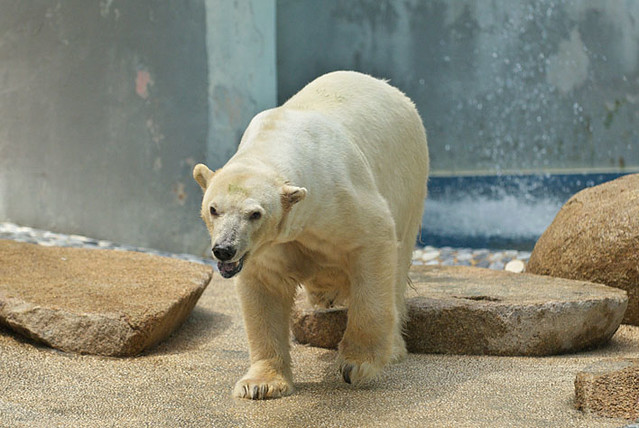
Sheba, the polar bear that has been a key attraction at the Singapore Zoo for over 30 years, has died.
Wildlife Reserves Singapore, the parent company of the zoo, said it is extremely saddened by the death of its beloved polar bear, adding that Sheba lived to a ripe old age of 35 years, far exceeding the normal life span of 25 years for polar bears that are not in the wild.
She was under treatment since September for loss of strength in her hind limbs, but her condition worsened in the past week, and she had to be put down after a close evaluation showed that her prognosis was poor.
Sheba arrived at the Singapore Zoo on April 14, 1978, from Cologne Zoo, Germany, when she was just 14 months old, and she was the first polar bear to have successfully raise a cub in the tropics.
Her son Inuka continues to be in the Singapore Zoo, and is now 21 years old.
Once there were four polar bears in Singapore Zoo — Nanook (Inuka's father), Sheba, Inuka and another female, Anana.
What will be the fate of Inuka? Lonely and Bored.
Thursday, November 15, 2012
Efforts to save the Devil
A group of Tasmanian devils will be transferred to a small Australian island to start what is hoped will be a self-sustaining population.
Tasmania's Environment Minister Brian Wightman said 14 of the marsupials, carefully selected from captive breeding programmes across Australia, would be released Thursday on Maria Island, a nature sanctuary off the state's east coast.
He said it was a "major step forward" in the race against extinction of the devil due to an extremely contagious facial tumour that has decimated the once-rampant rat-like marsupial.
Their plight is so dire authorities have started breeding a so-called "insurance population" in captivity to ensure they do not die out.
"The Maria Island translocation is designed to establish a self-sustaining population of healthy wild devils in a safe haven where they are protected from interaction with the deadly facial tumour disease," Wightman said.
"It will strengthen the insurance population of disease-free Tasmanian devils, help preserve wild traits in the insurance population and provide genetic stock for future reintroductions."
Tasmania is the only place where the devil is found in the wild and since the facial tumour was first discovered in 1996 numbers have plunged by 91 percent to the low tens of thousands.
There are few disease-free pockets remaining on the island state.
The cancer, which typically causes death within three to six months, is spread during fighting over food and territory, when a healthy devil will bite an infected devil's face and pick up cancer cells.
Maria Island, a rugged national park that can only be reached by boat or plane and is vehicle and shop-free, has never before been a devil habitat so Wightman said there was "no known risk of the facial tumour disease".
National Environment Minister Tony Burke said the transfer was a method of "last resort and it has to be done carefully with good scientific oversight", with all animals to be carefully screened before release.
Experts had deemed the devils unlikely to impact other native species on the island and the ecosystem would be monitored carefully, he added.
If successful authorities plan to increase the overall population on Maria Island over the next two years to about 50 animals.
Tuesday, November 13, 2012
Strays to stay HDB
A pilot programme initiated by the Action for Singapore Dogs (ASD) and Society for the Prevention of Cruelty to Animals (SPCA) had helped 10 stray dogs find homes in Housing and Development Board (HDB) flats by mid October.
The programme, which started in April, requires dog owners to adhere to a strict set of guidelines drawn up by the Ministry of National Development and animal welfare groups. This is to prevent friction between residents that could arise from disturbances caused by household pets.
Some guidelines include:
* Proper screening and counseling for potential adopters
* Compliance with dog ownership regulations
* Maintenance of a proper list of all adopters
* Only stray dogs of up to medium size can be re-homed
* Signing of a declaration to adhere to codes of conduct
* Imposition of adoption fees
Medium sized strays of 15kg and below which are deemed to have an appropriate temperament for apartment living are accepted in this pilot scheme. This is a move away from current HDB regulations, which stipulate that only small or toy breeds not exceeding 40cm in height can be owned by flat-dwellers.
Non-compliance with the guidelines will result in the dog being returned to the animal welfare groups.
The proposal to rehouse stray dogs was submitted to an inter-agency task force formed in July last year. ASD and SPCA ensure that all 'Singapore Specials' - referring to local breeds - would be properly vaccinated, sterilized and micro-chipped before adoption.
Apart from the re-homing of stray dogs, then Minister of State for National Development Tan Chuan-Jin announced in November last year that stray cats will also be allowed in HDB flats to reduce the issue of strays on the streets.
Monday, November 12, 2012
Pandas' Bamboo Food May Be Lost to Climate Change
Though they are one of the most beloved animal species on Earth, pandas aren't safe from the devastating effects of climate change.
According to a new study, projected temperature increases in China over the next century will likely seriously hinder bamboo, almost the sole source of food for endangered pandas. Only if bamboo can move to new habitats at higher elevations will pandas stand a chance, the researchers said.
However, if conservation programs wait too long, human inhabitants and activities could claim all of the new habitats capable of supporting bamboo in a warming world.
"It is tough, but I think there's still hope, if we take action now," said research team member Jianguo Liu, a sustainability scientist at Michigan State University. "If we wait, then we could be too late."
The researchers used various climate-change models to project the future for three bamboo species relied on by pandas in the Qinling Mountain region of China, which represents about a quarter of the total remaining panda habitat. These models varied in their specific predictions, but each forecasted some level of temperature rise within the coming century.
The results suggest that if the bamboo is restricted to its current distribution area, between 80 and 100 percent of it will disappear by the end of the 21st century, because it won't be able to grow under the increased temperatures.
If, however, bamboo can move into new, cooler areas (which will reach the same temperatures as current bamboo habitats due to warming), then there is hope. However, that all still depends on the extent to which humans can curtail climate change by limiting greenhouse-gas emissions in the future.
"All the models are quite consistent — the general trend is the same," Liu told LiveScience. "The difference is the degree of the changes. Even with very hopeful scenarios, where we allow bamboo to go anywhere it wants, there are still very severe consequences. Of course, if the bamboo has nowhere to go, then the panda habitat will be lost more quickly."
Many pandas in the wild currently live in nature reserves protected from human encroachment. However, almost all of the land encompassed by those reserves will be unsuitable for the bamboo if the temperatures rise as predicted.
But if conservationists plan ahead now to move those reserves in line with changing bamboo habitats, then it may be possible to preserve the land the pandas will need.
And climate change is not the only challenge facing giant pandas, one of the most endangered species in the world, researchers say. Human activities have already severely limited the animals' habitats, and their dependence on a single source of food, one that's not that nutrient- or energy-rich, doesn't help.
In addition to their native habitats in China, pandas live around the world in zoos and breeding centers. But Liu doesn't predict a bright future for the bears if they lose their wild habitats.
"To really protect pandas, you cannot just stick [them] into a breeding center or a zoo," he said, noting that the animals' genetic diversity would suffer, among other issues. "That's not a long-term solution."
Subscribe to:
Posts (Atom)