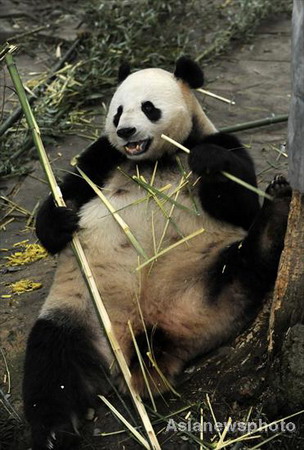
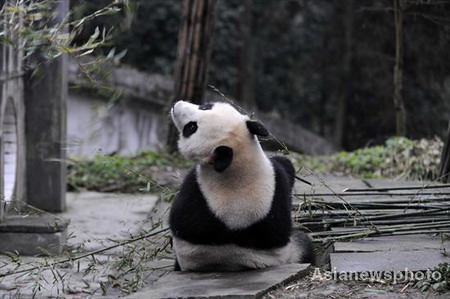
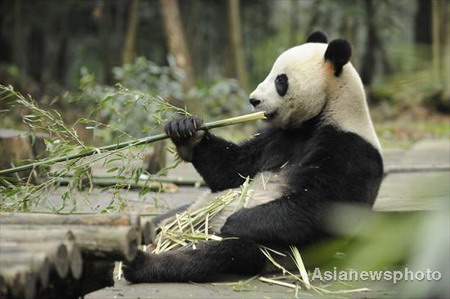
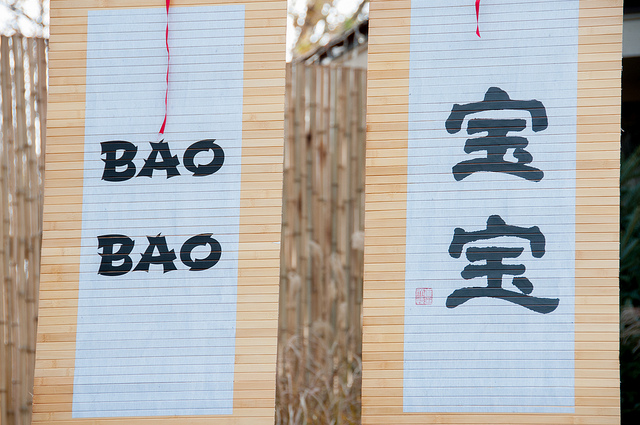
The National Zoo is preparing panda cub Bao Bao (bow-bow) for her public debut this month.
Bao Bao had a tryout Monday in front of the media. She spent the morning climbing on rocks and following her mother, Mei Xiang (may-shong), around the indoor exhibit.
Curators say Bao Bao has turned out to be a calm and relaxed panda cub, more subdued than older brother Tai Shan (ty-shawn).
Bao Bao goes on display Jan. 18. Curators say she may be visible inside or outside, depending on the day. Zoo members will have an early preview starting Saturday.
Bao Bao is receiving the best medical care anywhere in the world, according to handlers at the Smithsonian's National Zoo in Washington, DC after being born at the facility in August last year.
The panda cub was weighed on Tuesday morning, tipping the scales at just over 1st 2oz (17 pounds).
Panda handlers are currently giving Bao Bao human contact and some tactile stimulation in order for her to get used to encounters with humans.
"Her personality is really laid back. As you can see she doesn't seem to mind the interaction with us," explained biologist Laurie Thompson, from the Giant Panda Programme.
Bao Bao will make her public debut on January 18.
I have been Friends of the Singapore Zoo for many years, if you want it to continue giving us the fun and joy of animals, please visit the Singapore Zoo. Singapore Zoo, 80 Mandai Lake Road (Bus 138 from Ang Mo Kio MRT or 171 from City). Opening hours are 8.30am-6.00pm daily and adult admission is S$28, children is $18. *Park Hooper packages are more worth it. Check them out first before you purchase those tickets. Zoo, Night Safari, Jurong Bird Park or River Safari.
Showing posts with label Panda. Show all posts
Saturday, January 11, 2014
Wednesday, January 08, 2014
Zoo doctors unsure about panda birth
Veterinarians started to have doubts yesterday about whether Chiang Mai Zoo will welcome a second panda baby after Lin Hui began to appear anxious, had a rise in appetite and others signs that led them to question if she will really give birth. Head veterinarian Boripat Siriaroonrat told a press conference that his team would perform another ultrasound and progesterone test to confirm her pregnancy later yesterday, while also checking her stress hormone level.
'Acting differently'
Since Lin Hui was acting differently than the team had expected, they could not be positive that she would give birth to a cub.
In cases abroad, sometimes a giant panda whose ultrasound test showed an embryo might not give birth and sometimes a giant panda with twin embryos might only have one cub.
There were many variations in Lin Hui's case, so her behaviour pattern didn't indicate a pregnancy failure. She was still lactating. "There is a 50:50 chance Lin Hui will give birth," he said.
The zoo last month reported that Lin Hui was expecting after undergoing a series of artificial inseminations in September and that a new media 'darling' was due this week, so the zoo put the mother on a close watch and prepared a delivery room and cub-care room.
'Acting differently'
Since Lin Hui was acting differently than the team had expected, they could not be positive that she would give birth to a cub.
In cases abroad, sometimes a giant panda whose ultrasound test showed an embryo might not give birth and sometimes a giant panda with twin embryos might only have one cub.
There were many variations in Lin Hui's case, so her behaviour pattern didn't indicate a pregnancy failure. She was still lactating. "There is a 50:50 chance Lin Hui will give birth," he said.
The zoo last month reported that Lin Hui was expecting after undergoing a series of artificial inseminations in September and that a new media 'darling' was due this week, so the zoo put the mother on a close watch and prepared a delivery room and cub-care room.
Sunday, January 05, 2014
Giant panda cub Yuan Zai unveiled in Taiwan’s Taipei zoo
Six-month-old Yuan Zai, the island's first giant panda cub, was unveiled to the media on Saturday and then to the public on Monday.
She climbed around her cage before retiring for a nap with her mother, much to the delight of visitors.
Her parents Tuan Tuan and Yuan Yuan, whose names together mean "reunion" in Chinese, were given to Taiwan by China in December 2008.
Taipei zoo expects 19,000 visitors daily to see its newest attraction.
The BBC's Cindy Sui says many visitors took time off from school and work to see the panda cub, which currently sleeps for about 20 hours each day.
Director of Taipei Zoo Jin Shih-chien said Yuan Zai was generally active for about 20 minutes at a time, and advised visitors to be patient if they found her asleep.
Taipei zoo staff had to separate tiny Yuan Zai from her mother a few days after her birth in July.
She was raised in an incubator after a slight injury in her leg.
The pandas have become star attractions at Taipei zoo, as well as a symbol of warming ties between China and Taiwan, and panda mania has swept the island since Yuan Zai was born.
Saturday, October 05, 2013
Pandas Kai Kai and Jia Jia celebrated 1st year anniversary in Singapore
Wildlife Reserves Singapore (WRS) and CapitaLand Limited (CapitaLand) threw a big panda party for Kai Kai and Jia Jia today, with a specially-made cake and toy for the birthday duo.
The birthday bash marks the start of week-long festivities at River Safari from Sept 7 to 15 to commemorate the pandas' one-year anniversary in Singapore. It also celebrates Jia Jia turning five on Sept 3 and Kai Kai turning 6 on Sept 14.
Male panda Kai Kai received a three-tiered birthday cake made of ice, bamboo and his favourite treats, while Jia Jia received a chime toy made of bamboo stems.
The birthday presents were specially created and presented by 10 Panda Party Planners - lucky members of the public, including five readers of the CapitaLand Inside Different Geographies e-publication, who went behind-the-scenes with panda keepers to prepare these treats for the pandas to keep them mentally and physically stimulated.
Ms Claire Chiang, Chairman, Wildlife Reserves Singapore, said: "The past year has been an exciting one as we discover more about the personalities of our pandas. Kai Kai and Jia Jia are ambassadors for their own kind, and we hope that visitors who meet them will learn more about these endangered bears and be inspired to protect these magnificent creatures."
Almost 600,000 panda lovers have visited Kai Kai and Jia Jia since the Giant Panda Forest opened to the public last year. Kai Kai, who is usually laid-back, has recently been spotted climbing up a tree at 5pm every day to look out for his keepers, and preparing to retreat to his den for evening treats.
He is curious when keepers implement enrichment activities such as introducing new scents, or wrapping treats with leaves for him to find.
Jia Jia, on the other hand, is the shyer of the two. A closed-circuit television was installed in February so that visitors can see Jia Jia during moments when she chooses to stay in her den.
Sunday, August 25, 2013
New Panda born
Giant panda Mei Xiang gives birth at Washington's national zoo
Zookeepers say giant pandas give birth to twins 50% of the time, so they will keep an eye on Mei Xiang for 24 hours
A giant panda gave birth at Washington's national zoo on Friday, causing a buzz among fans as they flocked to a panda cam's live feed to hear the cub squeal and watch the mother immediately start caring for it.
The zoo said Mei Xiang gave birth two hours after her water broke. Zoo officials said the panda team heard the cub vocalize and that the mother picked it up immediately and began cradling and caring for it.
"We have a cub!! Born at 5.32pm this evening," the zoo tweeted.
"I'm glued to the new panda cams and thrilled to hear the squeals, which appear healthy, of our newborn cub," said Dennis Kelly, director of the Smithsonian's national zoo.
Fans of the 15-year-old panda who had been tracking her suspected pregnancy on a Giant Panda Cam flocked to the live feed.
With the zoo heralding the cub's birth on Twitter, the pandas' excited fans responded in kind. Congratulations poured in under the hashtag "cubwatch," including hopes that this year's cub would survive. "Last year was so heartbreaking," as one person tweeted, while another said, "Good luck, little Butterstick 2 !!!"
Mei Xiang had previously given birth to two cubs. Tai Shan was born in 2005 and a week-old cub died last September.
Panda cubs are especially delicate and vulnerable to infection and other illness. They are about the size of a stick of butter at birth. The first weeks of life are critical for the cubs as mothers have to make sure they stay warm and get enough to eat.
Zookeepers said at a news conference on Friday night that giant pandas give birth to twins 50 percent of the time, so they will continue to keep an eye on Mei Xiang for 24 hours.
Brandie Smith, curator of mammals at the zoo, said Friday night that mindful of last year's loss, zookeepers will be more hands-on with this cub.
"We know that Mei Xiang is an excellent mother," Smith said. "When she has a cub, she will take care of it."
Smith said that will zookeepers don't want to disturb the bonding between the mother and cub, but they will take the risk and do an assessment of the cub within the first 48 hours.
The biggest concern is the cub's weight, Smith said, and that it continues to gain weight. Zookeepers will also be listening for healthy squeals from the cub, and signs and sounds that it is nursing.
The panda team will perform health checks every few days. Its gender was not immediately known.
Mei Xiang is expected to spend almost all of her time in her den for the next two weeks with her new cub.
The zoo has been on round-the-clock panda watch since August 7, when Mei Xiang began showing behavioral changes consistent with a pregnancy or pseudo-pregnancy.
A Chinese panda expert performed artificial inseminations on Mei Xiang on March 30 after she failed to breed naturally with male panda Tian Tian.
Zookeepers had not been certain that Mei Xiang was pregnant, because she refused to cooperate with attempts to perform an ultrasound.
The David M Rubenstein Family Giant Panda Habitat, which has been closed to the public since August 2, will remain closed to provide quiet time for Mei Xiang and her cub.
Zookeepers say giant pandas give birth to twins 50% of the time, so they will keep an eye on Mei Xiang for 24 hours
A giant panda gave birth at Washington's national zoo on Friday, causing a buzz among fans as they flocked to a panda cam's live feed to hear the cub squeal and watch the mother immediately start caring for it.
The zoo said Mei Xiang gave birth two hours after her water broke. Zoo officials said the panda team heard the cub vocalize and that the mother picked it up immediately and began cradling and caring for it.
"We have a cub!! Born at 5.32pm this evening," the zoo tweeted.
"I'm glued to the new panda cams and thrilled to hear the squeals, which appear healthy, of our newborn cub," said Dennis Kelly, director of the Smithsonian's national zoo.
Fans of the 15-year-old panda who had been tracking her suspected pregnancy on a Giant Panda Cam flocked to the live feed.
With the zoo heralding the cub's birth on Twitter, the pandas' excited fans responded in kind. Congratulations poured in under the hashtag "cubwatch," including hopes that this year's cub would survive. "Last year was so heartbreaking," as one person tweeted, while another said, "Good luck, little Butterstick 2 !!!"
Mei Xiang had previously given birth to two cubs. Tai Shan was born in 2005 and a week-old cub died last September.
Panda cubs are especially delicate and vulnerable to infection and other illness. They are about the size of a stick of butter at birth. The first weeks of life are critical for the cubs as mothers have to make sure they stay warm and get enough to eat.
Zookeepers said at a news conference on Friday night that giant pandas give birth to twins 50 percent of the time, so they will continue to keep an eye on Mei Xiang for 24 hours.
Brandie Smith, curator of mammals at the zoo, said Friday night that mindful of last year's loss, zookeepers will be more hands-on with this cub.
"We know that Mei Xiang is an excellent mother," Smith said. "When she has a cub, she will take care of it."
Smith said that will zookeepers don't want to disturb the bonding between the mother and cub, but they will take the risk and do an assessment of the cub within the first 48 hours.
The biggest concern is the cub's weight, Smith said, and that it continues to gain weight. Zookeepers will also be listening for healthy squeals from the cub, and signs and sounds that it is nursing.
The panda team will perform health checks every few days. Its gender was not immediately known.
Mei Xiang is expected to spend almost all of her time in her den for the next two weeks with her new cub.
The zoo has been on round-the-clock panda watch since August 7, when Mei Xiang began showing behavioral changes consistent with a pregnancy or pseudo-pregnancy.
A Chinese panda expert performed artificial inseminations on Mei Xiang on March 30 after she failed to breed naturally with male panda Tian Tian.
Zookeepers had not been certain that Mei Xiang was pregnant, because she refused to cooperate with attempts to perform an ultrasound.
The David M Rubenstein Family Giant Panda Habitat, which has been closed to the public since August 2, will remain closed to provide quiet time for Mei Xiang and her cub.
Monday, November 12, 2012
Pandas' Bamboo Food May Be Lost to Climate Change
Though they are one of the most beloved animal species on Earth, pandas aren't safe from the devastating effects of climate change.
According to a new study, projected temperature increases in China over the next century will likely seriously hinder bamboo, almost the sole source of food for endangered pandas. Only if bamboo can move to new habitats at higher elevations will pandas stand a chance, the researchers said.
However, if conservation programs wait too long, human inhabitants and activities could claim all of the new habitats capable of supporting bamboo in a warming world.
"It is tough, but I think there's still hope, if we take action now," said research team member Jianguo Liu, a sustainability scientist at Michigan State University. "If we wait, then we could be too late."
The researchers used various climate-change models to project the future for three bamboo species relied on by pandas in the Qinling Mountain region of China, which represents about a quarter of the total remaining panda habitat. These models varied in their specific predictions, but each forecasted some level of temperature rise within the coming century.
The results suggest that if the bamboo is restricted to its current distribution area, between 80 and 100 percent of it will disappear by the end of the 21st century, because it won't be able to grow under the increased temperatures.
If, however, bamboo can move into new, cooler areas (which will reach the same temperatures as current bamboo habitats due to warming), then there is hope. However, that all still depends on the extent to which humans can curtail climate change by limiting greenhouse-gas emissions in the future.
"All the models are quite consistent — the general trend is the same," Liu told LiveScience. "The difference is the degree of the changes. Even with very hopeful scenarios, where we allow bamboo to go anywhere it wants, there are still very severe consequences. Of course, if the bamboo has nowhere to go, then the panda habitat will be lost more quickly."
Many pandas in the wild currently live in nature reserves protected from human encroachment. However, almost all of the land encompassed by those reserves will be unsuitable for the bamboo if the temperatures rise as predicted.
But if conservationists plan ahead now to move those reserves in line with changing bamboo habitats, then it may be possible to preserve the land the pandas will need.
And climate change is not the only challenge facing giant pandas, one of the most endangered species in the world, researchers say. Human activities have already severely limited the animals' habitats, and their dependence on a single source of food, one that's not that nutrient- or energy-rich, doesn't help.
In addition to their native habitats in China, pandas live around the world in zoos and breeding centers. But Liu doesn't predict a bright future for the bears if they lose their wild habitats.
"To really protect pandas, you cannot just stick [them] into a breeding center or a zoo," he said, noting that the animals' genetic diversity would suffer, among other issues. "That's not a long-term solution."
Monday, October 15, 2012
Pandas are eaten in prehistoric times
Are they delicious?
They are large, cuddly and the most gentle of creatures - but in prehistoric times, Giant Pandas were just another source of food to primitive man.
A Chinese scientist has claimed humans once included panda meat in their diet after uncovering fossils that show the animals died from wounds caused by hunters.
Wei Guangbiao said an examination of excavated fossils in the southwest Chinese city of Chongqing showed pandas had been "slashed to death by man".
He said prehistoric man would not have killed animals that would have been of use to them in the daily battle for survival.
Pandas, then in plentiful numbers, would have been a ready source of food and a good complement to a diet that consisted mostly of berries and anything else they could trap or catch.
Given their shy nature, and slow, lumbering walk, the bears would have been easy prey for hunters armed with sticks and stones, and later spears and knives.
The distinctive white and black fur of the panda would also have been used by primitive man to provide warmth.
Guiangbiao, head of the Institute of Three Gorges Paleoanthropology at a Chongqing museum, said the pandas who lived 10,000 to one million years ago were much smaller than those seen in captivity and the wild today.
He told the Chongqing Morning Post newspaper the pandas would have been found in the city’s high mountains. Here they flourished in their natural habitat of cool, wet and cloudy mountain forest land, which is rich in bamboo.
Historians believe panda meat was once a delicacy eaten by the rulers of Ancient China.
Today, the Giant Panda has been on the endangered species list for more than 50 years and is called a “National Treasure” in China, where there are breeding centres tasked with helping to boost the dwindling population.
Latest figures show there are 239 Pandas living in captivity, while the wild population is said to number under 3,000.
They are large, cuddly and the most gentle of creatures - but in prehistoric times, Giant Pandas were just another source of food to primitive man.
A Chinese scientist has claimed humans once included panda meat in their diet after uncovering fossils that show the animals died from wounds caused by hunters.
Wei Guangbiao said an examination of excavated fossils in the southwest Chinese city of Chongqing showed pandas had been "slashed to death by man".
He said prehistoric man would not have killed animals that would have been of use to them in the daily battle for survival.
Pandas, then in plentiful numbers, would have been a ready source of food and a good complement to a diet that consisted mostly of berries and anything else they could trap or catch.
Given their shy nature, and slow, lumbering walk, the bears would have been easy prey for hunters armed with sticks and stones, and later spears and knives.
The distinctive white and black fur of the panda would also have been used by primitive man to provide warmth.
Guiangbiao, head of the Institute of Three Gorges Paleoanthropology at a Chongqing museum, said the pandas who lived 10,000 to one million years ago were much smaller than those seen in captivity and the wild today.
He told the Chongqing Morning Post newspaper the pandas would have been found in the city’s high mountains. Here they flourished in their natural habitat of cool, wet and cloudy mountain forest land, which is rich in bamboo.
Historians believe panda meat was once a delicacy eaten by the rulers of Ancient China.
Today, the Giant Panda has been on the endangered species list for more than 50 years and is called a “National Treasure” in China, where there are breeding centres tasked with helping to boost the dwindling population.
Latest figures show there are 239 Pandas living in captivity, while the wild population is said to number under 3,000.
Tuesday, December 15, 2009
Time to Start fucking U Animals!
Australian and Chinese officials urged two bamboo-munching giant pandas on Sunday to consider reproducing during their 10-year residency Down Under. Wang Wang and Funi, on loan from China, arrived at the Adelaide Zoo in Australia two weeks ago but were officially welcomed Sunday by leaders at the opening ceremony of their 8 million Australian dollar ($7.25 million) enclosure. Their exhibit opened to the public on Monday. "Look after yourselves, keep healthy and active, eat your greens and maybe, when the time is right, think about starting a family," Governor General Quentin Bryce said in a speech directed at Funi and Wang Wang, who were sprawled against nearby boulders, chewing bamboo shoots. "There are not enough of you in this world." Chinese Ambassador Zhang Junsai said he was already thinking of Australian names for a possible panda cub. "Wang Wang and Funi carry the friendship and greetings from the Chinese people," he told the gathering, explaining that Funi means "Lucky Girl" and Wang Wang means "Net Net." "Who can rule out the possibility that the lucky girl will fall into the net of love and later have a lovely baby?" Zhang said. "This would be a great achievement of the joint Australia-China conservation program." The pandas, 3 and 4 years old, are the only giant pandas in the southern hemisphere. Chinese President Hu Jintao offered the pandas as a goodwill gesture during a 2007 visit to Australia.
Monday, December 07, 2009
Its all about sperm and egg
Beloved National Zoo panda going to China
Under agreement, cubs born at the zoo must be sent to China for breeding
A young giant panda who became a major draw after his birth at Washington's National Zoo will leave for China early next year for breeding.
Zoo officials announced Friday that Tai Shan (pronounced "ty shawn") will be leaving the Smithsonian Institution park as soon as January or February.
Panda mother Mei Xiang (may-SHONG) and father Tian Tian (tee-YEN tee-YEN) are on a 10-year, $10 million loan to the zoo until December 2010.
Stop prostituting US!
Thursday, November 26, 2009
Subscribe to:
Posts (Atom)