Visit Singapore Zoo

Friday, December 21, 2012

Safari Zoo Run 2013


Date: 17 February 2013
Venue: Singapore Zoo & Night Safari
Time: 7.00am - 12.00pm

http://www.safarizoorun.com.sg/

Wednesday, December 12, 2012

2012 Zoo Death worries

The century-old Mysore Zoo, which has been attracting attention for various reasons, is in the limelight for a different reason now what with 38 animals reported dead since April this year.

The total percentage of deaths as on November 30 rose to 2.7 per cent.

However, there is significant improvement in the health management system of the animals in this zoo, according to officials.

They told UNI that of the 38 animals, 11 died because of diseases. The remaining died either of old age and injuries or other causes. Only one animal died due to stress, according to statistics provided by the zoo authorities.

The total number of animals had gone up in the last five years from 1,052 in 2007-08 to 1,393 in 2012-13.

Animals do die naturally. Death of young ones is very high in animals.

Even in case of human being infant mortality is 5-6% with in spit of medical advances. The famous Smithsonian National Zoological Park, Washington, USA reports an annual mortality rate varying from 6.5 to 10 pc, they said.

According to the Zoo Executive Director, B P Ravi, said regular procedures and protocol had been put in place to constantly improve the animal health management system.

The death of animals in zoos always attracts attention. The debate always ends up in the general conclusion that zoos lack experience in handling animals which are stressed, lack proper veterinary care and sometimes due to foul play and lack of coordination between various sections of the zoo personnel.

‘We feel that this matter needs better understanding and appreciation, he said.

The zoo management always tries to keep public informed about deaths, births and new arrivals apart from any happening, the excutive director said.

In Indian zoos, new births are not taken into inventory unless they complete two months their life.

This is also true with any animals received as rescued.

However all deaths in Zoo, will be reported as deaths of zoo animals. Recently Mysore Zoo received three rescued tigers from Nagarahole Tiger Reserve, out of which one died due to old age (probably 14 years) and starvation, one named Madesh successfully treated and sent to rescue center at Banneraghatta and another(female aged 6 years) was successfully released in to the same habitat after treatment.

Saturday, December 01, 2012

Zoo Lights 2012

Let there be light!

Smithsonian National Zoological Park
ZooLights is brighter than ever! More than 500,000 environmentally-friendly LED lights transform the Zoo into a winter wonderland. Lit animal silhouettes, musical light displays, and a new garden scene light sculpture make for truly magical sights!

Sunday, November 25, 2012

Resorts World Sentosa's Marine Life Park opens

Resorts World Sentosa's new Marine Life Park, which has drawn over 12,000 people since its opening on 22 Nov 2012.
.
The new attraction comprises the Adventure Cove Waterpark and an 8ha oceanarium called S.E.A Aquarium, which currently has 40,000 animals from 500 species.

Tuesday, November 20, 2012

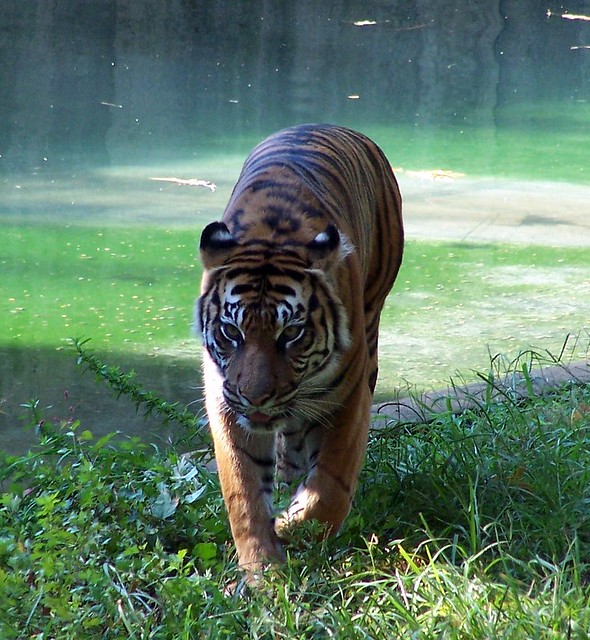
19-Year-Old Tiger Dies at the National Zoo

y

The National Zoo put down 19-year-old Sumatran tiger Soyono this morning, after the tiger fought a month-long battle with spinal degeneration. While much of the zoo's announcement is a nice remembrance of the tiger, one part, about Soyono's contribution to her struggling species, stands out:

Because her mother was wild-caught, Soy’s genes were not well-represented in the North American population, making her a valuable breeder...Soy birthed three litters of cubs and with her mate, Rokan, produced seven offspring altogether.

Left unspoken: Soyono's record stands in sharp contrast to certain other "clueless breeders" the zoo could mention.

The zoo still has two Sumatran tigers on display.

Monday, November 19, 2012

Worst than animals

Police have arrested one of two men who they believe broke into an Idaho zoo the night a monkey there died from blunt-force trauma, but questions remain about how and why the animal was killed.

Michael J. Watkins, 22, of Weiser was arrested Monday in Washington County on felony burglary and grand theft charges. Idaho law allows prosecutors to bring a grand theft charge against someone accused of killing livestock or other animals valued at more than $150 dollars.

A tip from a citizen led police to Watkins after identifying a hat found in the monkey's enclosure as similar to one Watkins was wearing the night two intruders were spotted at Zoo Boise. A security guard frightened away the intruders, then discovered the gravely injured patas monkey, which died a short time later.

Masterson said at a news conference Monday evening that Watkins sought care at a hospital for injuries to his upper torso sometime after the early Saturday incident. The story he gave to hospital staff "did not seem to mesh up with the injuries," Masterson said.

The monkey's death has left zoo workers shocked and devastated, zoo director Steve Burns said. The Crime Stoppers organization offered an award of up to $1,000 for information leading to the culprits' arrest.

Investigators had not had a chance to question Watkins extensively and have not revealed whether they think the zoo break-in was a prank that turned violent or something done with more sinister intent. But the police department and community are "angered and outraged over this senseless crime," Masterson said.

"The loss of this patas monkey has touched many lives, including our officers and investigators," he said.

The zoo doesn't have surveillance video. Instead, security guards patrol the grounds when the zoo is closed.

Burns said the guard who discovered the crime spotted one intruder inside the zoo and one outside the perimeter fence near the primate exhibit. Both men fled, with one running into the interior of the zoo.

Investigators believe Watkins is the man who was seen inside the fence.

Burns and police were searching the grounds when Burns heard a groan and found the injured monkey outside its exhibit, near the fence surrounding the zoo. They were able to get the animal into a crate and to the zoo's animal hospital, but the monkey died of blunt-force trauma to its head and neck just a few minutes later.

An inventory showed none of the other animals was missing or harmed.

Police say Watkins was visiting Boise with friends over the weekend from his home in Weiser, an agricultural town about 60 miles away near the Oregon-Idaho border.

Court records show Watkins has been in trouble with the law before, including drug arrests. Police said they do not know whether Watkins may have been under the influence of alcohol or drugs at the time of the break-in.

Officers have spoken with the other man spotted outside the zoo but do not expect charges to be filed against him, Masterson said.

Crimes at the zoo are rare, Burns said.

"I've been here for 15 years, and I don't remember any cases where we've had a visitor intentionally or even accidentally injure an animal," Burns said. "People in Boise are usually pretty respectful. We were just saying the other day that we can't even remember the last time that someone was found inside the zoo after hours. The security guards do a really good job."

Burns said it will take a few weeks before he can decide if the remaining patas monkey will be sent to another zoo or if another patas monkey will be brought in as a companion. The animals are social and need to be around members of their own species.

The crime may have raised interest in the patas monkeys. A donation for the remaining patas monkey under the zoo's adopt-an-animal program came in over the weekend, Burns said.

The monkey exhibit remains open to the public, although zoo workers were keeping some of the larger garage-sized doors to the exhibit closed to keep down noise, and keepers were giving the remaining patas monkey a little more attention, Burns said. The zoo kicked off a fundraiser to build a new exhibit house for the primates in September.

"That primate house was built back in the 1960s and it's just time to update it and provide the animals with more space and things like that," he said.

For now, he said, zoo workers are just focusing on caring for the remaining 300 animals at the zoo.

"We're going to grieve for the animal and make sure the community's OK. But we're going to move on with the plans that we have and continue to take care of the animals. Boise's a really nice place to live, and usually this kind of stuff doesn't happen in Boise," he said.

Saturday, November 17, 2012

Rest in Peace Sheba

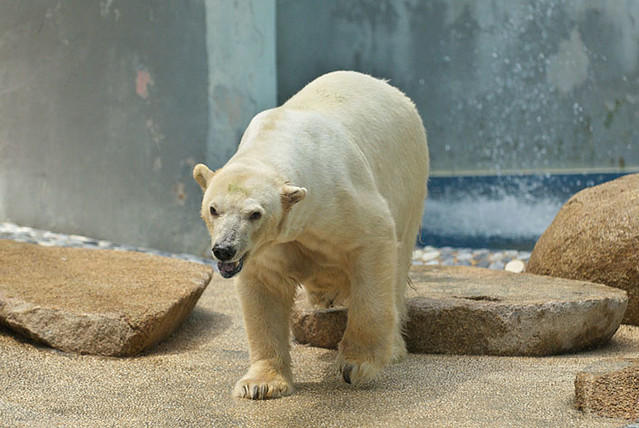
Sheba, the polar bear that has been a key attraction at the Singapore Zoo for over 30 years, has died.


Wildlife Reserves Singapore, the parent company of the zoo, said it is extremely saddened by the death of its beloved polar bear, adding that Sheba lived to a ripe old age of 35 years, far exceeding the normal life span of 25 years for polar bears that are not in the wild.

She was under treatment since September for loss of strength in her hind limbs, but her condition worsened in the past week, and she had to be put down after a close evaluation showed that her prognosis was poor.

Sheba arrived at the Singapore Zoo on April 14, 1978, from Cologne Zoo, Germany, when she was just 14 months old, and she was the first polar bear to have successfully raise a cub in the tropics.

Her son Inuka continues to be in the Singapore Zoo, and is now 21 years old.

Once there were four polar bears in Singapore Zoo  — Nanook (Inuka's father), Sheba, Inuka and another female, Anana.

What will be the fate of Inuka? Lonely and Bored.

Thursday, November 15, 2012

Efforts to save the Devil

A group of Tasmanian devils will be transferred to a small Australian island to start what is hoped will be a self-sustaining population.

Tasmania's Environment Minister Brian Wightman said 14 of the marsupials, carefully selected from captive breeding programmes across Australia, would be released Thursday on Maria Island, a nature sanctuary off the state's east coast.

He said it was a "major step forward" in the race against extinction of the devil due to an extremely contagious facial tumour that has decimated the once-rampant rat-like marsupial.

Their plight is so dire authorities have started breeding a so-called "insurance population" in captivity to ensure they do not die out.

"The Maria Island translocation is designed to establish a self-sustaining population of healthy wild devils in a safe haven where they are protected from interaction with the deadly facial tumour disease," Wightman said.

"It will strengthen the insurance population of disease-free Tasmanian devils, help preserve wild traits in the insurance population and provide genetic stock for future reintroductions."

Tasmania is the only place where the devil is found in the wild and since the facial tumour was first discovered in 1996 numbers have plunged by 91 percent to the low tens of thousands.

There are few disease-free pockets remaining on the island state.

The cancer, which typically causes death within three to six months, is spread during fighting over food and territory, when a healthy devil will bite an infected devil's face and pick up cancer cells.

Maria Island, a rugged national park that can only be reached by boat or plane and is vehicle and shop-free, has never before been a devil habitat so Wightman said there was "no known risk of the facial tumour disease".

National Environment Minister Tony Burke said the transfer was a method of "last resort and it has to be done carefully with good scientific oversight", with all animals to be carefully screened before release.

Experts had deemed the devils unlikely to impact other native species on the island and the ecosystem would be monitored carefully, he added.

If successful authorities plan to increase the overall population on Maria Island over the next two years to about 50 animals.

Tuesday, November 13, 2012

Strays to stay HDB

A pilot programme initiated by the Action for Singapore Dogs (ASD) and Society for the Prevention of Cruelty to Animals (SPCA) had helped 10 stray dogs find homes in Housing and Development Board (HDB) flats by mid October.


The programme, which started in April, requires dog owners to adhere to a strict set of guidelines drawn up by the Ministry of National Development and animal welfare groups. This is to prevent friction between residents that could arise from disturbances caused by household pets.

Some guidelines include:

    * Proper screening and counseling for potential adopters
    * Compliance with dog ownership regulations
    * Maintenance of a proper list of all adopters
    * Only stray dogs of up to medium size can be re-homed
    * Signing of a declaration to adhere to codes of conduct
    * Imposition of adoption fees

Medium sized strays of 15kg and below which are deemed to have an appropriate temperament for apartment living are accepted in this pilot scheme. This is a move away from current HDB regulations, which stipulate that only small or toy breeds not exceeding 40cm in height can be owned by flat-dwellers.

Non-compliance with the guidelines will result in the dog being returned to the animal welfare groups.

The proposal to rehouse stray dogs was submitted to an inter-agency task force formed in July last year. ASD and SPCA ensure that all 'Singapore Specials' - referring to local breeds - would be properly vaccinated, sterilized and micro-chipped before adoption.

Apart from the re-homing of stray dogs, then Minister of State for National Development Tan Chuan-Jin announced in November last year that stray cats will also be allowed in HDB flats to reduce the issue of strays on the streets.

Monday, November 12, 2012

Pandas' Bamboo Food May Be Lost to Climate Change


Though they are one of the most beloved animal species on Earth, pandas aren't safe from the devastating effects of climate change.

According to a new study, projected temperature increases in China over the next century will likely seriously hinder bamboo, almost the sole source of food for endangered pandas. Only if bamboo can move to new habitats at higher elevations will pandas stand a chance, the researchers said.

However, if conservation programs wait too long, human inhabitants and activities could claim all of the new habitats capable of supporting bamboo in a warming world.

"It is tough, but I think there's still hope, if we take action now," said research team member Jianguo Liu, a sustainability scientist at Michigan State University. "If we wait, then we could be too late."

The researchers used various climate-change models to project the future for three bamboo species relied on by pandas in the Qinling Mountain region of China, which represents about a quarter of the total remaining panda habitat. These models varied in their specific predictions, but each forecasted some level of temperature rise within the coming century.

The results suggest that if the bamboo is restricted to its current distribution area, between 80 and 100 percent of it will disappear by the end of the 21st century, because it won't be able to grow under the increased temperatures.

If, however, bamboo can move into new, cooler areas (which will reach the same temperatures as current bamboo habitats due to warming), then there is hope. However, that all still depends on the extent to which humans can curtail climate change by limiting greenhouse-gas emissions in the future.

"All the models are quite consistent — the general trend is the same," Liu told LiveScience. "The difference is the degree of the changes. Even with very hopeful scenarios, where we allow bamboo to go anywhere it wants, there are still very severe consequences. Of course, if the bamboo has nowhere to go, then the panda habitat will be lost more quickly."

Many pandas in the wild currently live in nature reserves protected from human encroachment. However, almost all of the land encompassed by those reserves will be unsuitable for the bamboo if the temperatures rise as predicted.

But if conservationists plan ahead now to move those reserves in line with changing bamboo habitats, then it may be possible to preserve the land the pandas will need.

And climate change is not the only challenge facing giant pandas, one of the most endangered species in the world, researchers say. Human activities have already severely limited the animals' habitats, and their dependence on a single source of food, one that's not that nutrient- or energy-rich, doesn't help.

In addition to their native habitats in China, pandas live around the world in zoos and breeding centers. But Liu doesn't predict a bright future for the bears if they lose their wild habitats.

"To really protect pandas, you cannot just stick [them] into a breeding center or a zoo," he said, noting that the animals' genetic diversity would suffer, among other issues. "That's not a long-term solution."

Saturday, November 10, 2012

Baby elephant’s sticky situation

A rescue crew lends a helping hand to free a baby elephant who stumbled into a pool of mud near Victoria Falls, Zimbabwe.

A baby elephant was rescued with just minutes to spare after spending over 12 hours stuck in a mudpool.

The young bull was spotted with mud up to its neck by a group of tourists on safari along the Zambezi River in Africa.

When the rescue team arrived it became apparent that they needed to act quickly as the baby pachyderm struggled to free its trunk and was close to drowning.


Mr White said it was likely the elephant had become trapped the evening before and after surviving for more than 12 hours wouldn't have lasted much longer.

He said: 'Elephants are particularly drawn to these areas and when moving towards the luscious vegetation they become stuck and sink deep into the mud, causing them to dehydrate and loose blood circulation to their legs.'

'The only safe place to put the rope is around his neck. Elephants have a very strong neck that can take a lot of strain. If we had tried to pull him out by any part of his legs which eventually become exposed, we risked breaking them.

'When he was finally free and lay on the solid ground we had to act fast and get him to his feet, to allow the blood to circulate.

'Towing straps were placed under his belly and with our team off staff we heaved him to his feet manually.

'So far the baby is doing well and although he is very young he is able to look after himself.

'We are keeping an eye on him though to make sure he doesn't get into any more sticky situations.'


Monday, November 05, 2012

Wild Dogs killed boy in Zoo

Toddler Killed by Wild Dogs At Pittsburgh Zoo Exhibit Should Make Us Question Zoos


A toddler boy visiting the Pittsburgh zoo somehow managed to fall into the wild dog exhibit and be ripped to shreds while his helpless mother watched from above. The horrific tragedy happened on Sunday and within minutes the story was everywhere with many questioning exactly how the little boy fell into the exhibit in the first place.

It's a good question. Wild "painted" African dogs are about the size of Labrador retrievers, weight about 37 to 80 pounds and are most dangerous in a pack. In this case, 11 dogs attacked the boy, though it is unclear whether he died from the fall or from the attack as yet.

One thing is clear: None of this should have been possible. A woman trying to "give her child a better view" should not have been able to drop him into the exhibit.

Of course, there are questions. Why did the mother not jump in after him? Understandably it happened in a matter of a seconds and the dogs were on him immediately. But imagining myself in that scenario, I can't imagine I would not make the (probably stupid) choice to jump right in and beat off the dogs.

Or maybe not.

Obviously, I can't judge the mom. I don't have any understanding of what that must have been like for her. What I can judge, though, is the zoo. For many reasons.

First of all, zoos are generally just controversial. The last dog -- a species considered endangered -- was shot because of this incident. It's not really the dog's fault. He was not a domesticated dog. He was a wild African beast who should probably be roaming in his native land, not on display for a toddler to be eaten.

Even more to the point, why was a mother able to drop her child into the exhibit? I have been to a thousand zoos from San Diego to Cincinnati and around the world and never once do I remember seeing an exhibit where it was possible to "accidentally" fall into a cage. Sure, someone who WANTED to scale a fence could do so. Stupid people do that regularly. But on "accident"? That just seems wrong.

Maybe we was wiggling. Maybe the mom was holding him in a bad way. Maybe she should not have been holding him in the way she was at all. But really, he should not have been able to fall into the exhibit. Until it is clear how this happened, I will place blame on the zoo.

The poor grieving mom, who screamed for help so loudly she was heard all over the park, is not the first person I would blame. This story is everything that is wrong with zoos.

Painted dogs are not an "exhibit." They are wild animals capable of great destruction. As parents, we trust the zoos to know that and keep us safe. How did this happen? It is unimaginable and my heart breaks for that poor mom.

Wednesday, October 31, 2012

S'pore's giant pandas to go on show from Nov 29


River Safari's giant panda exhibit, the Giant Panda Forest, will open to the public for a special preview from Nov 29 in time for the year-end school holiday season.

The Giant Panda Forest is part of the upcoming River Safari, which is located in between Night Safari and Singapore Zoo. It is scheduled to open in the first quarter of 2013.

A media statement by Wildlife Rerves Singapore said the panda exhibit will be opened to the public ahead of the park's official launch for visitors to enjoy a special preview of the pandas.

Visitors will be able to enter the Giant Panda Forest from a specially-created access point in Singapore Zoo.

Those planning to meet Kai Kai and Jia Jia at the Giant Panda Forest will need to purchase a Singapore Zoo admission ticket and a top-up fee of $5 per adult or $3 per child (3 to 12 years old).

Chairman of WRS Claire Chiang said they are pleased that the giant pandas have settled into their new home and look forward to welcoming visitors who are excited to see Kai Kai and Jia Jia.

"By bringing visitors up close to these endangered bears, we aim to educate Singaporeans and tourists alike on the importance of conservation," she said.

Tickets to the giant panda exhibit will be on sale daily from 8.30am from Nov 29 onwards.

These tickets can be purchased at Singapore Zoo's ticketing counters and are valid only on the day of purchase.

Tickets are on a first-come-first-served basis to accommodate an optimum number of visitors in the Giant Panda Forest at any one time.

The Giant Panda Forest will also have other wildlife exhibits from China, such as the golden pheasant and the red panda.

The two pandas are here for 10 years as part of a joint collaboration between China Wildlife Conservation Association and WRS to raise public awareness on wildlife conservation and develop a breeding programme for these endangered animals.

Tickets
Current admission fees to the Singapore Zoo are at S$20 per adult and S$13 for children under 12 years, and top-up prices to the Panda exhibit are $5.00 per adult or $3.00 per child (3 to 12 years old). Tickets to the preview can be purchased at the ticketing booths in the Singapore Zoo.

Saturday, October 27, 2012

Singapore to open world's largest oceanarium Dec 7

Marine Life Park finally has an official opening date. Here's a preview of the country's latest, biggest, wettest attraction

The world's largest oceanarium is set to open at Resorts World Sentosa in Singapore on December 7.

Officials say Marine Life Park will have more than 100,000 marine animals of over 800 species in more than 60 million liters of water.

Among these are manta rays, hammerhead sharks and controversial Indo-Pacific bottlenose dolphins. According to Singapore's Straits Times newspaper, animal rights activists have long been lobbying for the resort management to release the 25 wild dolphins captured for the resort.

Park officials defend the wild dolphins' inclusion.

"We hold the belief that zoological organizations have a role to play in wildlife conservation and that to avert species crises, controlled wildlife collections can occur for quality zoological facilities to increase our understanding of the species and for breeding purposes," says the resort in a series of unusually detailed responses to critics on its website's FAQ page.

More on CNNGo: Malaysia and Singapore: The Orlando of Southeast Asia?
Southeast Asia's first hydro-magnetic coaster

Marine Life Park will have two ticketed attractions that allow for wet or dry fun -- Adventure Cove Waterpark and the Southeast Asia Aquarium. Prices have not yet been announced.

Adventure Cove Waterpark will feature Southeast Asia’s first hydromagnetic coaster, Riptide Rocket, a slide that propels riders up and down inclines and around sharp curves.

Visitors can also snorkel with fish in the Rainbow Reef. 

The S.E.A. Aquarium will feature the world’s largest aquarium viewing panel.

Marine Life Park is the last of 12 major launches planned for the S$7 billion integrated resort since it opened in January of 2010, joining Universal Studios, a casino, the Maritime Experiential Museum and several luxury hotels and restaurants helmed by celebrity chefs.

Friday, October 19, 2012

Attempt to stop dolphins re-export to Singapore fails

Dolphins coming to Singapore.


A Philippine court yesterday denied an application by environmental and animal rights groups to extend a temporary court order, which it had granted last week to prevent the export of 25 dolphins to the Marine Life Park at Singapore's Resorts World Sentosa (RWS).

The court's decision clears the way for RWS to bring the dolphins here, amid protests by animal rights groups. An RWS spokesperson welcomed the decision and criticised the parties which initiated the court action for "perpetuating the same falsehoods that we had repeatedly made numerous clarifications and corrections to in the past". The groups intend to file an appeal later this week.

The mammals, which were caught in waters off the Solomon Islands, are being kept and trained at Subic Bay, Philippines. Last Friday, the court had issued a 72-hour "temporary environmental protection order" on the grounds that the exportation will "result in grave and irreparable damage to the population of the dolphins from the Solomon Islands".

Slated to lapse yesterday, the order was granted after 13 Philippines-based groups - including Earth Island Institute Philippines (EII-Phils) and the Philippine Animal Welfare Society - had banded together to file a civil suit against the Philippines' Bureau of Fisheries and Aquatic Resources, the Department of Agriculture, and RWS.

Yesterday, Quezon City court judge Evangeline Castillo-Marigomen rejected the application for an extension of the order, "as the petitioners have not proved any violation of law committed by the concerned government agencies", according to a media release that EII-Phils put up on its website.

EII-Phils Regional Director for Asia-Pacific Trixie Concepcion said that scientific studies were produced in court during the hearing yesterday, arguing that the survival rates of the dolphins would be threatened after their capture. "(But) the judge did not consider this as evidence," she said.

Ms Concepcion said the petitioners also took umbrage at comments by the judge when she likened the dolphins to "pets". Ms Concepcion said: "This is a very, very sad day for conservation, for all animals in general, because this may set a precedent where animals from unsustainable sources can be traded by the Philippines."

In response to media queries, the RWS spokesperson said: "We are pleased that the court has decided to lift the temporary environment protection order. Our dolphins are doing well under the care of our team of experienced experts, and we look forward to welcoming them to Singapore".

She added: "We regret that the group which initiated this court action had gone on various public platforms with inaccurate statements pertaining to our dolphins, perpetuating the same falsehoods that we had repeatedly made numerous clarifications and corrections to in the past."

The spokesperson reiterated that the acquisition of the dolphins adheres to regulations governed by the United Nations Environment Programme under the Convention on International Trade in Endangered Species of Wild Fauna and Flora. The Marine Life Park is also preparing for accreditation with international accreditation bodies on its standards of animal husbandry, veterinary care and facility, she added.

In Singapore, the Animal Concerns Research and Education Society (ACRES) has been campaigning against RWS' move to keep the dolphins in captivity. ACRES Chief Executive Louis Ng was disappointed at the Philippine court's latest decision. He said that the "fight is far from over" and that ACRES will soon launch the next phase of its campaign to "increase the pressure on RWS to respond positively to public concerns about the plight of the dolphins".

Marine Life Park, scheduled to open by December, will house more than 100,000 marine animals. Dates to bring over the 25 dolphins have not been confirmed but according to the RWS spokesperson, the "dolphin interaction programmes" would begin next year.

Wednesday, October 17, 2012

Lonely elephant in Philippine Zoo

Mali, who is 38, spends her days in Manila picking peanuts from children's hands and being squirted with water in a concrete-floored enclosure that animal rights groups say is far too small for any elephant to enjoy living in.


They also say that, after being shipped from Sri Lanka when she was three years old, Mali is suffering profound loneliness after living her entire adult life without another elephant.

"She is definitely unwell. As much as her physical suffering... there is also psychological suffering," said Rochelle Rigodon, campaign manager for Manila-based People for the Ethical Treatment of Animals.

PETA began campaigning for Mali to be removed from the zoo seven years ago, and its efforts to have the elephant spend the rest of her life at a sanctuary in Thailand have brought together a strikingly diverse group of people.

British pop star Morrissey, 2003 Nobel laureate in literature J.M. Coetzee and famous animal welfare campaigner Jane Goodall have all written letters to the Philippine government asking for Mali to be transferred.

"Mali is cruelly denied stimulation, room to explore... (and) is in danger of going insane," Morrissey wrote in a letter to President Benigno Aquino when he performed in Manila in May.

Archbishop Jose Palma, president of the influential Catholic Bishops Conference of the Philippines, has also written a letter calling for Mali to be shifted to Thailand.

He has formed an unlikely union with local fashion models and actresses, such as Isabel Roces and Chin-Chin Gutierrez, who have posted messages expressing concern about Mali's plight to their masses of Twitter followers.

Their campaign has had some success, with Mr Aquino ordering the Bureau of Animal Industry in May to evaluate if Mali should be transferred to Thailand. So far, no decision has been announced.

Animal rights activists say the problems at the zoo are not limited to Mali.

Gone were the days
The zoo, owned by the City of Manila and built in 1959, is a far cry from its glory days in the early 1960s, when it boasted a huge menagerie of lions, tigers, bears, leopards, giraffes, chimpanzees and bison.

Many of these animals have succumbed to old age, and there are not enough funds to replace them.

Many of the animals that do remain reside in half-century-old cages made of wire and bars, with the zoo operating on a budget of $1.4 million a year, small for its size. It holds 717 animals from 102 species.

Anna Cabrera, executive-director of the Philippine Animal Welfare Society accused the zoo's veterinarians and administrators of "gross incompetence".

"It (the zoo) stinks... they don't have the expertise for the animals in the zoo," she said.

However chief veterinarian Donald Manalastas insisted Mali and the other animals were treated well.

"We could do better but their (the animals') care is never compromised," Mr Manalastas said.

He pointed to the advanced ages of Mali and another 38-year-old star of the zoo, Berta the hippopotamus, as proof the animals were being looked after.

"If we were not giving them the right food, the proper care, they would not survive. We must be doing something right," he said.

Mr Manalastas also talked enthusiastically about the zoo's success in breeding the Philippine freshwater crocodile, or Crocodylus Mindorensis, which is critically endangered.

From an original four, these reptiles reproduced rapidly until there were 20 last year, according to Manalastas. He said they were able to trade eight to another zoo overseas for a camel that will hopefully arrive next year.

And the zoo undoubtedly remains a popular attraction, with 950,000 visitors a year, many of whom come from poor communities in and around Manila.

The Philippines has a dire poverty problem, with roughly one quarter of the population of 100 million people living on a dollar a day or less.

The entrance fee for the zoo is set deliberately low at 40 pesos (95 cents) for adults and 20 pesos for children to give the poorer citizens of Manila the opportunity to see wildlife and have a fun day out.

"This place is a social service, not a profit-oriented organisation," said Manila City's parks and recreations chief, Deogracias Manimbo.

"It's an alternative place for less-privileged people. It is designed for the poor of Manila."

Amid the uproar over Mali, Manila Mayor Alfredo Lim has rejected calls to relocate the elephant, and his stance is popular among the visitors.

"Manila Zoo would not be complete without an elephant," office worker Rowena Castro said as she pointed to her four-year-old son watching the enormous animal being hosed down by a keeper.

"That is the main reason he came: to see the elephant."

Monday, October 15, 2012

Pandas are eaten in prehistoric times

Are they delicious?

They are large, cuddly and the most gentle of creatures - but in prehistoric times, Giant Pandas were just another source of food to primitive man.

A Chinese scientist has claimed humans once included panda meat in their diet after uncovering fossils that show the animals died from wounds caused by hunters.

Wei Guangbiao said an examination of excavated fossils in the southwest Chinese city of Chongqing showed pandas had been "slashed to death by man".

He said prehistoric man would not have killed animals that would have been of use to them in the daily battle for survival.

Pandas, then in plentiful numbers, would have been a ready source of food and a good complement to a diet that consisted mostly of berries and anything else they could trap or catch.

Given their shy nature, and slow, lumbering walk, the bears would have been easy prey for hunters armed with sticks and stones, and later spears and knives.

The distinctive white and black fur of the panda would also have been used by primitive man to provide warmth.

Guiangbiao, head of the Institute of Three Gorges Paleoanthropology at a Chongqing museum, said the pandas who lived 10,000 to one million years ago were much smaller than those seen in captivity and the wild today.

He told the Chongqing Morning Post newspaper the pandas would have been found in the city’s high mountains. Here they flourished in their natural habitat of cool, wet and cloudy mountain forest land, which is rich in bamboo.

Historians believe panda meat was once a delicacy eaten by the rulers of Ancient China.

Today, the Giant Panda has been on the endangered species list for more than 50 years and is called a “National Treasure” in China, where there are breeding centres tasked with helping to boost the dwindling population.

Latest figures show there are 239 Pandas living in captivity, while the wild population is said to number under 3,000.

Friday, October 12, 2012

Jia Jia & Kai Kai moves into their new Home

Giant pandas Kai Kai and Jia Jia are being introduced to their new home at the River Safari after completing their month-long quarantine, Wildlife Reserves Singapore (WRS) announced on Thursday.

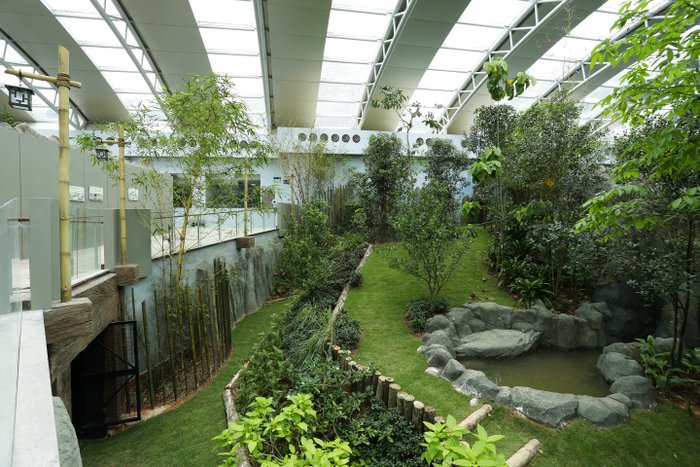
The River Safari's zoology team is helping them settle into the Giant Panda Forest, which simulates the bears' natural habitat.

To encourage the pandas to explore their new surroundings, keepers will be placing their favorite food, bamboo, in various locations around the exhibit.

The pandas currently live in dens linked to the Forest, which they are visiting daily. They first entered their new home on Monday and spent two hours there before returning to their dens. The duration will be progressively increased as they familiarise themselves with the area.


Friday, October 05, 2012

Precious Animals should be left in the Wild or placed in Captivity for security?

Do they really helps to prevent extinction of the species or accelerate the process as more attempts to capture their priced animal...

CAPTIVITY IS CRUEL

Dolphins, elephants, gorillas, chimpanzees and orangutans are all mammals that have a very high cognitive potential.  Their life expectancy is important and all benefit from an extremely prolonged childhood, during which their parents charge themselves with their education and transmitting their proper savior-fare.

They are thus "cultural beings", living in the "third world" (Popper & Eccles, 1989) that interweave their rules of relationships, social identity, language, aesthetic emotion, filial attachments or friendly and moral values such as altruism, encouragement of talent or the sense of the common well being (F. De Waal, 1995).

In the context where the regard of another builds and reinforces the sensation of existence, isolation is felt as a serious punishment.

For man, life imprisonment often replaces the death penalty.  When this isolation becomes total - for example, in solitary confinement - hallucinations happen very quickly, then complete dementia and death by suicide.

Simple clinical observation teaches us that chimpanzees and dolphins demonstrate exactly the same reactions as we do under the same circumstances.  For them also, it is inconceivable to live far from others, far from the world with which they are familiar.

A chimpanzee is only a TRUE chimpanzee when it is in the forest, surrounded by its group, of behaviors and that it earns in this manner its proper identity.  However, for these highly encephalitic cetaceans beings, no form of captivity, no cage, no special facilities, no pool, even Olympic-sized, will ever replace the simple pleasure of living free in the wild.

In no way could the captivity imposed on dolphins replace the fantastic sensory and social diversity that they know in the natural environment.

Enclosure is for them, particularly, a treatment of extreme cruelty that comes to reinforce the measures of discipline imposed on stubborn dolphins (rationing and isolation). We remember to finish that these "combats to death" don't exist in the ocean, even if certain conflicts are sometimes resolved in a violent manner.

For commercial gains
Singapore Sentosa Underwater World's dolphin captive breeding programe has been struck a third blow in the space of six months - a miscarriage, the death of a newborn and now, the death of an adult female.

There are five pink dolphins left at the Underwater World after the death of Namtam, an adult female. She succumbed to a stomach inflammation. .

Namtam, a pink dolphin about 20 years old, miscarried last September and nearly died then. She succumbed on March 5 to acute gastritis, or inflammation to the stomach. A dolphin born on Feb 18 died within 15 minutes of its birth.

The pink dolphins in Singapore are bought from Thai fishermen who don't have the knowledge and care to handle the animals less cruelly when catching them.  Because of this trade, the wild Sousa chinensis in Thai waters have been unsustainable caught, seriously depleting the population.

Wild caught dolphins for Resorts World Sentosa - SPCA says 'NO' to dolphins in captivity
http://www.spca.org.sg/captivedolphins.html


Thursday, September 27, 2012

Panda Diplomacy Isn’t Working for China & Japan


It was supposed to be a goodwill gesture.

After the earthquake and tsunami devastated much of her Japanese city last year, Sendai Mayor Emiko Okuyama asked Beijing if it would loan a pair of giant pandas to the local Yagiyama Zoo to cheer up young kids in the Tohoku region.

In a meeting with Japan’s Prime Minister Yoshihiko Noda, China’s Premier Wen Jiabao said he would strongly consider it.

Yet, a year later, that panda diplomacy has been stalled by an escalating dispute between China and Japan over the uninhabited Senkaku or Diaoyu islands. Michiya Ujiie, who is spearheading Sendai’s efforts, says he has not spoken with his Chinese counterparts in months.

“Neither side has suggested suspending the exchange altogether,” Ujiie said. “But under these circumstances, I don’t expect to get a call at all.”

Sendai residents aren’t so eager now to accept accepting China’s national treasures. Ujiie said the city has received dozens of emails from residents urging officials to halt the panda luring efforts, saying Sendai should not negotiate with a country that holds so much animosity towards Japan.

City officials hoped to firm up plans to bring the pandas to Sendai at an event marking the 40th anniversary of normalization between Japan and China this month, but Beijing cancelled the celebration.

This isn’t the first time the cuddly creatures have been dragged into diplomatic disputes.

In June, nationalist Tokyo Gov. Shintaro Ishihara quipped the newly born panda cub at Tokyo’s Ueno Zoo should be named “Sen-sen” or “Kaku-kaku,” referring to the Japanese name for the disputed islands, Senkaku. China calls the rocks Diaoyu.

The cub died six days later, but its body remains in a freezer on zoo grounds, nearly three months later. China maintains full ownership of the pandas it loans out, but Tokyo officials say they have not received any word from Beijing about what to do with the frozen creature.

China and Japan both claim the tiny, uninhabited archipelago in the East China Sea. Tensions between the two countries have escalated since Tokyo nationalized the islands earlier this month, setting off a wave of anti-Japanese protests throughout China.